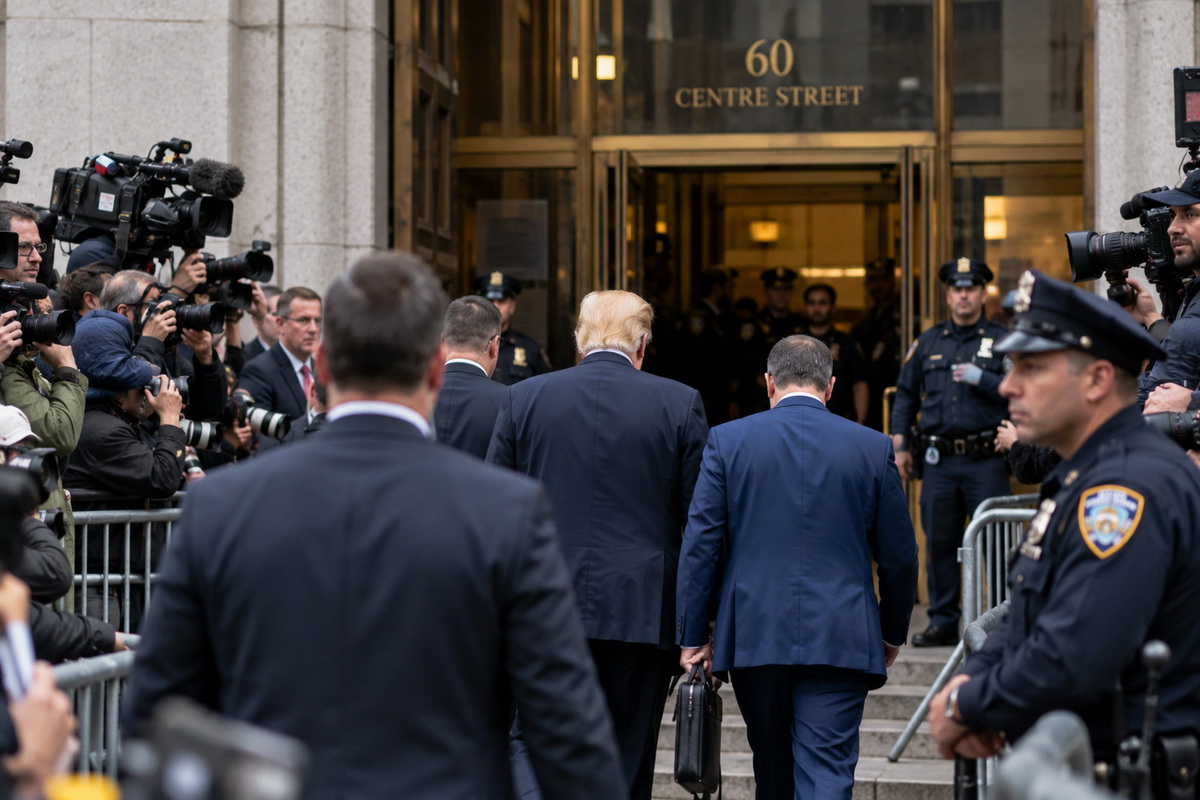
Donald Trump returned to a Manhattan courtroom Tuesday for the second day of a civil fraud trial that threatens the business empire upon which he built his name, fortune and political identity.
Trump was not required to be there.
He came anyway.
The former president again took his place at the defense table as New York Attorney General Letitia James continued her case accusing Trump, his company and other defendants of manipulating the stated value of properties and other assets to obtain favorable financial terms.
Trump denies wrongdoing and has repeatedly denounced the case as politically motivated.
But he enters this trial having already suffered a major legal defeat.
Last week, New York Supreme Court Justice Arthur Engoron ruled that Trump and other defendants committed persistent fraud by submitting financial statements containing false and misleading valuations.
The trial now underway will address remaining claims in James's lawsuit and determine what additional penalties could be imposed.
A $250 Million Case
James is seeking approximately $250 million and restrictions on Trump's ability to conduct business in New York.
Her office alleges that Trump and executives at the Trump Organization repeatedly inflated the value of properties and other assets on annual statements of financial condition.
Those statements were provided to banks and insurers.
According to the attorney general, the inflated figures helped Trump obtain better terms on loans and insurance.
Trump's attorneys reject that characterization.
They argue that the financial statements contained disclaimers, that sophisticated banks performed their own evaluations and that the institutions doing business with Trump were ultimately paid.
Trump himself has maintained that many of his properties were actually worth considerably more than the values listed on his financial statements.
Trump's Accountant Takes the Stand
Much of Tuesday's courtroom testimony centered on Donald Bender, a longtime accountant for Trump and the Trump Organization.
Bender worked for the accounting firm Mazars USA and helped prepare Trump's annual statements of financial condition.
Those statements sit at the center of James's case.
The attorney general's office argues that Trump's organization supplied inflated and inaccurate information that was then incorporated into the statements.
Bender's testimony provides prosecutors with an opportunity to examine how those documents were assembled and where the underlying numbers originated.
Trump sat at the defense table as his former accountant testified.
At times, the former president leaned toward his attorneys and examined evidence being displayed in the courtroom.
Trump Says the Case Is Political
Outside the courtroom, Trump continued attacking the case.
He has repeatedly called James, a Democrat, politically motivated and has accused Engoron of treating him unfairly.
Trump has characterized the trial as an effort to interfere with his campaign to return to the White House in 2024.
James rejects that accusation.
Her office says the case is about financial fraud and the application of New York law.
“This case is about one thing and one thing only,” James said when the trial opened Monday.
“Knowing and persistent fraud.”
The Fraud Ruling Has Already Been Made
The unusual thing about this trial is that one of its biggest questions was answered before anyone entered the courtroom Monday morning.
Engoron has already ruled that Trump and other defendants committed fraud.
In his September 26 decision, the judge concluded that Trump's financial statements repeatedly contained false valuations.
The ruling addressed properties including Trump's triplex apartment in Trump Tower, his Mar-a-Lago estate in Florida and other holdings.
Engoron also ordered the cancellation of certain New York business certificates connected to Trump-controlled entities, although precisely how that order will be implemented remains unresolved.
Trump's attorneys are fighting that decision.
The trial now concerns additional allegations brought by James and the penalties Trump and the other defendants could ultimately face.
His Business Empire Is on the Line
The consequences of the case could reach directly into the business that made Donald Trump famous.
Long before entering politics, Trump built his public identity around New York real estate.
Trump Tower.
Office buildings.
Hotels.
Golf properties.
Licensing deals.
And above all, the image of Donald Trump as an extraordinarily wealthy businessman.
James's lawsuit attacks the financial statements underlying that image, alleging that Trump's reported wealth was repeatedly manipulated depending upon what benefited him financially.
Trump insists his assets were valuable and that no banks were harmed.
Those competing versions of Trump's business practices are now colliding in a New York courtroom.
Trump Turns the Courthouse Into a Political Stage
Trump's decision to attend the trial has also transformed an otherwise technical civil proceeding into a political spectacle.
Television cameras line the courthouse.
Reporters wait in the hallways.
Trump stops to speak before entering the courtroom and again during breaks.
The Republican presidential front-runner has used those appearances to attack James, Engoron and the case itself.
Inside the courtroom, however, the proceeding is considerably less theatrical.
Accountants testify.
Lawyers introduce financial documents.
Attorneys argue over accounting practices, property valuations and statutes of limitations.
And Trump sits at the defense table listening as the financial practices of the company bearing his name are dissected in open court.
Day Two
Trump could have stayed away Tuesday.
Instead, he returned.
That decision ensures that every development in the case unfolds with the former president sitting only feet away.
For Trump, the trial is simultaneously a legal battle, a fight over his business legacy and another stage for his presidential campaign.
For James, it is a fraud case built around years of financial statements and property valuations.
And for Engoron, at least one major question has already been answered.
The judge has ruled that fraud occurred.
Now the courtroom battle is increasingly about how extensive the misconduct was — and what it could ultimately cost Donald Trump and his business.