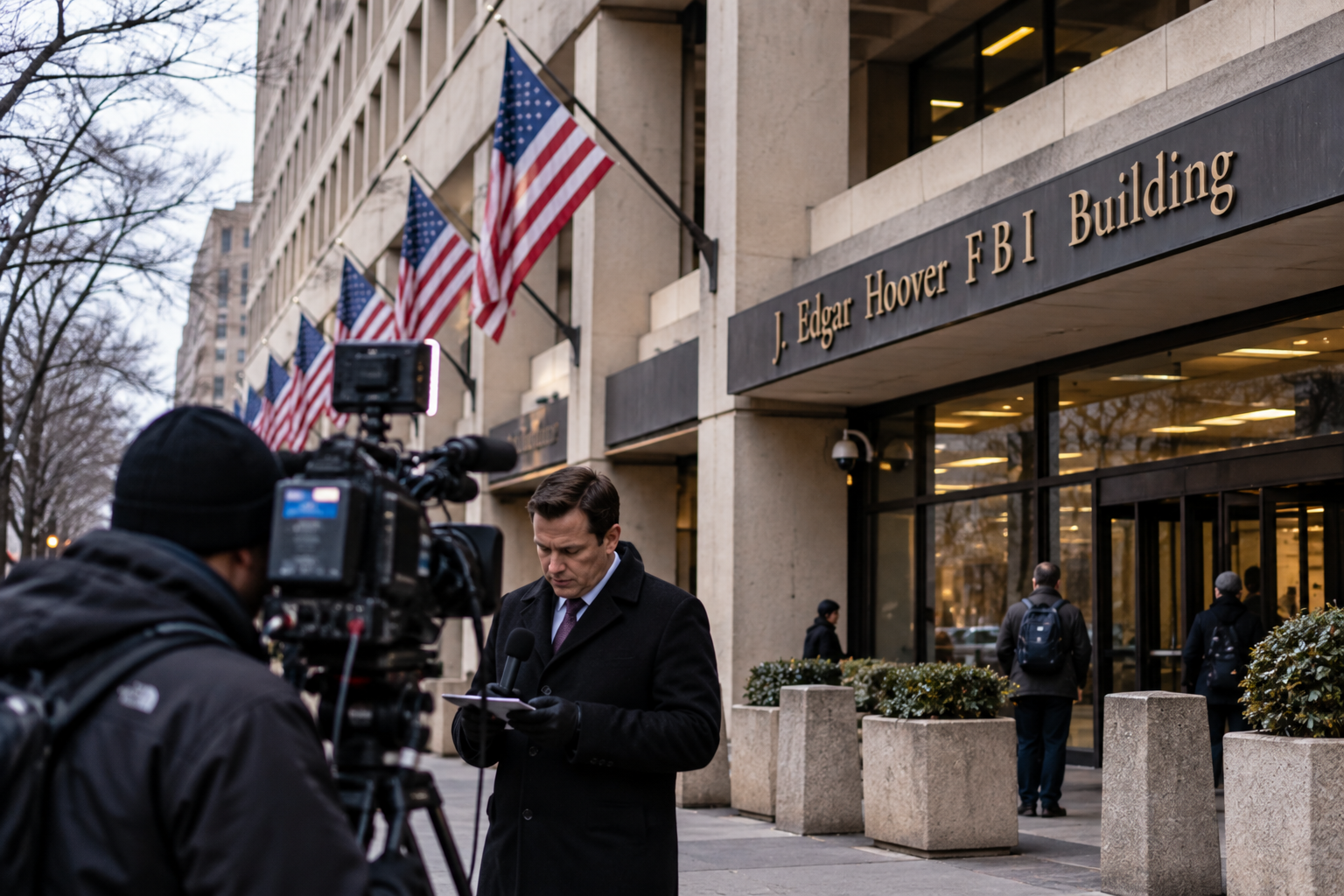
President Donald Trump authorized the release of a controversial Republican congressional memo on February 2, escalating his administration's confrontation with the FBI and Justice Department as the investigation into Russian interference in the 2016 election continued to close in around his presidency.
The four-page document, produced by Republican staff on the House Intelligence Committee under Chairman Devin Nunes, accused the FBI and Justice Department of serious problems in obtaining surveillance authority against former Trump campaign foreign policy adviser Carter Page.
Republicans presented the memo as evidence that federal law enforcement had abused its extraordinary surveillance powers.
The FBI took the unusual step of publicly objecting before the document was released.
The bureau warned that it had “grave concerns about material omissions of fact that fundamentally impact the memo's accuracy.”
Trump released it anyway.
And almost immediately, he portrayed the document as vindication of his attacks on the Russia investigation.
The Carter Page Surveillance
At the center of the dispute was Carter Page, who had served for several months as a foreign policy adviser to Trump's presidential campaign.
On October 21, 2016, the FBI and Justice Department obtained authorization from the Foreign Intelligence Surveillance Court to conduct electronic surveillance of Page.
The surveillance order was subsequently renewed three times.
Each renewal required the government to return to the secret court and demonstrate that continued surveillance was justified.
The Nunes memo argued that the government had failed to provide the court with important information about material supplied by former British intelligence officer Christopher Steele.
Steele had compiled a series of reports about Trump and Russia that became known collectively as the Steele dossier.
The research had ultimately been financed by Hillary Clinton's presidential campaign and the Democratic National Committee through the opposition-research firm Fusion GPS.
Republicans argued that the political origins of Steele's work were not adequately disclosed to the FISA court.
That became the central accusation behind the Nunes memo.
Republicans Say the FBI Abused the Process
The memo accused the FBI and Justice Department of omitting information that Republicans believed would have affected the court's evaluation of Steele's credibility and motivations.
It also questioned the government's continued reliance on Steele after the FBI ended its relationship with him as a confidential source.
For Trump and his allies, the memo appeared to support a narrative they had been developing for months:
The Russia investigation wasn't simply an investigation of Trump's campaign.
They argued it had been tainted by political bias from inside the government.
Trump seized upon that interpretation.
After the memo became public, he told reporters:
“A lot of people should be ashamed of themselves.”
He soon went further on Twitter, claiming the memo “totally vindicates ‘Trump’” in the Russia investigation.
But the memo did not establish that.
In fact, one portion of the document complicated Trump's argument considerably.
The Memo Undercuts One of Trump's Central Claims
Trump's defenders had repeatedly suggested that the Russia investigation itself originated with the Steele dossier.
But the Republican memo acknowledged that wasn't what happened.
According to the document, information concerning another Trump campaign foreign policy adviser — George Papadopoulos — triggered the FBI's counterintelligence investigation in late July 2016.
Papadopoulos had previously been told that Russia possessed damaging information about Hillary Clinton.
Australian officials later informed the United States about a conversation involving Papadopoulos.
The FBI opened its investigation, known as Crossfire Hurricane, months before obtaining the surveillance order against Carter Page.
That distinction was critical.
Whatever problems might have existed with the Page surveillance application, the Nunes memo itself did not establish that the Steele dossier caused the broader Russia investigation to begin.
The FBI Publicly Objects
The FBI's response to the proposed release was extraordinary.
Federal law enforcement agencies normally avoid publicly confronting the White House over classified intelligence matters.
This time, the bureau did.
On January 31, two days before the memo's release, the FBI issued a public statement.
The bureau said it had been given only a limited opportunity to review the document before the House Intelligence Committee voted to release it.
Then came its warning:
The FBI had “grave concerns about material omissions of fact that fundamentally impact the memo's accuracy.”
The Justice Department had also warned against releasing classified material without a full review.
Trump nevertheless approved its declassification.
The White House said the decision followed review involving the Office of the Director of National Intelligence and the Justice Department.
White House counsel Donald McGahn formally informed Congress that Trump had determined releasing the memo was appropriate because of the significant public interest surrounding it.
Democrats Call It an Attempt to Undermine Mueller
Democrats saw something very different happening.
They argued that Republicans had selectively assembled classified information to create a misleading impression of the FBI's actions.
House Intelligence Committee ranking Democrat Adam Schiff prepared a separate memorandum responding to the Republican allegations.
Democrats argued that the FBI had multiple sources supporting its request to surveil Page and that the FISA application provided the court with information indicating that Steele's research had been commissioned for political purposes.
But the Democratic response wasn't released alongside the Nunes memo.
That allowed the Republican accusations to dominate the initial news cycle without the underlying Democratic rebuttal being available to the public.
The competing Democratic memo would eventually be released later in February.
Trump Versus His Own FBI
The controversy also illustrated an increasingly unusual feature of Trump's presidency.
The president was publicly attacking institutions within his own executive branch.
Trump had already fired FBI Director James Comey in May 2017.
Special Counsel Robert Mueller was investigating Russian interference and possible connections between Trump's campaign and Russia.
Deputy Attorney General Rod Rosenstein was overseeing Mueller's investigation because Attorney General Jeff Sessions had recused himself from matters involving the 2016 campaign.
Trump repeatedly described the Russia investigation as a “witch hunt.”
Now a Republican-controlled congressional committee had produced a document attacking the conduct of the FBI and Justice Department involved in one part of that broader investigation.
And Trump had used his presidential declassification authority to make it public over the FBI's objections.
What the Memo Did — And Didn't — Establish
The Nunes memo raised legitimate questions about how the government presented politically funded opposition research when seeking surveillance authority from the secret FISA court.
Those questions deserved examination.
The government's ability to secretly surveil Americans under national-security authorities carries enormous power and requires rigorous oversight.
But the memo did not establish several of the broader claims Trump and his allies attached to it.
It did not show that the Russia investigation began because of the Steele dossier.
It did not prove that the entire investigation was politically motivated.
It did not establish that Mueller's investigation was illegitimate.
And it did not “totally vindicate” Trump.
The document itself acknowledged that the FBI's investigation began with information involving George Papadopoulos.
Later Investigations Would Find Real FISA Problems
The story would become more complicated in the years that followed.
A later Justice Department inspector general investigation identified serious errors and omissions in the FBI's applications to surveil Carter Page.
The inspector general found numerous significant inaccuracies and failures in the FISA process.
Those findings gave substantial weight to concerns about how the Page surveillance applications had been handled.
But the inspector general did not conclude that political bias caused the FBI to open the Russia investigation.
The later findings therefore produced a more complicated picture than either side's political narrative in February 2018.
The Carter Page surveillance process contained serious problems deserving scrutiny.
But that did not establish that the entire Russia investigation had been fabricated to attack Trump.
Both things could be true at the same time.
A Turning Point in the Russia Fight
The importance of February 2, 2018, extended beyond the four pages of the Nunes memo.
It demonstrated how the Russia investigation was changing Washington.
A Republican-controlled congressional committee was challenging the FBI.
The FBI was publicly challenging the accuracy of a congressional document.
The president was siding with congressional Republicans against senior officials within his own Justice Department.
Democrats accused Republicans of attempting to undermine an ongoing federal investigation.
And classified intelligence had become ammunition in an increasingly bitter political battle.
Trump presented the memo as evidence that the investigation surrounding his campaign was corrupt.
The FBI warned that Americans weren't being given the complete picture.
The document itself ultimately provided evidence for neither side's most sweeping claims.
But its release marked another escalation in a conflict that would consume Washington for much of Trump's presidency.
The Russia investigation was no longer simply examining what happened during the 2016 election.
It had become a battle over the institutions conducting the investigation itself.