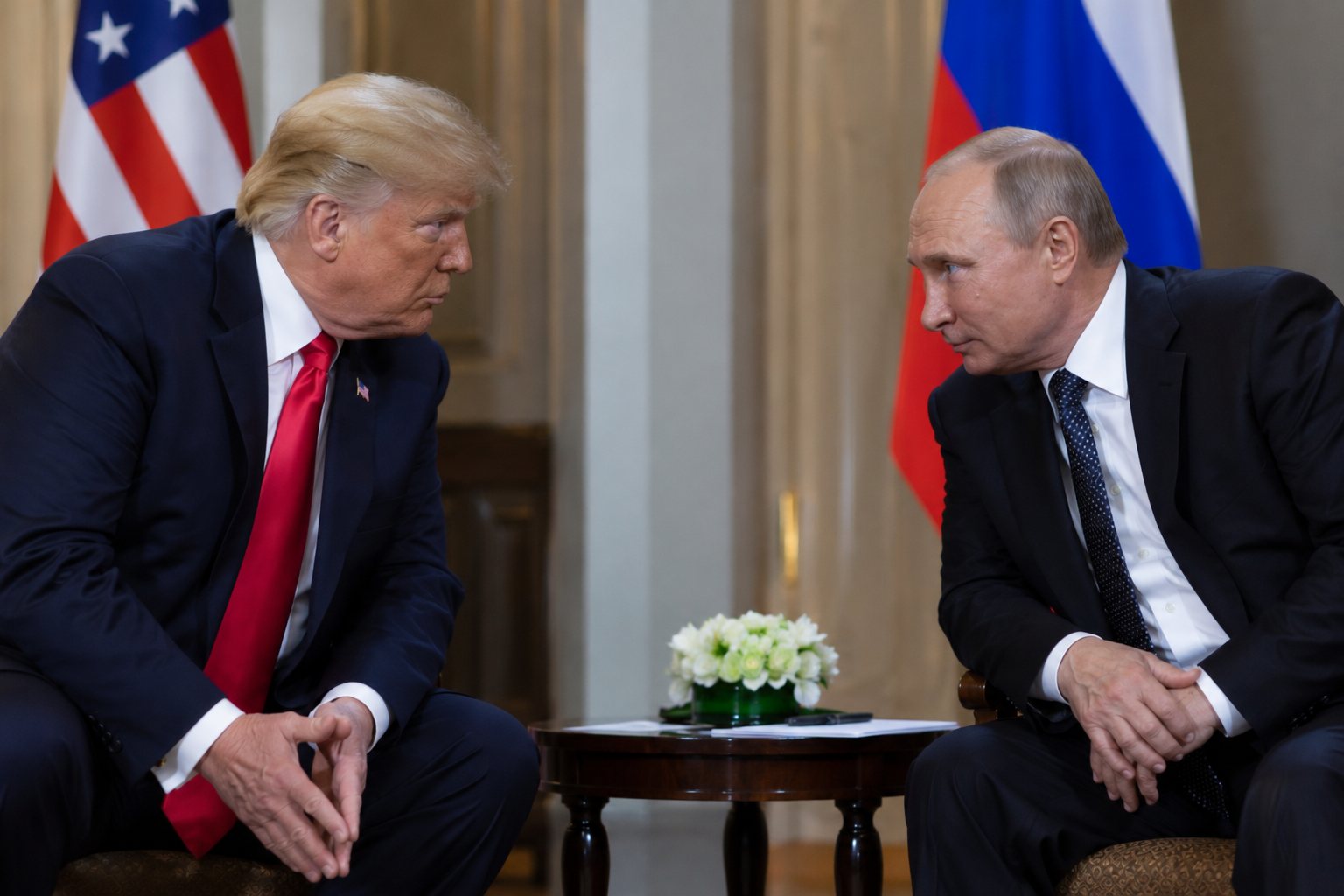
Former President Donald Trump refused to confirm or deny whether he had privately communicated with Russian President Vladimir Putin after leaving office, raising fresh questions about his relationship with the Russian leader during a contentious interview in Chicago on October 15, 2024.
Speaking with Bloomberg News Editor-in-Chief John Micklethwait at the Economic Club of Chicago, Trump was confronted with allegations from veteran investigative journalist Bob Woodward that he had maintained private contact with Putin after his presidency ended in January 2021.
Woodward's newly released book, War, reported that Trump and Putin may have spoken as many as seven times after Trump left the White House, including a private telephone conversation in early 2024.
The allegations were particularly significant because Russia was continuing its full-scale invasion of Ukraine, while Trump was campaigning to return to the presidency.
Asked directly whether the conversations had occurred, Trump declined to provide a straightforward answer.
Instead, he suggested that speaking privately with Putin would have been a wise decision.
Trump: Talking to Putin Would Be a Smart Thing
During the October 15 interview, Micklethwait asked Trump whether he had spoken with Putin since leaving the presidency.
Trump replied:
"Well, I don't comment on that, but I will tell you that if I did, it's a smart thing."
He went on to argue that maintaining personal relationships with foreign leaders was beneficial for the United States.
Trump emphasized that Russia possessed a large nuclear arsenal and suggested that communication between American and Russian leaders could help prevent dangerous confrontations.
His argument reflected a position he had expressed throughout his political career: that personal relationships with powerful foreign leaders could improve diplomatic outcomes.
But the question was not whether communication between Washington and Moscow was inherently inappropriate.
The issue was whether a former American president, no longer holding public office, had maintained undisclosed contacts with the leader of a country conducting a major war against a U.S.-supported nation.
Trump did not answer that question.
Bob Woodward Reports Up to Seven Private Conversations
The controversy began gaining national attention on October 8, when news organizations published excerpts from Woodward's book War.
Woodward reported that Trump had maintained contact with Putin after leaving office, citing information from an unnamed Trump aide.
According to the book, Trump asked an aide to leave his office at Mar-a-Lago in early 2024 so he could conduct a private telephone conversation with the Russian president.
The aide reportedly believed Trump and Putin had spoken multiple times since January 2021, possibly as many as seven.
Woodward did not establish the precise number of conversations or provide a comprehensive account of what the two men allegedly discussed.
Those limitations were important.
The allegations came from Woodward's reporting, not from publicly released telephone records or an acknowledgment by either leader.
Trump's campaign rejected the claims, and the Kremlin also denied that the reported post-presidency conversations had occurred.
Nevertheless, Woodward's account raised questions because Trump had continued to speak favorably about his relationship with Putin while criticizing aspects of American support for Ukraine.
Trump Had Denied the Calls Days Earlier
Trump's October 15 response was especially notable because he had previously issued a more definitive denial.
In an interview with ABC News Chief Washington Correspondent Jonathan Karl the previous week, Trump was asked whether he had spoken to Putin since leaving the White House.
Trump answered that he had not and described the allegation as false.
But when Micklethwait asked essentially the same question in Chicago, Trump changed his approach.
Rather than repeat the denial, he refused to comment and defended the potential value of such conversations.
That difference did not prove Woodward's allegations were accurate.
However, it left the public with two different responses from the former president to the same factual question.
One was an explicit denial.
The other was a refusal to confirm or deny, accompanied by an explanation of why the alleged conduct could be beneficial.
Woodward Also Reports Secret COVID-19 Assistance to Putin
The allegations about telephone calls were not the only revelations involving Trump and Putin in Woodward's book.
Woodward also reported that Trump had secretly provided Putin with COVID-19 testing equipment during the early stages of the coronavirus pandemic in 2020.
According to the account, the equipment included Abbott point-of-care testing machines.
The alleged transfer occurred while American hospitals, healthcare workers, and communities were struggling with shortages of medical supplies and testing resources.
Woodward reported that Putin wanted the assistance kept confidential because public disclosure could create political problems for Trump.
The Trump campaign disputed Woodward's reporting.
The Kremlin, however, acknowledged that COVID-19 testing equipment had been exchanged between the United States and Russia during the pandemic, while denying the reported post-presidency telephone calls.
The distinction mattered: the Kremlin's acknowledgment of a pandemic-era exchange did not independently verify Woodward's description of a secret personal arrangement.
The account nevertheless added another dimension to questions about the relationship between the two leaders.
Russia's War in Ukraine Made the Allegations More Significant
By October 2024, Russia's full-scale invasion of Ukraine had continued for more than two and a half years.
Russian forces had attacked Ukrainian cities, occupied territory, and caused extensive destruction and civilian suffering.
The United States, under President Joe Biden, had supplied Ukraine with military equipment, financial assistance, intelligence support, and diplomatic backing.
Trump, meanwhile, repeatedly criticized the scale of American assistance to Ukraine and claimed he could quickly negotiate an end to the war if returned to office.
He did not publicly explain what concessions either side would need to make to reach such an agreement.
During the September 2024 presidential debate, Trump declined to answer directly when asked whether he wanted Ukraine to win the war.
Instead, he said he wanted the fighting to stop.
His position raised questions about how a second Trump administration might approach Russia, Ukraine, NATO, and European security.
Against that backdrop, Woodward's allegations about private conversations with Putin attracted particular scrutiny.
If such conversations occurred, their timing and content would be relevant to understanding Trump's approach to the conflict.
But without confirmation or reliable information about what was discussed, no conclusion could be drawn that Trump had negotiated with Putin over Ukraine or made commitments on American policy.
The Long History of Trump and Putin
Trump's relationship with Putin had been controversial since his first presidential campaign in 2016.
American intelligence agencies concluded that Russia interfered in the 2016 election through hacking operations and influence campaigns intended to undermine public confidence in the electoral process and damage Hillary Clinton's candidacy.
The intelligence community also assessed that Russia's leadership developed a preference for Trump.
During a 2018 summit in Helsinki, Finland, Trump publicly questioned the American intelligence community's conclusions while standing beside Putin.
His remarks generated bipartisan criticism in Washington.
Trump subsequently said he had misspoken and affirmed his confidence in American intelligence agencies.
Throughout his presidency, Trump argued that maintaining a positive relationship with Russia was preferable to confrontation.
His administration also imposed sanctions on Russia and provided lethal military assistance to Ukraine, illustrating that its official policies were not uniformly favorable to Moscow.
Supporters of Trump's diplomatic approach pointed to those actions as evidence that his administration could maintain communication with Putin while pursuing policies that opposed Russian interests.
Critics argued that Trump's personal praise of Putin and repeated public questioning of U.S. intelligence findings created uncertainty about his priorities.
The October 2024 allegations revived that longstanding debate.
Is It Illegal for a Former President to Speak With a Foreign Leader?
A former president is not automatically prohibited from speaking with foreign officials.
Private citizens, former government officials, business executives, and political figures regularly maintain international relationships.
Such conversations can be entirely lawful.
However, federal law places restrictions on certain efforts by private citizens to conduct unauthorized diplomacy on behalf of the United States.
The Logan Act, enacted in 1799, addresses unauthorized correspondence or interactions intended to influence foreign governments concerning disputes with the United States.
The law has rarely been enforced, and its constitutional application has long been debated.
There was no publicly established evidence in October 2024 that Trump had violated the Logan Act.
Even if Woodward's reported conversations occurred, their existence alone would not establish a violation.
Determining whether any legal issue existed would require reliable information about what was said, the purpose of the communications, and whether Trump attempted to influence an active dispute with the United States.
The more immediate issue was transparency.
Trump was seeking another term as president while declining to clarify whether he had privately communicated with the leader of a major American geopolitical adversary.
Trump Praises His Relationships With Authoritarian Leaders
During the Chicago interview, Trump also emphasized his relationships with several powerful foreign leaders.
He cited Putin, Chinese President Xi Jinping, and North Korean leader Kim Jong Un as examples of leaders with whom he had developed personal relationships.
Trump argued that such relationships could help the United States avoid conflict and improve its negotiating position.
His supporters viewed that approach as practical diplomacy, particularly when dealing with nuclear-armed nations.
Critics questioned whether personal relationships with authoritarian leaders could substitute for established diplomatic institutions, alliances, and clear foreign policy commitments.
The distinction was particularly important because Trump was not serving as president in October 2024.
He was a private citizen and presidential candidate, while the Biden administration remained responsible for conducting American foreign policy.
A Question That Remained Unanswered
The October 15 interview did not establish whether Trump had actually spoken with Putin after leaving office.
Woodward reported that private conversations had occurred.
Trump's campaign denied the allegations.
The Kremlin denied the reported post-presidency calls.
And Trump himself, when questioned directly in Chicago, refused to confirm or deny them.
His response was significant not because it proved the allegations, but because it left unresolved a factual question about his contacts with the Russian president.
With the presidential election only three weeks away, voters were being asked to evaluate Trump's proposed approach to Russia and the war in Ukraine without knowing whether the former president had maintained private communications with Putin.
The issue was not whether American leaders should communicate with adversaries. Such diplomacy is often necessary.
It was whether those communications had occurred outside official channels, what their purpose might have been, and why Trump would not provide a clear answer.
On October 15, 2024, Donald Trump was asked a simple question: Had he spoken privately with Vladimir Putin since leaving the White House?
He declined to answer, saying instead that doing so would have been smart.
The existence, frequency, and content of the alleged conversations remained unverified publicly that day.