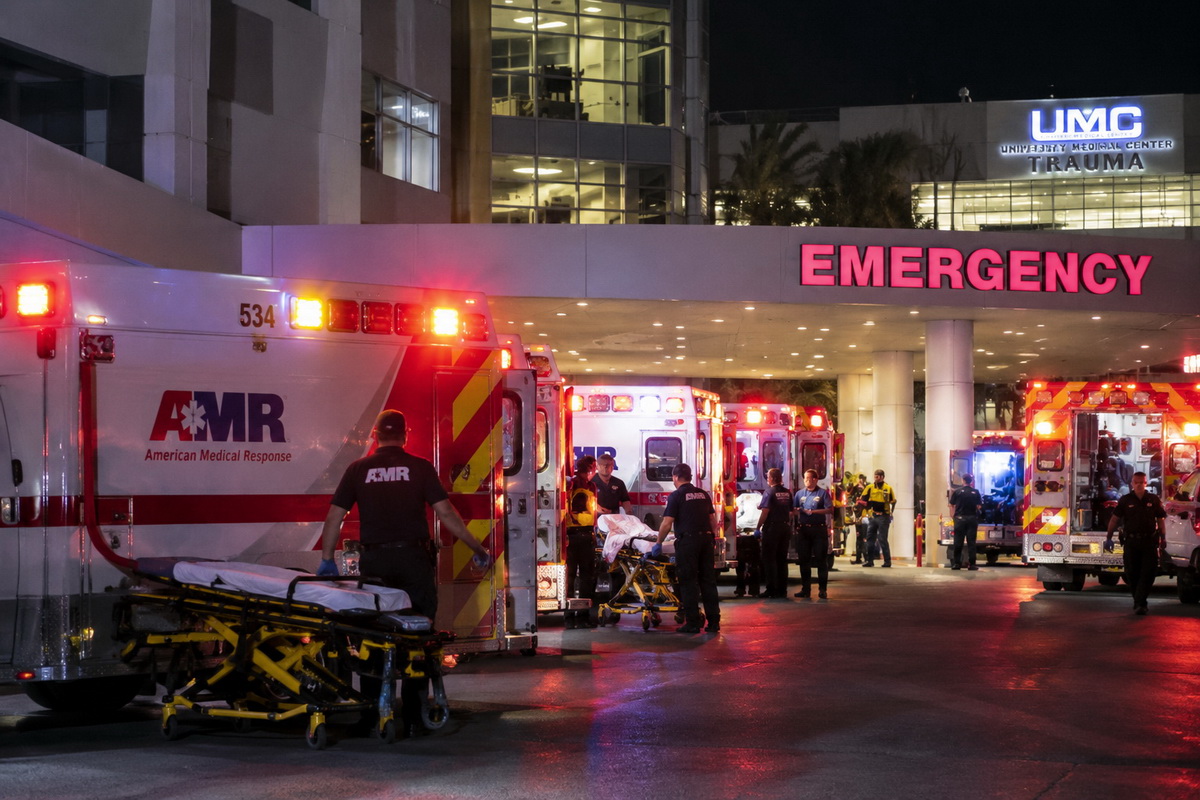
Three days after a gunman opened fire on a Las Vegas music festival, President Donald Trump stood inside University Medical Center after meeting survivors of the massacre.
He praised the doctors and nurses who had treated the wounded. He praised the bravery of the victims. He told survivors that the country stood behind them.
Then a reporter asked Trump a direct question:
Does America have a gun violence problem?
Trump's response was equally direct.
> "Well, we're not going to talk about that today. We won't talk about that."
With that, the president moved on.
A Question Hanging Over the Country
It was difficult to separate Trump's answer from what had happened only three nights earlier.
From his room on the 32nd floor of the Mandalay Bay hotel, the Las Vegas gunman had fired into the crowd attending the Route 91 Harvest music festival.
Hundreds of people were shot.
The attack immediately renewed America's long-running argument over firearms, mass shootings and whether changes to federal gun laws could prevent—or at least reduce the severity of—future attacks.
But during Trump's October 4 visit, the president made clear that he did not believe that was the moment to have that discussion.
ABC News reported that Trump declined to discuss gun-control measures during the visit even as lawmakers in Washington were beginning to consider restrictions on the type of bump-stock devices used by the Las Vegas gunman.
"We're Not Going to Talk About That Today"
Trump's supporters and the White House argued that the immediate aftermath of a massacre should be devoted to the victims rather than political arguments.
There was a legitimate debate behind that position.
Should lawmakers wait until investigators understand exactly what happened before proposing legislation?
Or is the immediate aftermath of a mass shooting precisely when elected officials should confront the policies that might prevent the next one?
Trump chose the former approach on October 4.
The difficulty was that the question wasn't particularly complicated.
The reporter didn't ask Trump to endorse a specific gun-control bill.
He was asked whether the United States had a gun violence problem.
Trump declined to answer.
Washington Was Already Talking About Guns
Even as Trump avoided the subject in Las Vegas, the political debate was already underway.
Particular attention was being paid to bump stocks, devices that could dramatically increase the rate at which a semiautomatic rifle could be fired.
The Las Vegas gunman had used rifles equipped with the devices.
Members of Congress began discussing restrictions, and even the National Rifle Association would announce the following day that it supported an ATF review and additional regulation of devices that allowed semiautomatic rifles to function more like fully automatic weapons.
Trump himself would soon become part of that discussion.
The day after his Las Vegas visit, he said his administration would examine bump stocks.
His administration ultimately went considerably further.
In 2018, the Justice Department issued a rule classifying bump-stock-equipped firearms as machine guns under federal law and prohibiting the devices.
The Larger Question Remained
The bump-stock action is an important part of Trump's record. It means his October 4 response should not be interpreted as evidence that his administration never took any action concerning firearms after Las Vegas.
But the moment remains striking.
Trump had just walked through a hospital treating victims of a mass shooting. He had personally seen people who had suffered catastrophic wounds. He had praised the doctors, nurses, police officers and ordinary citizens who responded after the shooting began.
Then he was asked whether America itself had a gun-violence problem.
He could have acknowledged the problem without proposing legislation.
He could have promised a national discussion.
He could have said his administration would examine what could be done to prevent another massacre.
Instead, on October 4, 2017, President Donald Trump gave America a different answer:
"We're not going to talk about that today."