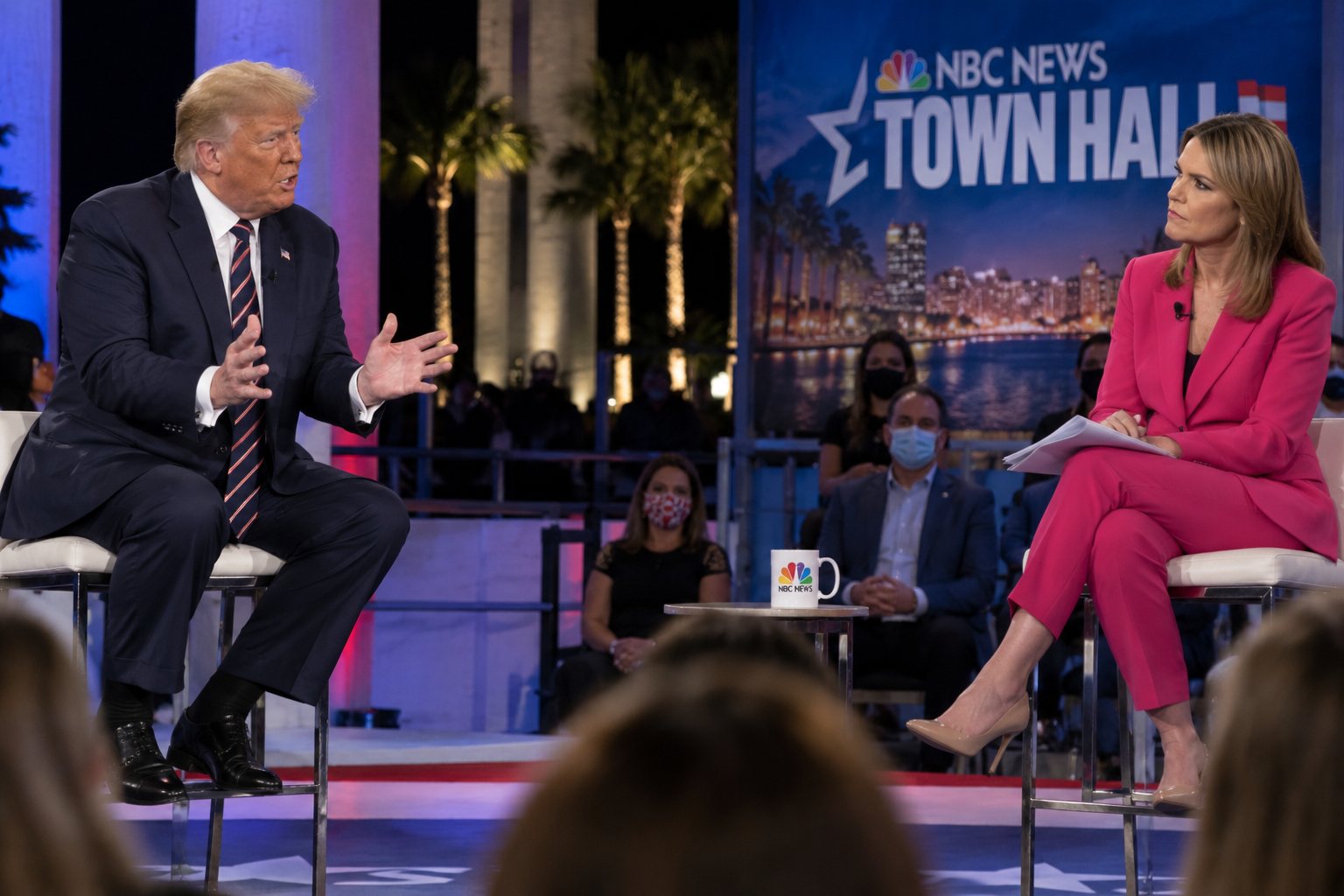
With less than three weeks remaining before the presidential election, President Donald Trump appeared at an NBC News town hall in Miami, Florida, where moderator Savannah Guthrie confronted him about the QAnon conspiracy movement, misinformation surrounding the coronavirus pandemic, and his repeated allegations of election fraud.
One of the evening's most significant exchanges came when Guthrie asked Trump to unequivocally reject QAnon, a far-right conspiracy movement whose followers believed that a secret network of powerful politicians and celebrities was operating a child sex-trafficking ring and that Trump was secretly working to defeat it.
Trump refused to condemn the movement.
Instead, he repeatedly claimed to know little about QAnon while offering a favorable description of its supposed opposition to child abuse.
The exchange highlighted a growing controversy surrounding Trump's relationship with conspiracy movements that viewed him as a central figure in an imagined struggle against hidden enemies.
What Was QAnon?
QAnon emerged in October 2017 when an anonymous internet user identifying as "Q" began posting cryptic messages on the website 4chan.
The anonymous figure claimed to possess high-level government intelligence and suggested that Trump was secretly fighting a powerful criminal conspiracy involving Democratic politicians, Hollywood celebrities, and government officials.
Followers interpreted the messages as clues about a supposed operation to expose and arrest members of this imaginary network.
The movement promoted numerous false allegations, including claims that prominent political figures were involved in satanic rituals and organized child trafficking.
There was no credible evidence supporting these extraordinary accusations.
Despite repeated failed predictions, QAnon developed a substantial online following. Its theories spread through Facebook, YouTube, Twitter, and other social media platforms.
By 2020, some congressional candidates and political activists had publicly expressed sympathy for the movement.
The FBI had also identified conspiracy-driven extremism as a potential domestic terrorism concern in a 2019 intelligence bulletin.
That warning did not mean every QAnon follower was violent. It reflected concern that some individuals could be motivated to commit crimes by conspiratorial beliefs.
Guthrie Asks Trump to Reject the Conspiracy
During the October 15 town hall, Guthrie directly described QAnon's central claims and asked Trump to reject the movement.
Trump responded that he knew nothing about it.
When Guthrie explained the conspiracy, Trump disputed whether her description was accurate.
He then claimed that QAnon followers strongly opposed pedophilia.
The statement was significant because it repeated one of the movement's principal claims about itself while avoiding any acknowledgment that its accusations against political opponents were baseless.
Guthrie continued pressing him, asking why he would not simply reject the conspiracy.
Trump maintained that he did not know enough about QAnon to make that judgment.
The moderator also cited Republican Senator Ben Sasse of Nebraska, who had publicly criticized the movement and argued that political leaders should identify conspiracy theories as such.
Trump acknowledged that Sasse might be correct but continued declining to condemn QAnon.
His refusal came despite extensive national reporting about the movement and its increasing presence within his political coalition.
Trump Had Previously Praised QAnon Supporters
The NBC exchange was not Trump's first public encounter with questions about QAnon.
In August 2020, a reporter asked him about the movement during a White House briefing.
Trump said he did not know much about QAnon but understood that its supporters liked him.
He described them as people who loved America and were concerned about problems in American cities.
When informed that followers believed he was secretly working to defeat a satanic network of child abusers, Trump did not reject the premise outright.
Instead, he responded positively to the idea of being viewed as someone fighting such wrongdoing.
Those earlier remarks made his October claim of near-total unfamiliarity particularly notable.
By the time of the NBC town hall, Trump had repeatedly been given opportunities to learn about the movement and publicly distance himself from its unsupported allegations.
Nevertheless, he continued to avoid an unequivocal denunciation.
A Confrontation Over Coronavirus Misinformation
QAnon was only one of several subjects on which Guthrie challenged the president.
Trump had recently recovered from COVID-19 after being hospitalized at Walter Reed National Military Medical Center.
His diagnosis followed a White House gathering associated with the nomination of Supreme Court Justice Amy Coney Barrett, an event attended by several people who subsequently tested positive for the coronavirus.
Guthrie questioned Trump about the event's limited use of masks and the administration's precautions.
Trump defended the White House's testing procedures and claimed that a study showed 85% of people who wore masks contracted the coronavirus.
Guthrie immediately challenged that interpretation.
The CDC study Trump referenced did not establish that masks were ineffective or that 85% of mask wearers became infected. It examined reported behaviors among people who had already tested positive and a comparison group.
Trump also struggled to provide a clear answer when Guthrie asked whether he had undergone coronavirus testing before his September 29 debate with Joe Biden.
He initially suggested that he probably had been tested but later acknowledged that he could not say with certainty.
The exchange illustrated continuing questions about the White House's handling of the pandemic and the accuracy of the president's public statements.
Trump Defends Sharing an Unfounded Bin Laden Conspiracy
Another confrontation concerned Trump's promotion of an unsupported conspiracy theory involving the 2011 killing of Osama bin Laden.
Trump had amplified a social media post suggesting that the Obama administration had arranged the killing of a body double rather than the actual al-Qaeda leader.
There was no credible evidence supporting that claim.
When Guthrie challenged him about spreading the allegation, Trump argued that he had merely retweeted someone else's statement and that people could decide for themselves whether to believe it.
Guthrie rejected the distinction between publishing a false allegation and amplifying one.
She emphasized that the president's public communications carried responsibilities beyond those of an ordinary social media user.
The exchange became one of the most widely discussed moments of the evening.
It also underscored a broader issue: the ability of prominent political figures to give unsupported claims enormous visibility simply by sharing them with their followers.
Election Fraud Claims Also Face Scrutiny
Guthrie challenged Trump over his repeated warnings that mail-in voting could produce widespread election fraud.
Throughout the 2020 campaign, Trump had claimed that expanded voting by mail created substantial opportunities for corruption.
Those allegations were not supported by evidence of widespread fraud.
Election officials and researchers acknowledged that isolated cases of voting irregularities could occur, as with other voting methods, but maintained that safeguards existed to detect and prevent misconduct.
Guthrie questioned why Trump continued casting doubt on the election process without evidence demonstrating fraud on the scale he suggested.
Trump defended his position and continued raising concerns about mailed ballots.
The discussion occurred less than three weeks before Americans would vote in an election taking place amid a deadly pandemic.
Millions of voters were expected to cast ballots by mail to reduce potential exposure to the coronavirus.
Why the Town Hall Happened
The NBC event was originally supposed to be the date of the second presidential debate between Trump and Democratic nominee Joe Biden.
After Trump tested positive for COVID-19, the Commission on Presidential Debates proposed holding the debate virtually for health and safety reasons.
Trump refused to participate under those conditions.
The debate was subsequently canceled.
Biden scheduled a televised town hall with ABC News, while Trump agreed to a separate event with NBC.
The competing programs aired simultaneously on October 15.
NBC faced criticism for scheduling Trump's appearance opposite Biden's, with some observers arguing that the arrangement rewarded the president for refusing the virtual debate format.
But Guthrie's questioning turned the program into an extended examination of Trump's statements, political associations, and handling of the pandemic.
The Broader Significance of Trump's QAnon Response
Trump's refusal to disavow QAnon mattered because the movement had made him central to its identity.
Its followers were not merely expressing conventional support for a presidential candidate.
Many believed Trump was secretly directing a campaign against a fictional criminal network and that dramatic arrests and revelations were imminent.
Such beliefs were unsupported by evidence.
The movement also demonstrated how conspiracy theories could move from obscure internet communities into mainstream political discussions.
By October 2020, QAnon supporters were appearing at political rallies, promoting candidates, and distributing misinformation about public officials.
Trump's statements did not establish that he personally believed QAnon's theories.
However, his repeated refusal to reject them allowed followers to interpret his remarks as encouragement.
Critics argued that a clear condemnation from the president could have helped discourage the movement's spread. Supporters of Trump countered that he had repeatedly stated he knew little about the group and opposed child abuse.
The distinction between explicitly endorsing a conspiracy and declining to condemn it became central to the controversy.
A Defining Moment of the 2020 Campaign
The October 15 town hall captured several of the issues dominating the final weeks of the 2020 presidential election.
The United States was confronting a deadly pandemic.
The president was questioning the reliability of voting procedures.
Conspiracy theories were spreading rapidly across social media.
And a growing political movement was promoting extraordinary allegations about government officials without credible supporting evidence.
Savannah Guthrie's questioning forced Trump to address those subjects in front of a national television audience.
When asked to reject QAnon, Trump could have clearly stated that its allegations were false and unsupported.
Instead, he said he did not know enough about the movement to condemn it.
On October 15, 2020, the president was offered a direct opportunity to distance himself from a conspiracy movement that portrayed him as its hero. He declined to do so.