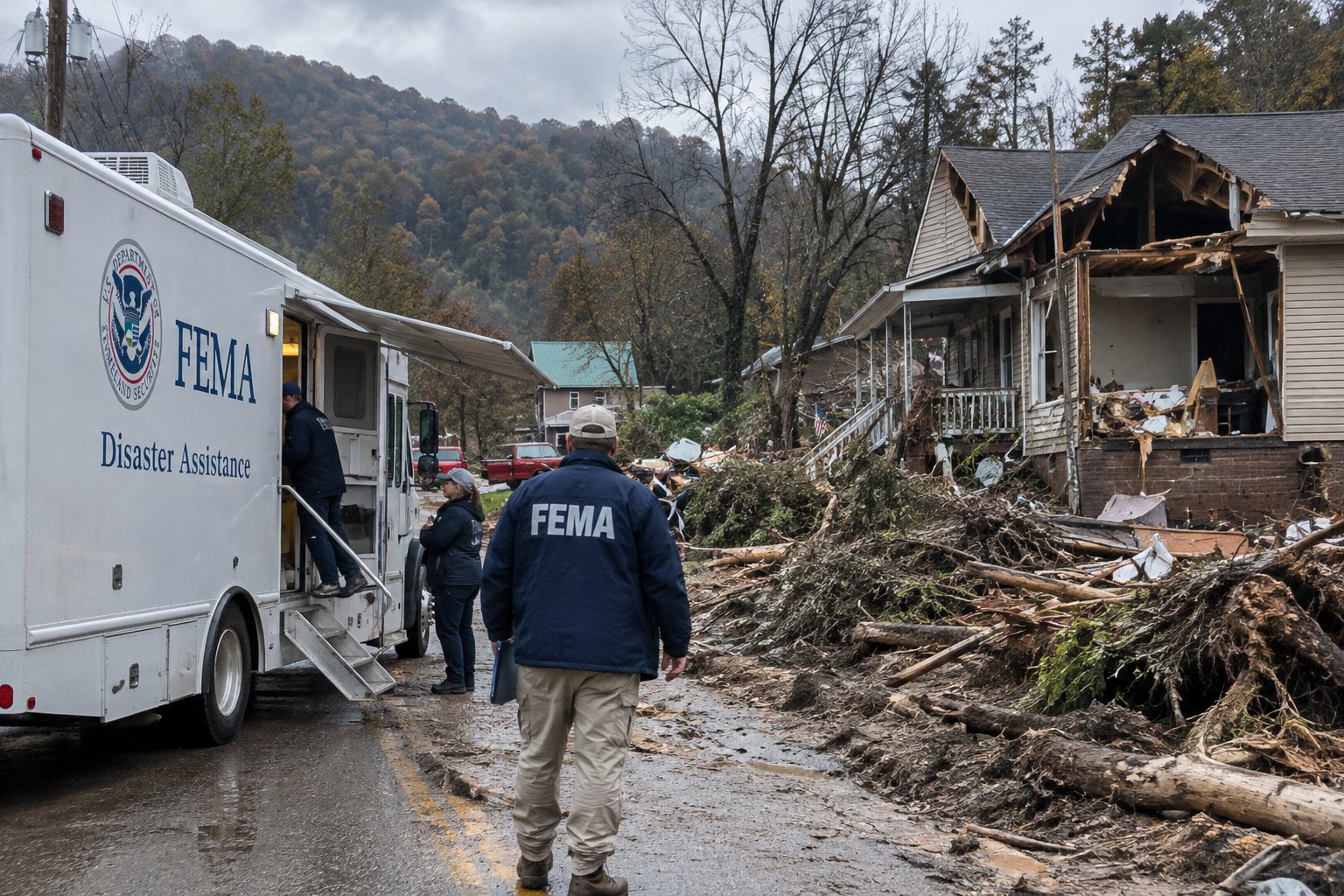
Former President Donald Trump refused to condemn threats against federal disaster relief workers Monday while visiting communities devastated by Hurricane Helene, instead repeating false allegations about the government's emergency response.
Standing amid the wreckage left behind by one of the deadliest hurricanes to strike the United States in recent years, the Republican presidential nominee continued accusing the Biden administration of diverting disaster relief money to undocumented immigrants.
The claims have repeatedly been debunked by federal officials and even Republican lawmakers in North Carolina.
More troubling, the misinformation has contributed to an increasingly hostile environment for emergency workers attempting to help families who have lost their homes, businesses, and possessions.
Asked About Threats, Trump Attacks FEMA Again
During his visit to Swannanoa, Trump was asked whether his continued criticism of the Federal Emergency Management Agency was helping recovery efforts, particularly after an armed man was arrested for threatening disaster workers.
Rather than condemn the threats, Trump defended his criticism.
"Does that mean that if they're doing a poor job, we're supposed to not say it?" Trump responded.
He then repeated his allegation that FEMA had spent money intended for hurricane victims on migrants.
The claim is false.
FEMA's disaster relief funding is separate from federal programs supporting migrant services. Money appropriated for hurricane recovery has not been redirected to housing undocumented immigrants.
Nevertheless, Trump insisted that the government had depleted its resources and could not adequately assist North Carolina residents.
Federal Workers Face Threats While Helping Storm Victims
The consequences of the misinformation have extended beyond political rhetoric.
Earlier this month, FEMA temporarily adjusted its operations in parts of western North Carolina after receiving reports of threats against its employees.
Authorities arrested William Jacob Parsons, a North Carolina man accused of making threats against federal disaster workers while armed.
The incident prompted FEMA to temporarily move some personnel away from door-to-door assistance and toward fixed locations where workers could operate more safely.
Although authorities subsequently determined that reports of a broader armed militia threat were unfounded, the incident demonstrated the dangers facing workers in an already difficult recovery operation.
Emergency responders are attempting to restore essential services, help displaced families, and distribute assistance throughout communities where roads, bridges, and homes have been destroyed.
Even Republicans Have Debunked Trump's Claims
Trump's allegations have been contradicted by members of his own party.
Republican Congressman Chuck Edwards, whose district includes some of the hardest-hit communities, issued a public statement earlier this month addressing widespread misinformation about the disaster response.
Edwards specifically rejected claims that FEMA was diverting disaster money to immigration programs or had exhausted its resources.
Despite that correction, Trump repeated the allegations Monday while Edwards stood nearby.
The former president also continued criticizing federal officials for what he described as an inadequate response, even as federal, state, and local agencies worked to deliver emergency assistance.
North Carolina Governor Calls for an End to Misinformation
Democratic Governor Roy Cooper urged Trump and others to stop spreading inaccurate information about the recovery.
Cooper emphasized that survivors need reliable information and assistance, not political disputes that could undermine relief efforts.
The White House also condemned the spread of conspiracy theories surrounding FEMA's work, warning that misinformation can discourage storm victims from seeking help and place emergency personnel at risk.
For residents trying to rebuild their lives, confusion about available assistance can have serious consequences.
False claims that the government has run out of money may discourage eligible families from applying for the assistance they desperately need.
Disaster Recovery Becomes a Campaign Battleground
North Carolina is one of the most closely contested states in the presidential election, now just two weeks away.
Trump's visit comes as he and Vice President Kamala Harris compete for support in a state where Hurricane Helene has left widespread destruction and disrupted daily life for thousands of residents.
Criticism of government disaster response is a legitimate part of political debate. But Trump's repeated claims about FEMA funding have been contradicted by documented facts, and his refusal to denounce threats against relief workers has raised additional concerns.
The people of western North Carolina are facing destroyed homes, damaged roads, lost businesses, and an uncertain recovery.
Federal disaster workers are there to help them.
Yet even as those workers face threats and harassment, Trump is continuing to promote allegations that officials have repeatedly demonstrated are false.
The controversy raises a question extending far beyond the presidential campaign: What happens when political misinformation begins interfering with the people responsible for responding to a national emergency?