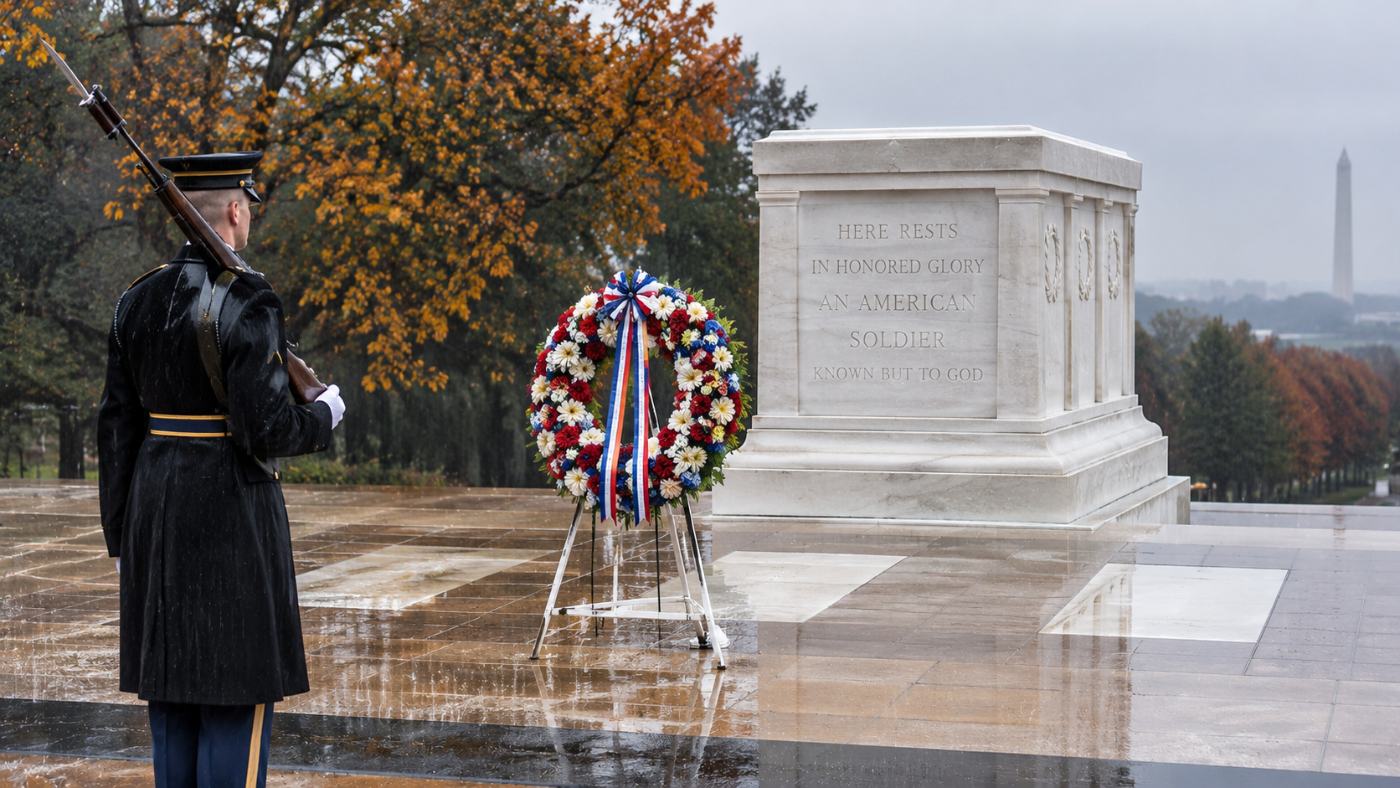
President Donald Trump emerged from the White House on Wednesday for his first official public appearance since Joe Biden was projected to win the presidential election, attending a Veterans Day ceremony at Arlington National Cemetery while continuing to refuse to acknowledge his defeat.
Five days after his last public remarks, Trump participated in a wreath-laying ceremony at the Tomb of the Unknown Soldier as rain fell over the cemetery.
The president stood alongside Vice President Mike Pence, briefly touched the ceremonial wreath, and saluted as military honors were rendered. First Lady Melania Trump and Karen Pence also attended.
Trump made no public remarks and departed shortly after the ceremony.
Meanwhile, his administration continued challenging election results, advancing allegations of widespread voter fraud without producing evidence sufficient to substantiate those claims.
Trump Refuses to Accept the Election Results
Major news organizations projected Biden's victory on November 7 after Pennsylvania's electoral votes placed him above the 270 needed to win the presidency.
Rather than concede, Trump insisted that the election had been stolen and continued asserting that illegal ballots and improper counting procedures had changed the outcome.
His campaign filed lawsuits in several battleground states, including Pennsylvania, Michigan, Nevada, and Arizona.
Courts had already rejected multiple challenges, while state election officials reported no evidence of widespread fraud capable of overturning the projected results.
Despite these setbacks, Trump continued suggesting that he would ultimately emerge victorious.
His refusal to acknowledge Biden's projected victory left the country facing an unusually contentious presidential transition.
The White House Blocks the Transition
The General Services Administration, responsible for formally recognizing the apparent winner of a presidential election, had not authorized the transition process to begin.
Without that determination, Biden's team could not access certain federal resources, agency briefings, and funding normally provided to an incoming administration.
The delay raised concerns among national security specialists and former government officials about the consequences of withholding information from the incoming president.
Secretary of State Mike Pompeo further intensified the controversy on Tuesday when he suggested there would be a smooth transition to another Trump administration.
The remark came despite Biden's substantial Electoral College advantage and the absence of verified evidence supporting Trump's allegations.
Pentagon Leadership Changes Raise Questions
While refusing to concede, Trump also made significant changes within the Defense Department.
On Monday, he fired Defense Secretary Mark Esper and replaced him with Christopher Miller, director of the National Counterterrorism Center.
Additional senior Pentagon positions were filled by officials considered loyal to the president.
The sudden personnel changes, occurring during a disputed presidential transition, prompted concerns about stability within the nation's military leadership.
Miller attended Wednesday's Veterans Day ceremony at Arlington.
Biden Moves Forward
While Trump remained unwilling to acknowledge the election results, President-elect Biden continued preparing for the presidency.
Biden and his wife, Jill, observed Veterans Day at the Korean War Memorial in Philadelphia, where they participated in a wreath-laying ceremony honoring American service members.
On Tuesday, Biden described Trump's refusal to concede as an embarrassment and expressed confidence that the transition would eventually proceed.
His advisers continued assembling an incoming administration despite the lack of formal cooperation from the White House.
An Unprecedented Post-Election Standoff
Presidential elections have produced bitter disputes before, including the contested 2000 election between George W. Bush and Al Gore.
However, Trump's continued refusal to recognize the projected outcome, combined with unsupported allegations of widespread fraud and the administration's unwillingness to begin transition preparations, created an extraordinary political confrontation.
As Americans honored military veterans on November 11, the country remained divided over a presidential election whose projected winner was clear but whose losing incumbent refused to concede.
The coming weeks would determine whether the administration would cooperate with the transfer of power or continue challenging the results through the courts.