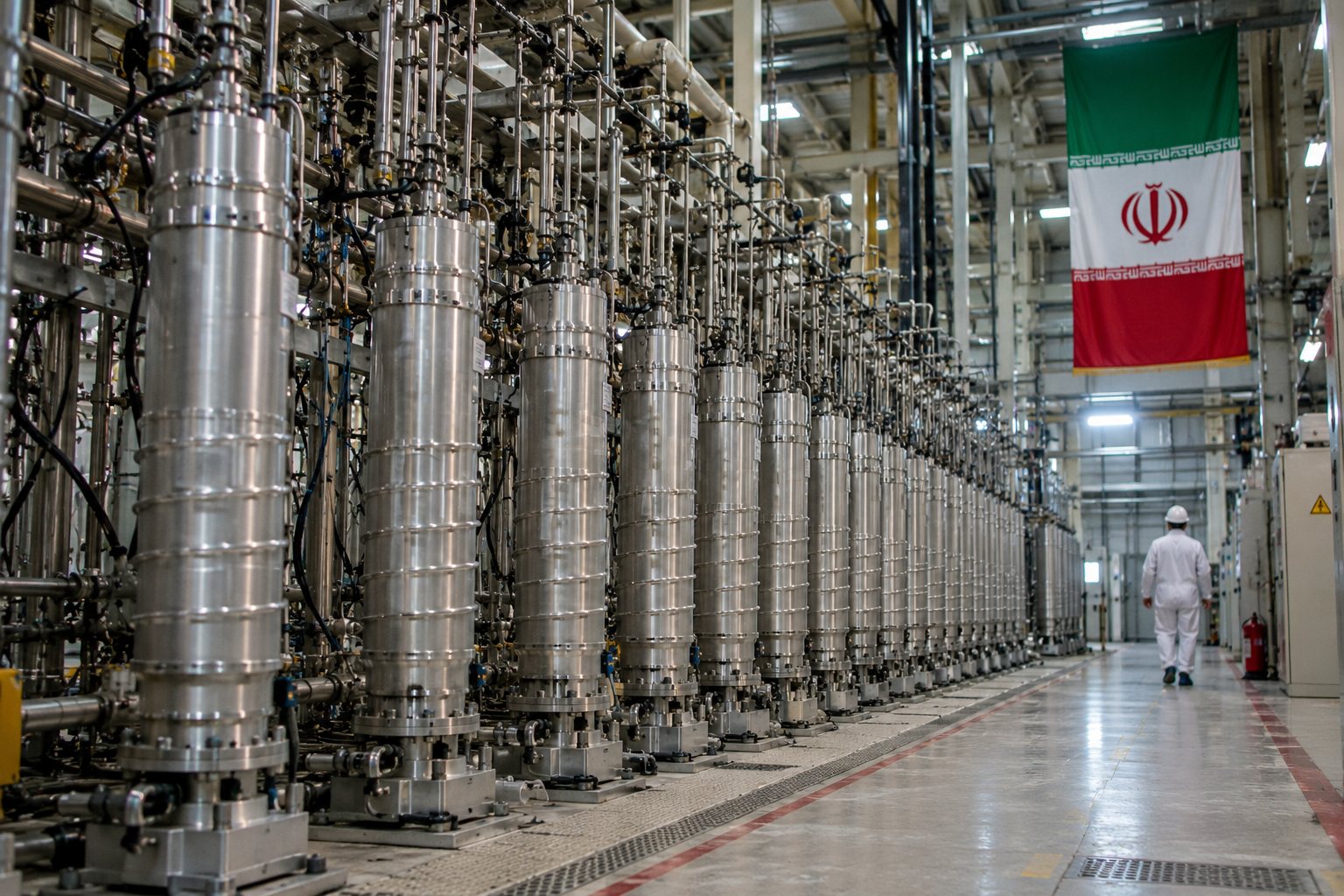
President Donald Trump refused to certify the Iran nuclear agreement, escalating his campaign against one of Barack Obama's signature foreign-policy achievements even though international nuclear inspectors had repeatedly reported that Iran was implementing its nuclear commitments. Trump stopped short of immediately withdrawing the United States from the agreement, but warned that he could terminate American participation if Congress and U.S. allies did not address what he called the deal's “many serious flaws.”**
Donald Trump had spent years attacking the Iran nuclear agreement.
On October 13, 2017, he took his most consequential step yet toward dismantling it.
Speaking from the White House, Trump announced that he would no longer certify the agreement under a U.S. law requiring the president to periodically report to Congress about the deal and whether continued sanctions relief remained appropriate.
“We cannot and will not make this certification,” Trump declared.
But there was an important complication.
The international organization responsible for monitoring Iran's nuclear program had not reached the same conclusion about Iran's nuclear compliance.
The Inspectors Said Iran Was Implementing the Deal
The agreement—formally known as the Joint Comprehensive Plan of Action, or JCPOA—had been negotiated by the United States, Iran, Britain, France, Germany, Russia, China and the European Union.
Under the 2015 agreement, Iran accepted extensive restrictions on its nuclear program in exchange for relief from nuclear-related economic sanctions.
Iran reduced its stockpile of enriched uranium.
Thousands of centrifuges were removed.
Its Arak heavy-water reactor was altered to prevent it from producing weapons-grade plutonium through its original design.
And international inspectors received expanded access to monitor Iran's nuclear activities.
By October 2017, the International Atomic Energy Agency had issued eight reports since implementation of the agreement.
All eight found Iran was implementing its nuclear commitments.
Trump's own administration had previously certified the agreement twice.
Then Trump changed course.
Trump Said Iran Was Violating the “Spirit” of the Agreement
Trump's argument went beyond whether Iran had exceeded a particular nuclear limit.
He pointed to Iran's ballistic missile program, support for militant and terrorist organizations, involvement in regional conflicts and other activities that the administration considered threatening to American interests and allies.
Those concerns were substantial.
But many of them were not prohibited by the nuclear agreement itself.
The JCPOA was principally an agreement restricting Iran's nuclear program—not a comprehensive settlement of every dispute between Iran and the United States.
Trump argued that this was precisely the problem.
He called the agreement “one of the worst and most one-sided transactions the United States has ever entered into.”
He criticized its expiration provisions, complained that inspections were inadequate and argued that the agreement failed to address Iran's ballistic missiles and regional activities.
Trump also said Iran had committed “multiple violations.”
But the IAEA—the organization actually charged with monitoring Iran's nuclear commitments—had not found Iran in material breach of the agreement.
Trump Didn't Actually Withdraw—Yet
The October 13 announcement is sometimes described as Trump withdrawing from the Iran nuclear agreement.
That isn't what happened that day.
Trump decertified the deal under U.S. law, sending the issue back to Congress and creating an opportunity for lawmakers to reimpose sanctions.
The United States technically remained a participant in the JCPOA.
Trump simultaneously directed his administration to negotiate with Congress and America's allies in an attempt to change the agreement.
He wanted tougher enforcement, restrictions on Iran's ballistic missile program and changes to the deal's “sunset” provisions, under which some nuclear restrictions would eventually expire.
Then came the threat.
If those changes couldn't be achieved, Trump said:
> “The agreement will be terminated.”
It was an unmistakable warning that America's continued participation was now in jeopardy.
America's Allies Didn't Follow Trump
The other major powers involved in the agreement did not abandon it.
Britain, France and Germany continued supporting the JCPOA.
Russia and China did as well.
European leaders acknowledged concerns about Iran's missile program and regional behavior but argued that those issues should be addressed separately rather than destroying an agreement that was restricting Iran's nuclear activities.
The disagreement placed the United States increasingly at odds with some of its closest allies.
The question was no longer simply whether Iran would honor the nuclear agreement.
It was whether the United States would.
Seven Months Later, Trump Pulled the Plug
October 13 turned out to be a warning of what was coming.
Trump continued demanding changes to the agreement.
They didn't materialize to his satisfaction.
On May 8, 2018, he announced that the United States would withdraw from the JCPOA and restore economic sanctions against Iran.
The remaining participants attempted to keep the agreement alive without Washington.
For a time, Iran continued observing major nuclear restrictions.
But after the United States withdrew and reimposed sanctions, the agreement steadily deteriorated.
Iran eventually began exceeding JCPOA limits on uranium enrichment and its enriched-uranium stockpile.
The system designed to constrain Iran's nuclear program was unraveling.
A Decision With Consequences Far Beyond 2017
There were legitimate criticisms of the original Iran nuclear agreement.
It did not permanently eliminate Iran's ability to enrich uranium.
Some restrictions expired over time.
It did not eliminate Iran's ballistic missile program.
And it did not stop Tehran's support for armed groups or its involvement in conflicts throughout the Middle East.
Those shortcomings formed the core of Trump's argument.
But there is an equally important fact about what happened on October 13, 2017:
Trump refused to certify the agreement even though the international inspectors responsible for monitoring Iran's nuclear commitments were reporting that Iran was implementing them.
Trump believed the agreement itself was inadequate.
Rather than continue operating within it while pursuing separate measures against Iran's other activities, his administration began moving toward abandoning it.
October 13 was not the day Trump formally withdrew America from the Iran nuclear deal.
That came seven months later.
But it was the day he made clear that the United States might walk away—and placed one of the world's most consequential nuclear agreements on a path toward collapse.