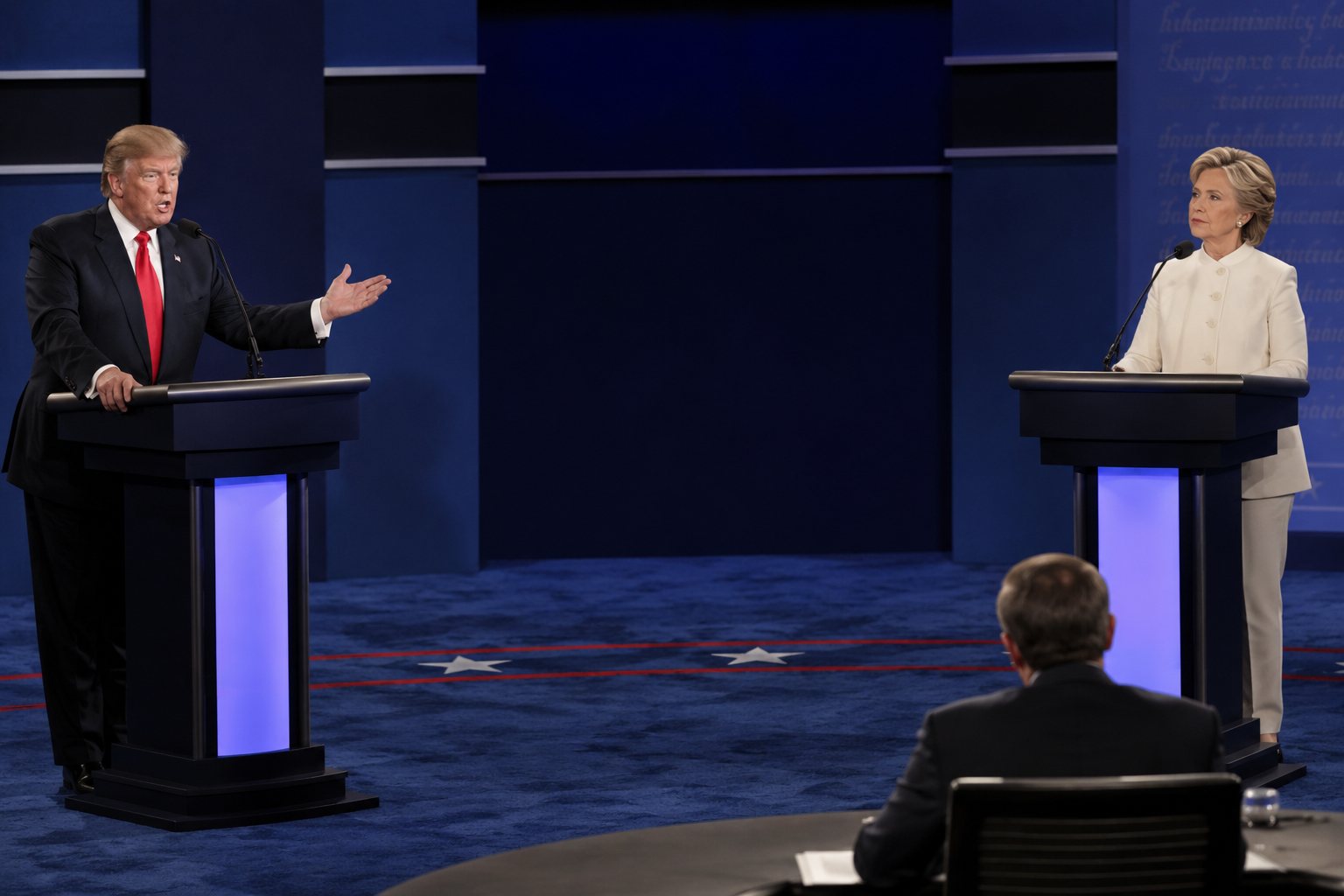
Republican presidential nominee Donald Trump refused Wednesday night to promise that he would accept the results of the November 8 election, delivering one of the most consequential statements of the 2016 campaign during his final presidential debate against Hillary Clinton.
Asked directly whether he would honor the outcome if he loses, Trump declined to make that commitment.
Instead, he told moderator Chris Wallace that he would evaluate the results after the election.
"I'll keep you in suspense," Trump said.
The exchange immediately overshadowed much of the debate, raising concerns about a fundamental principle of American democracy: that candidates accept legitimate election results and that political power changes hands peacefully.
Trump's refusal also contradicted public assurances from his own running mate, Indiana Governor Mike Pence, who has repeatedly stated that the Republican ticket would accept the outcome.
With fewer than three weeks remaining before Election Day, the Republican nominee is openly questioning the legitimacy of an election that has not yet taken place.
A Question Every Presidential Candidate Should Be Able to Answer
The confrontation occurred during the third and final presidential debate at the University of Nevada, Las Vegas.
Wallace, the Fox News anchor moderating the event, asked Trump about his repeated claims that the election is rigged and that Clinton is attempting to steal the presidency.
Wallace noted that Pence had pledged to accept the results and that Trump's daughter Ivanka had expressed the same position.
He then asked Trump to make an equivalent commitment.
Trump refused.
He argued that the news media had treated him unfairly, complained about voter registration problems, and repeated accusations that Clinton should not have been permitted to run for president.
Wallace pressed him again, explaining that accepting election results is central to the American tradition of a peaceful transfer of power.
Trump remained unwilling to commit.
The exchange was remarkable because Wallace was not asking Trump to abandon his right to challenge a documented irregularity or seek a lawful recount.
He was asking whether the Republican nominee accepted the basic legitimacy of the electoral process.
Trump would not say yes.
Clinton Calls the Refusal 'Horrifying'
Clinton immediately challenged Trump's response.
"That's horrifying," she said.
The Democratic nominee argued that Trump has developed a pattern of describing institutions and competitions as rigged whenever their outcomes do not favor him.
She pointed to his complaints about the Republican primaries, the FBI investigation into her private email server, and legal proceedings involving Trump University.
Clinton also referenced Trump's previous complaints about the Emmy Awards, drawing laughter from the audience when Trump interjected that his television program deserved to win.
Her broader argument was that Trump's willingness to reject unfavorable outcomes extended beyond ordinary campaign criticism.
Clinton said the United States depends on candidates and elected officials respecting democratic institutions, even when they disagree with decisions those institutions produce.
The exchange highlighted a significant disagreement between the candidates.
Clinton argued that accepting the electoral process is an obligation of presidential leadership.
Trump maintained that he should reserve judgment until he sees the results.
Trump's Own Running Mate Has Promised to Accept the Results
The refusal placed Trump at odds with senior members of his own campaign.
On Sunday, Pence told television interviewers that the Republican ticket would accept the election's outcome.
He reiterated that position earlier Wednesday, before the debate.
Trump's answer directly contradicted those assurances.
The inconsistency raises questions about which position represents the campaign's actual commitment.
It also leaves Republican officials in the uncomfortable position of defending an electoral system that their presidential nominee continues to portray as potentially illegitimate.
Trump has not presented evidence establishing that widespread illegal voting or coordinated manipulation is occurring on a scale capable of determining the presidential election.
Nevertheless, he has repeatedly warned supporters that the election could be stolen.
Those warnings have become an increasingly prominent part of his campaign message.
The Evidence Does Not Support Trump's Claims of Widespread Voter Fraud
Trump's allegations of widespread voter fraud have been challenged by election administrators and researchers.
He has cited inaccurate voter registration records, including registrations associated with people who have moved or died.
But outdated registration information is not proof that someone has voted illegally.
A 2012 Pew report identified substantial problems with voter registration records, including outdated and duplicate entries.
The report did not conclude that millions of fraudulent ballots had been cast.
Election administration specialists distinguish between inaccurate records, isolated instances of wrongdoing, and organized fraud capable of changing election results.
Those are not interchangeable categories.
Research into voter impersonation has found that documented cases are extremely rare.
A widely cited investigation by Loyola Law School professor Justin Levitt identified only 31 credible allegations of voter impersonation among more than one billion ballots cast in elections between 2000 and 2014.
That finding does not mean election systems are immune from mistakes or misconduct.
It does, however, demonstrate the gap between documented evidence and Trump's sweeping assertions.
As of Wednesday night, there is no substantiated evidence supporting Trump's claim that the upcoming presidential election is being systematically rigged against him.
Allegations Against the Media Are Not Evidence of Election Fraud
Trump also defended his refusal by accusing major news organizations of dishonest and politically biased coverage.
The Republican nominee has frequently criticized newspapers and television networks for their reporting on his campaign, particularly following the release of the 2005 Access Hollywood recording and allegations of sexual misconduct from multiple women.
Trump denies the allegations and argues that the coverage is intended to damage his candidacy.
Media bias is a legitimate subject of public debate.
But unfavorable news coverage is not equivalent to fraudulent voting, manipulated ballot counts, or unlawful interference with election administration.
The news media do not certify election results.
State and local election officials administer voting, count ballots, and carry out the legal procedures governing elections.
Trump's repeated movement between complaints about media coverage and allegations of election fraud risks blurring those distinctions.
A candidate can criticize journalists without establishing that the voting system itself is corrupt.
The Importance of a Peaceful Transfer of Power
For generations, the peaceful transfer of presidential power has been a defining feature of American government.
Presidential candidates frequently engage in bitter campaigns, challenge one another's qualifications, and dispute individual voting procedures.
Close elections can also produce recounts and legal challenges.
The 2000 presidential election between George W. Bush and Al Gore demonstrated that legitimate disputes over vote counting can require judicial resolution.
But those disputes take place within a constitutional system that provides mechanisms for determining an election's outcome.
Once the legal process is complete, the transfer of authority is expected to proceed.
That distinction matters.
There is a difference between contesting specific evidence of an election irregularity and suggesting, without substantiation, that an entire election is illegitimate before ballots have been counted.
Trump's statement Wednesday night leaves open the possibility that he will reject a result simply because he disputes its legitimacy.
He has not explained what evidence would persuade him to accept a defeat.
Nor has he identified a clear standard for determining whether the election has been conducted fairly.
Without such a standard, his position creates uncertainty about whether any unfavorable outcome would satisfy him.
A Campaign Already Promoting Claims of a Rigged System
Wednesday's debate did not mark the beginning of Trump's allegations.
For weeks, he has warned supporters that the election could be stolen.
At rallies, he has urged supporters to watch polling locations for suspicious activity.
His campaign has also accused the political establishment and news media of working together to prevent him from winning.
Election officials have pushed back against claims that widespread fraud is occurring.
The decentralized structure of American elections, administered across thousands of jurisdictions under varying state laws, presents substantial obstacles to the kind of nationwide manipulation Trump has suggested.
That does not eliminate the possibility of isolated errors, misconduct, or disputes.
It does mean that a claim of widespread coordinated fraud requires substantial evidence.
Trump has not provided it.
His continued allegations could have consequences beyond his own campaign.
Public confidence in elections depends in part on candidates distinguishing between legitimate concerns and accusations that cannot be substantiated.
When a major-party presidential nominee repeatedly declares that the system is rigged, some supporters may come to distrust results before any evidence has been examined.
The Debate's Other Confrontations
The exchange over election results came during an increasingly contentious final debate.
Trump and Clinton clashed over Supreme Court appointments, abortion, immigration, economic policy, Russia, and their qualifications for the presidency.
Trump defended his proposed border wall and argued for tougher immigration enforcement.
Clinton challenged his economic proposals and questioned his relationship with Russian President Vladimir Putin.
The candidates also confronted allegations of sexual misconduct against Trump, which he denied.
During another exchange, Trump referred to Clinton as a "nasty woman," adding to the evening's confrontational tone.
Yet the question of accepting election results carried implications extending beyond the policy disagreements and personal attacks that have characterized the campaign.
The candidates were not merely debating which policies the next president should pursue.
They were confronting whether the outcome of the election itself would be recognized as legitimate.
The Election Has Not Happened Yet
Trump's warnings are especially significant because voters have not yet completed the election.
Early voting is underway in several states, and millions of Americans are preparing to cast ballots.
Election administrators continue preparing polling places, voting equipment, ballot processing procedures, and security measures.
No final results exist.
No evidence has emerged demonstrating that the presidential election has been stolen.
Nevertheless, Trump is already preparing the public for the possibility that he may reject an unfavorable outcome.
His supporters are entitled to demand accurate vote counts and fair election procedures.
So are Clinton's supporters.
Every voter deserves a system that investigates credible allegations and corrects documented errors.
But confidence in democracy also requires political leaders to avoid presenting speculation as established fact.
A Defining Question About Democratic Institutions
The final presidential debate was intended to give Americans one last opportunity to compare the candidates before Election Day.
Instead, it produced a moment that may have implications for public confidence in the election itself.
Trump was given a direct opportunity to affirm that he would accept the result of a legitimate democratic election.
His running mate had already made that commitment.
His daughter had expressed the same position.
The moderator explained the importance of the principle.
Trump still refused.
The issue is not whether candidates have the right to challenge actual election misconduct. They do.
The issue is whether a presidential nominee should undermine confidence in an election without producing evidence that it is being manipulated.
On Wednesday night, Trump declined to provide the reassurance that his own campaign had offered.
The American electoral system provides procedures for resolving disputes. What it cannot guarantee is that every candidate will accept an outcome they dislike.
With Election Day less than three weeks away, Trump's refusal has introduced an additional question into an already contentious presidential race: not simply who will win the election, but whether the Republican nominee will recognize the result if he loses.