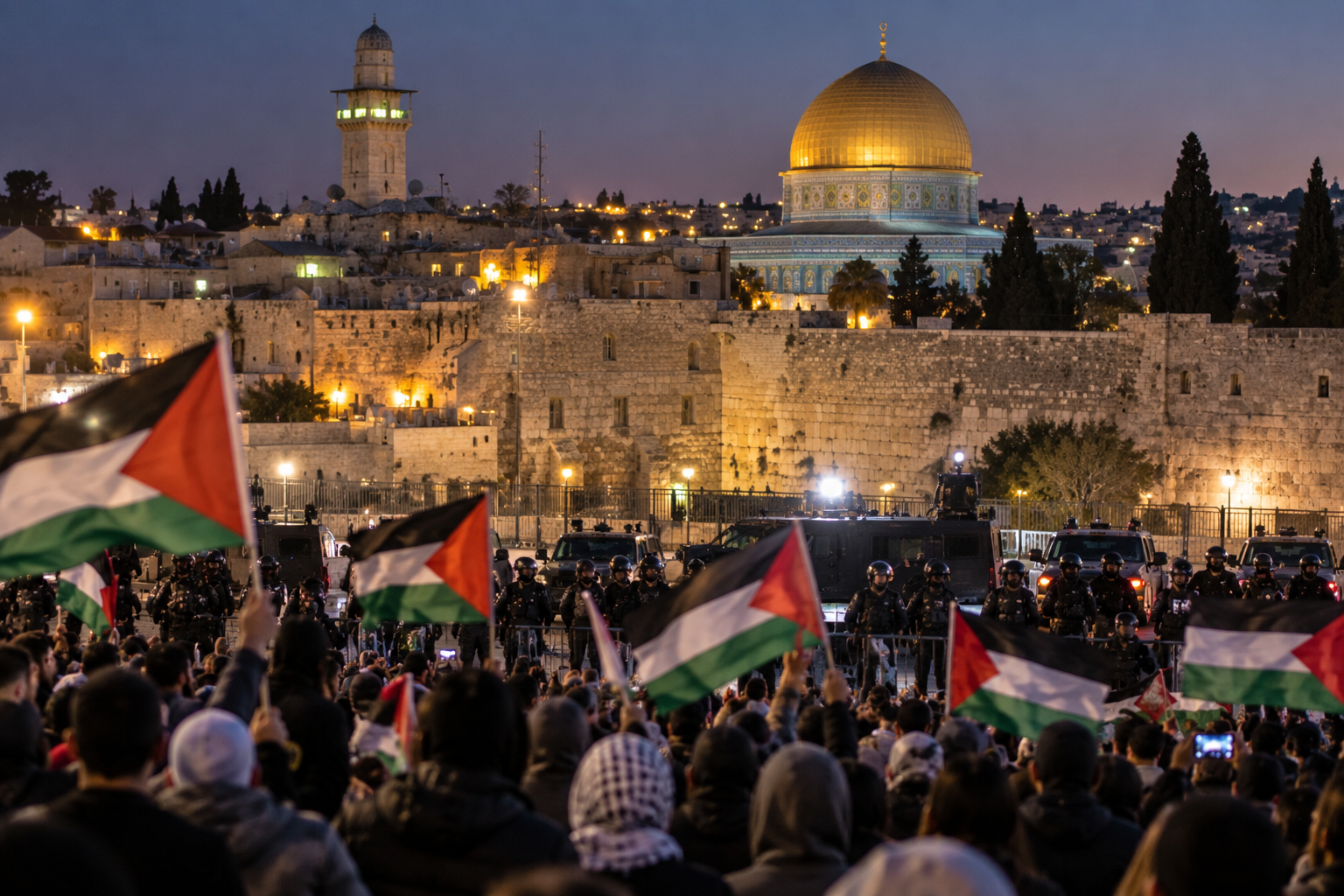
For decades, American presidents had avoided taking one of the most politically explosive steps available to the United States in the Israeli-Palestinian conflict.
Donald Trump decided to take it.
On December 6, 2017, Trump formally announced that the United States would recognize Jerusalem as the capital of Israel.
He also directed the State Department to begin preparations to move the American Embassy from Tel Aviv to Jerusalem.
Trump portrayed the decision as recognition of political reality and fulfillment of a promise that previous presidents had repeatedly postponed.
Israel celebrated the announcement.
Across much of the Middle East, the reaction was dramatically different.
Palestinian leaders rejected it. Jordan warned of dangerous consequences. Saudi Arabia, Egypt, Turkey and other governments had warned Washington against the move. Demonstrations followed across the region.
One of the most sensitive issues in the Israeli-Palestinian conflict had suddenly been transformed by a unilateral American decision.
“It Is Time”
Trump announced the change from the Diplomatic Reception Room at the White House.
For more than 20 years, he said, American presidents had followed essentially the same Jerusalem policy without achieving a lasting Israeli-Palestinian peace agreement.
Trump argued that continuing that policy made little sense.
He therefore announced:
The United States would officially recognize Jerusalem as Israel's capital.
Trump described the decision as recognition of an existing reality.
Israel's parliament, the Knesset, was located in Jerusalem.
So was its Supreme Court.
Its president and prime minister maintained official residences there.
Government ministries operated there.
American presidents and other officials regularly traveled to Jerusalem to meet Israeli leaders.
For Trump, refusing to recognize the city as Israel's capital was maintaining a diplomatic fiction.
Critics saw something very different.
They saw the United States taking a position on one of the most sensitive disputes in the Middle East before Israelis and Palestinians had reached a peace agreement.
The Jerusalem Embassy Act
Trump had not invented the idea of moving the embassy.
Congress had passed the Jerusalem Embassy Act in 1995.
The law called for Jerusalem to be recognized as Israel's capital and for the American Embassy to be moved there.
It had strong bipartisan support.
But the law also allowed presidents to delay implementation through a national-security waiver.
President Bill Clinton used it.
President George W. Bush used it.
President Barack Obama used it.
And during his first months in office, Trump initially used it as well.
The reason was straightforward.
Jerusalem was not simply another capital city.
Its status was one of the central unresolved issues in the Israeli-Palestinian conflict.
Previous administrations feared that recognizing Jerusalem before a negotiated settlement could damage America's ability to serve as a mediator and potentially ignite unrest throughout the Middle East.
Trump rejected that approach.
After more than two decades, he argued, delaying the decision had not produced peace.
Why Jerusalem Is So Sensitive
Few cities on Earth carry the religious, historical and political significance of Jerusalem.
The city is sacred to Judaism, Christianity and Islam.
For Jews, it is home to the Western Wall and the site of the ancient Jewish temples.
For Christians, Jerusalem contains sites associated with the crucifixion and resurrection of Jesus.
For Muslims, the city contains the Al-Aqsa Mosque and the Haram al-Sharif, one of Islam's holiest sites.
But Jerusalem is not only a religious question.
It is also a territorial one.
Israel captured East Jerusalem from Jordan during the 1967 Six-Day War and later extended Israeli law and administration over the area.
Palestinians seek East Jerusalem as the capital of a future Palestinian state.
The international community generally did not recognize Israeli sovereignty over East Jerusalem.
That was why foreign embassies had traditionally remained outside Jerusalem.
The city's final status was supposed to be negotiated between Israelis and Palestinians.
Trump's announcement disrupted that diplomatic formula.
Trump Says Borders Are Still Negotiable
The administration attempted to draw an important distinction.
Trump recognized Jerusalem as Israel's capital.
But he said the United States was not determining the final boundaries of Israeli sovereignty in the city.
Those borders, he said, remained subject to negotiations between Israelis and Palestinians.
Trump also said the United States would continue supporting the existing arrangements at Jerusalem's holy sites.
And he said Washington would support a two-state solution if Israelis and Palestinians agreed to one.
The administration therefore argued that it had not decided every question involving Jerusalem.
It had recognized the reality that Israel's government operated from the city while leaving territorial boundaries unresolved.
That distinction did little to calm the reaction across the region.
Palestinian Leaders Reject the Decision
For Palestinians, Jerusalem was not a symbolic issue.
It was central to their national aspirations.
Palestinian Authority President Mahmoud Abbas rejected Trump's decision.
Palestinian officials argued that the United States had undermined its traditional role as a neutral mediator by taking Israel's side on an issue that was supposed to be resolved through negotiations.
The decision generated anger in the Palestinian territories.
Protests and clashes followed.
Palestinian political factions called for demonstrations.
For many Palestinians, Trump's announcement suggested that one of the most important bargaining issues in any future peace agreement had been altered before negotiations could determine its outcome.
Jordan Warns of Dangerous Consequences
The reaction from Jordan was especially significant.
Jordan is a close American ally.
It also has a peace treaty with Israel and plays a special custodial role involving Muslim holy sites in Jerusalem.
King Abdullah II had personally warned Trump before the announcement.
Jordan said recognizing Jerusalem as Israel's capital outside a comprehensive peace settlement could have dangerous consequences for regional security and stability.
The king also warned that the decision could inflame Muslim and Christian sentiment.
Jordan and Palestinian officials called for an emergency meeting of Arab foreign ministers.
This wasn't criticism coming from an American adversary.
It was coming from one of Washington's closest partners in the Arab world.
Saudi Arabia, Egypt and Other Allies Object
Other important American partners in the Middle East had also warned Trump against the move.
Saudi Arabia opposed changing the longstanding American position before a final peace settlement.
Egypt warned of consequences for the peace process.
The United Arab Emirates expressed concern.
Turkey strongly condemned the decision.
These countries differed enormously in their relationships with Washington, Israel and the Palestinians.
But on Jerusalem, much of the region found itself opposing the American decision.
That was one of the most consequential aspects of Trump's announcement.
At a moment when the United States needed cooperation from Arab governments on terrorism, Iran, Syria, regional security and the Israeli-Palestinian peace process, the administration had deliberately chosen a policy that many of those governments had publicly warned against.
Trump Had Been Warned
The backlash was not unexpected.
Trump had spoken with major regional leaders before making the announcement.
On December 5, the president separately spoke with Israeli Prime Minister Benjamin Netanyahu, Palestinian Authority President Mahmoud Abbas, Jordan's King Abdullah II, Egyptian President Abdel Fattah el-Sisi and Saudi King Salman.
Jerusalem was discussed.
Several of those leaders had already made their objections clear.
Trump proceeded anyway.
That distinguished the decision from a diplomatic miscalculation in which the consequences became apparent only afterward.
The administration knew the issue could provoke significant opposition across the Middle East.
Trump decided that changing American policy was worth that risk.
Israel Celebrates
In Israel, the reaction was dramatically different.
Prime Minister Benjamin Netanyahu praised Trump.
He called the announcement historic and argued that recognizing Jerusalem as Israel's capital acknowledged an undeniable reality.
For Israelis who believed international refusal to recognize Jerusalem was fundamentally unfair, Trump's announcement corrected a longstanding diplomatic anomaly.
Israel's government had operated from Jerusalem for decades.
The Knesset met there.
The Supreme Court sat there.
Prime ministers governed there.
Foreign leaders visited Israeli officials there.
Yet most foreign embassies remained in or near Tel Aviv.
Trump had changed the American position.
Netanyahu urged other countries to follow.
The United States Becomes More Isolated on Jerusalem
International criticism extended well beyond the Middle East.
Many European allies opposed the decision.
The United Nations became another arena for the dispute.
Later in December, the U.N. Security Council considered a resolution rejecting changes to Jerusalem's status.
Fourteen members supported it.
The United States vetoed it.
Days later, the issue moved to the U.N. General Assembly.
On December 21, the General Assembly voted overwhelmingly for a resolution declaring actions intended to alter Jerusalem's status legally ineffective and calling for them to be rescinded.
The vote was 128 in favor, 9 against and 35 abstentions.
The United States found itself in a small minority.
Did Trump Damage America's Role as Mediator?
That became one of the central questions following the announcement.
For decades, the United States had attempted to position itself as the principal outside mediator between Israelis and Palestinians.
American administrations were never viewed as completely neutral.
The United States was Israel's closest major ally.
But Washington had generally maintained that Jerusalem's final status should be resolved through negotiations.
Trump altered that equation.
Palestinian leaders increasingly argued that the United States could no longer act as an honest broker.
The Trump administration rejected that conclusion.
It argued that previous diplomatic formulas had repeatedly failed and that acknowledging Jerusalem as Israel's capital could remove an artificial obstacle from negotiations.
Those were fundamentally different theories of how diplomacy should work.
Trump believed changing the assumptions surrounding the conflict could help break a decades-long stalemate.
His critics believed he had surrendered American leverage without receiving anything from Israel in return.
The Embassy Move Becomes Real
Trump's announcement did not mean diplomats packed their offices in Tel Aviv the following morning.
Moving an embassy normally takes years.
Trump directed the State Department to begin preparations.
But the administration ultimately moved much faster than initially expected.
The United States opened its embassy in Jerusalem on May 14, 2018, the 70th anniversary of Israel's declaration of independence.
The move transformed Trump's December announcement from diplomatic language into a physical reality.
The American flag now flew over a U.S. Embassy in Jerusalem.
A Fundamental Change in American Policy
Supporters of Trump's decision saw it as long overdue.
Congress had called for the embassy move more than two decades earlier.
Israel governed from Jerusalem.
Trump had promised voters he would recognize that reality.
And unlike previous presidents, he followed through.
Critics saw a different legacy.
They argued that Trump had taken one of the most sensitive issues in Middle Eastern diplomacy and changed American policy without extracting concessions from Israel or securing progress toward a Palestinian settlement.
The regional response demonstrated just how consequential the decision was.
Palestinian leaders rejected it.
Major Arab governments warned against it.
Turkey condemned it.
American allies in Europe opposed it.
Protests erupted.
The United Nations overwhelmingly rejected efforts to unilaterally change Jerusalem's status.
Israel, meanwhile, celebrated.
Trump Upends the Middle East Status Quo
Trump had campaigned as a president who would reject established diplomatic conventions.
On December 6, 2017, he did exactly that.
For more than two decades, Democratic and Republican presidents had looked at the Jerusalem Embassy Act and reached essentially the same conclusion:
Not yet.
Trump reached the opposite one.
He argued that maintaining the existing policy had accomplished nothing.
His supporters saw courage in breaking with that consensus.
His critics saw a president disregarding warnings from Palestinians, Arab governments and American allies while jeopardizing Washington's role in future peace negotiations.
What cannot be disputed is the scale of the reaction.
Jerusalem touches religion, territory, national identity and more than a century of conflict.
Changing America's position was never going to remain a Washington policy announcement.
It reverberated across the Middle East.
On December 6, Donald Trump made one of the most consequential foreign-policy decisions of his first year in office.
The United States recognized Jerusalem as Israel's capital.
The embassy was going to move.
Israel celebrated.
And across much of the Middle East, America's president had just ignited a new diplomatic crisis.