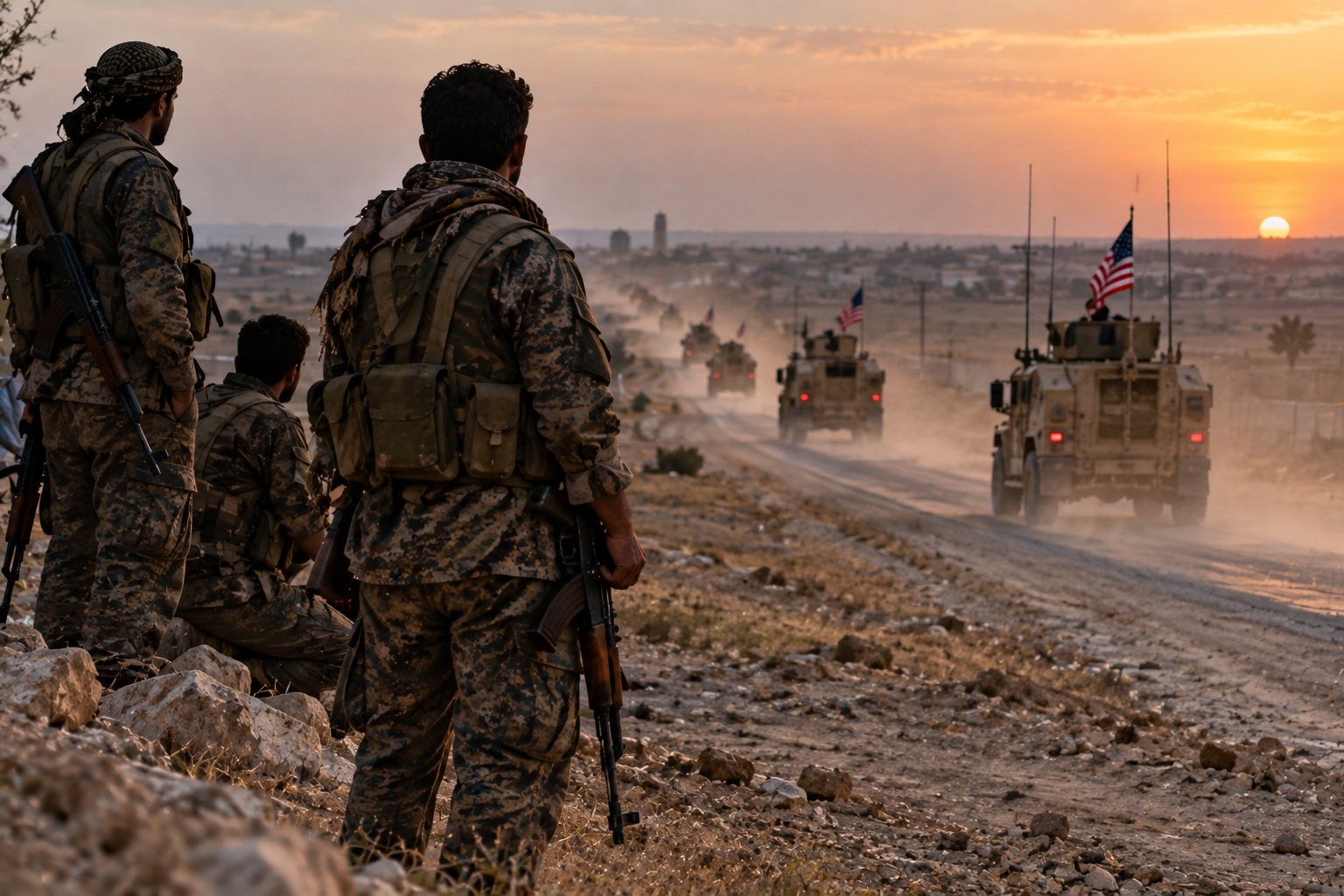
On October 7, 2019, American troops began withdrawing from positions along Syria's border with Turkey following a decision by President Donald Trump that stunned U.S. allies, military officials and members of his own Republican Party.
The troops were being moved away from an area where Turkey was preparing a military offensive against Kurdish-led forces.
Those Kurdish forces weren't simply another faction in Syria's long civil war.
They had been among America's most important partners in the ground war against ISIS.
For years, Kurdish-led fighters operating as part of the Syrian Democratic Forces had fought alongside the United States against the Islamic State, suffering thousands of casualties while helping dismantle the terrorist group's territorial caliphate.
Now, with Turkey preparing to move against them, their American partner was moving out of the way.
America's Partners Against ISIS
When ISIS controlled enormous portions of Syria and Iraq, the United States faced a difficult problem.
Washington wanted to destroy the terrorist group's territorial stronghold without deploying another massive American ground force into the Middle East.
Kurdish fighters became a crucial part of the solution.
Supported by American airpower, intelligence, weapons, training and Special Operations forces, the Syrian Democratic Forces became the principal ground partner of the U.S.-led campaign in northeastern Syria.
They fought ISIS street by street and town by town.
They helped capture Raqqa, the Islamic State's self-proclaimed capital.
They helped push ISIS from its final territorial stronghold at Baghouz in March 2019.
Thousands of SDF fighters were killed during the campaign.
Their partnership allowed the United States to pursue ISIS while keeping the number of American troops on the ground relatively small.
But there was another complication.
Turkey viewed the Kurdish YPG, the dominant military component of the SDF, as closely connected to the Kurdistan Workers' Party, or PKK, which Turkey considers a terrorist organization.
That placed the United States between two partners with fundamentally incompatible objectives.
Turkey was a NATO ally.
The Syrian Kurds were America's battlefield partners against ISIS.
For years, Washington attempted to manage that contradiction.
Then Trump made a decision that changed the equation.
A Phone Call With Erdoğan
On October 6, Trump spoke by telephone with Turkish President Recep Tayyip Erdoğan.
Afterward, the White House announced that Turkey would move forward with its planned military operation in northern Syria.
The statement contained a crucial sentence:
U.S. forces “will no longer be in the immediate area.”
The United States said it would neither support nor participate in Turkey's operation.
But removing American troops from the area also eliminated a significant obstacle to a Turkish offensive.
By October 7, American forces were pulling back from positions near the border.
For Kurdish commanders who had spent years fighting alongside the United States, the message was unmistakable: they would be facing Turkey without the American military standing between them.
Republicans Turn on Trump's Decision
The criticism was immediate — and notably bipartisan.
Some of the sharpest condemnation came from Republicans who normally supported Trump.
Senator Lindsey Graham warned that abandoning the Kurds would be a “disaster in the making.”
Senate Majority Leader Mitch McConnell urged Trump to reconsider, warning that withdrawing American forces could benefit Russia, Iran and the Assad government while increasing the risk that ISIS could return.
Former American officials and military figures also raised concerns about what the decision communicated to other U.S. partners.
The argument extended beyond Syria.
If local forces were expected to risk their lives fighting alongside Americans, critics asked, what happened when those forces were no longer politically convenient?
Would future partners trust American promises?
Trump Defends Getting Out
Trump defended the decision as part of his effort to remove the United States from prolonged military commitments in the Middle East.
He argued that America had spent enormous amounts of money fighting wars thousands of miles from home and that other countries needed to take responsibility for conflicts in their own region.
The United States, he argued, could not remain indefinitely simply to prevent Turkey and Kurdish forces from fighting one another.
Trump also emphasized that Turkey was a NATO ally and maintained that the United States had defeated ISIS's territorial caliphate.
It was an argument with genuine strategic implications: how long should American troops remain overseas after their original military objective has largely been achieved?
But critics argued that the relatively small American presence in northeastern Syria was doing far more than simply fighting ISIS.
American troops were also serving as a deterrent.
As long as they stood alongside Kurdish forces, Turkey risked confronting American soldiers if it launched an invasion.
Once those troops moved, that deterrent disappeared.
Turkey Invades
Two days later, on October 9, Turkey launched Operation Peace Spring into northeastern Syria.
Turkish forces and allied Syrian fighters attacked Kurdish-held territory along the border.
The fighting displaced civilians and forced Kurdish forces to redirect personnel away from operations against ISIS.
Concerns also emerged about ISIS prisoners being held in facilities guarded by Kurdish forces.
The consequences became serious enough that the Trump administration soon began pressuring Turkey to stop the offensive.
On October 14 — only a week after the initial American withdrawal began — Trump announced sanctions against Turkish officials and acknowledged that Turkey's military operation was endangering civilians and threatening regional stability.
The administration that had moved American troops away from Turkey's path was now attempting to use economic pressure to restrain the Turkish offensive.
The Cost of an Alliance
The episode became about more than a troop withdrawal.
It raised a fundamental question about what American partnership means.
The Syrian Democratic Forces had not been protected by a formal mutual-defense treaty with the United States. Washington had never promised the Kurds an independent state or permanent American military protection.
Turkey also had legitimate security concerns about the PKK, which has conducted a decades-long insurgency against the Turkish government and is designated a terrorist organization by both Turkey and the United States.
But none of that changed what Kurdish-led forces had done during the war against ISIS.
They had fought.
They had died.
And they had done so as America's primary local ground partner against one of the world's most notorious terrorist organizations.
Trump himself would later acknowledge their contribution.
On October 23, after a ceasefire arrangement had been negotiated, Trump thanked the Syrian Democratic Forces for their sacrifices and said they had been “terrific.”
But by then, the strategic landscape had already changed.
Turkey had invaded.
Kurdish forces had sought new arrangements with the Syrian government and Russia as they attempted to protect themselves.
And America's partners had received a powerful lesson about the limits of American support.
On October 7, 2019, U.S. troops began stepping away from the Syrian-Turkish border.
The soldiers they left behind were not America's enemies.
They were forces that had spent years fighting beside America against ISIS.