Former President Donald Trump returned to Detroit Friday evening with sweeping promises to revive American manufacturing, restore the city's automotive industry, and impose aggressive tariffs on foreign competitors. But several of his economic claims present a misleading picture of the country's manufacturing sector, while his proposed policies raise questions about their potential costs to American consumers.
Speaking at Huntington Place just 18 days before the presidential election, Trump portrayed Detroit as a city betrayed by decades of political leadership and promised an extraordinary economic recovery if voters return him to the White House.
He blamed President Joe Biden and Vice President Kamala Harris for the struggles of American manufacturers, despite the fact that many of the industry's most significant changes began decades before either entered the White House.
Trump promised that the world would soon witness what he called a "Michigan miracle."
His message was ambitious. His evidence was considerably less convincing.
Trump Promises to Restore Detroit's Industrial Glory
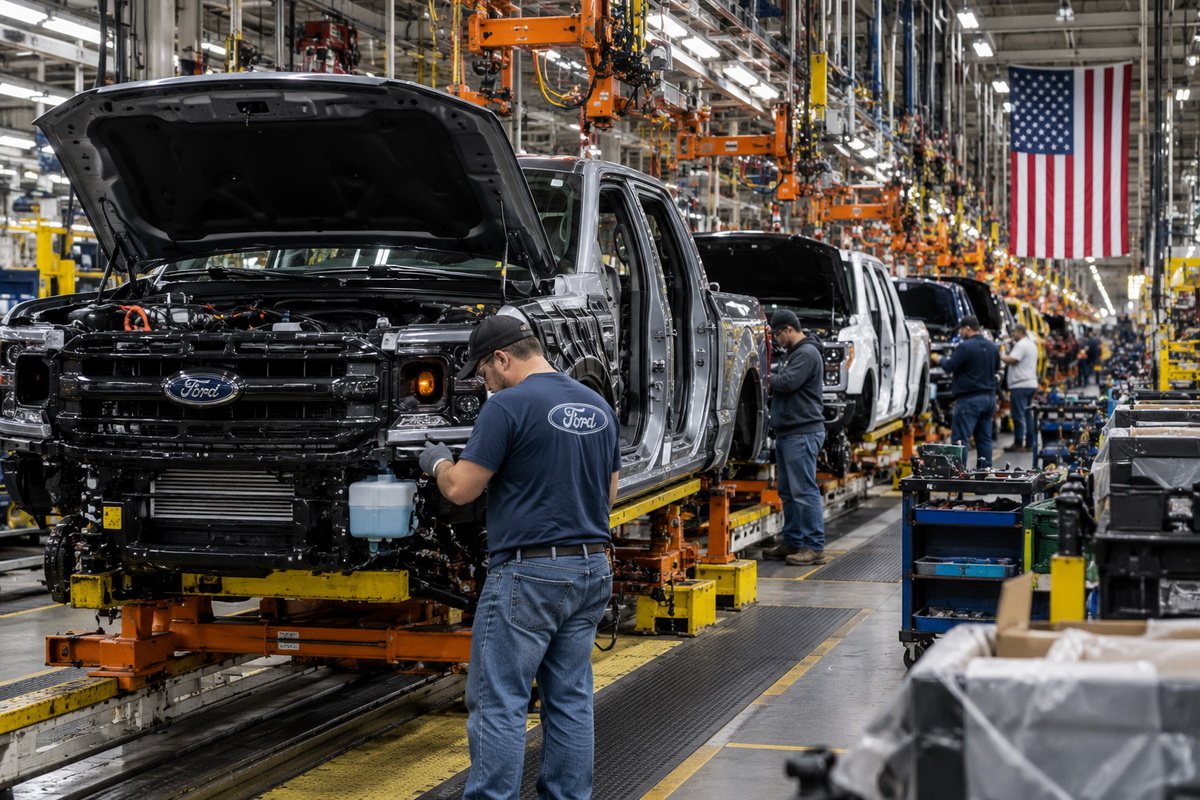
Detroit, once the undisputed center of American automobile manufacturing, has experienced decades of economic challenges as automation, international competition, suburbanization, and corporate restructuring transformed the industry.
Trump used that history to argue that Democratic leadership has failed the city.
He accused politicians of allowing foreign countries to take American manufacturing jobs and promised to reverse the damage through tariffs, corporate tax reductions, and policies intended to encourage domestic production.
Trump pledged to put Detroit and Michigan first, arguing that his administration would make the region a manufacturing powerhouse again.
But Detroit's economic history is more complicated than the former president's explanation suggests.
American automobile manufacturers began confronting significant international competition long before Biden became president. The industry also experienced major changes during Republican and Democratic administrations alike.
Automation has allowed factories to produce more vehicles with fewer employees, while changing consumer preferences have reshaped the types of vehicles Americans purchase.
Reversing those trends cannot be accomplished simply by threatening foreign manufacturers with higher taxes on imports.
The Tariff Plan: Who Actually Pays?
At the center of Trump's economic proposals is an aggressive expansion of tariffs on imported goods.
The former president argues that imposing substantial tariffs on foreign automobiles and other products will encourage companies to relocate manufacturing operations to the United States.
He has proposed tariffs exceeding 100% on certain vehicles imported from Mexico and has repeatedly threatened even higher rates.
Trump presents tariffs as a way to force foreign countries to pay for access to American consumers.
However, tariffs are collected by the United States government from American importers.
Those companies may absorb some of the costs, negotiate lower prices with suppliers, or pass the expenses along to consumers.
Economists warn that broad tariffs can increase prices for American households and businesses, particularly when imported components are essential to domestic manufacturing.
The automobile industry is especially vulnerable because vehicle production relies on complex international supply chains.
A car assembled in Michigan may contain parts manufactured in Mexico, Canada, Europe, or Asia.
Higher tariffs on those components could increase production costs for the very American automakers Trump says he wants to protect.
Tariffs can provide advantages to some domestic producers, but the broader economic effects depend on their design, the availability of domestic alternatives, and potential retaliation from trading partners.
Trump's promises of an economic revival do not eliminate those trade-offs.
A Questionable Claim About Automobile Sales
During Friday's rally, Trump claimed that U.S. car sales have fallen 38% since he left office.
The assertion paints a picture of an automobile market experiencing a dramatic collapse.
But it overlooks a fundamental change in American vehicle purchasing habits.
Traditional passenger cars have been losing market share for years as consumers increasingly purchase SUVs, crossovers, and pickup trucks.
Those vehicles represent a substantial portion of automobile manufacturers' sales and profits.
A decline in sales of conventional sedans does not necessarily indicate a comparable decline in the overall vehicle market.
In fact, total U.S. sales of cars and light trucks reached approximately 15.5 million vehicles in 2023, compared with roughly 14.5 million in 2020, Trump's final year in office.
That comparison does not support the impression of a 38% collapse in overall vehicle sales.
The industry continues to face significant challenges, including financing costs, competition, and the transition toward electric vehicles.
But the figures are more complicated than Trump's campaign rhetoric suggests.
Manufacturing Employment Tells a More Complicated Story
Trump also criticized the Biden-Harris administration over manufacturing employment, claiming that American factories are losing jobs.
Manufacturing has experienced periods of weakness, and some sectors are facing reduced demand and uncertainty.
However, the latest employment report available Friday does not support the suggestion that the entire American labor market is collapsing.
According to the Bureau of Labor Statistics, the United States added 254,000 jobs in September, while the unemployment rate stood at 4.1%.
Manufacturing employment has been comparatively sluggish, underscoring genuine challenges in the sector.
But the national economy has continued adding jobs, and unemployment remains historically low.
Manufacturing employment also declined during Trump's own presidency, particularly during the COVID-19 pandemic.
Trump frequently points to the economy before the pandemic as evidence of his success while assigning responsibility for current economic difficulties entirely to Biden and Harris.
A fair comparison must account for both administrations' records, including the pandemic, subsequent recovery, inflation, and changes in global supply chains.
A New Corporate Tax Cut
Trump is also proposing to reduce the corporate income tax rate from 21% to 15% for companies that manufacture products in the United States.
He argues that the reduction would attract investment and encourage businesses to open American factories.
During his first administration, Trump signed legislation lowering the federal corporate tax rate from 35% to 21%.
The proposed additional reduction would provide another substantial tax benefit to qualifying businesses.
Supporters of lower corporate taxes argue that they encourage investment and make the United States more competitive.
Critics question whether the benefits would primarily flow to shareholders and highly profitable corporations rather than workers.
A lower tax rate would also reduce federal revenue unless increased economic activity or other tax collections offset the loss.
With the national debt already exceeding $35 trillion, Trump's proposals raise questions about how he intends to finance additional tax cuts while also promising to reduce the federal deficit.
Detroit's Economy Is More Than Its Automobile Factories
Trump's depiction of Detroit emphasizes abandoned factories, lost manufacturing jobs, and decades of economic decline.
Those problems are part of the city's history, but they do not tell the entire story.
Detroit has experienced substantial redevelopment in parts of its downtown and surrounding neighborhoods.
Investment in technology, health care, transportation, entertainment, and commercial development has contributed to the city's changing economy.
At the same time, many residents continue to face poverty, inadequate infrastructure, and uneven access to economic opportunities.
The city's future depends on more than automobile manufacturing alone.
Policies addressing education, housing, public transportation, workforce development, and neighborhood investment are also central to long-term economic growth.
Trump's focus on tariffs and corporate taxes addresses only part of that challenge.
A Rally Interrupted by a Microphone Failure
The evening also produced an unusual interruption when Trump's microphone stopped working while he was discussing tariffs.
The audio failure left the former president unable to address the crowd for nearly 20 minutes.
Trump paced the stage while supporters chanted and waited for the sound system to be restored.
When the microphone finally began working again, Trump criticized the equipment provider and threatened not to pay the company's bill.
The episode briefly overshadowed his economic message.
It also produced an ironic moment: A rally centered on Trump's ability to restore American industry was interrupted by a basic equipment failure.
The former president eventually resumed his speech and continued outlining his plans for tariffs, manufacturing, and economic growth.
The Stakes for Michigan Voters
Michigan is one of the most closely contested states in the presidential election.
Both Trump and Harris are competing for voters concerned about manufacturing employment, inflation, automobile production, and the future of the state's economy.
Trump's message is built around the promise that tariffs and tax cuts will restore manufacturing jobs.
Harris and the Biden administration point to federal investments in infrastructure, semiconductor production, and clean-energy manufacturing as evidence of their commitment to American industry.
The candidates offer different approaches to trade, industrial policy, and economic development.
The challenge for voters is determining which proposals are financially realistic and which are likely to deliver measurable benefits.
That requires examining more than campaign slogans.
Big Promises, Unanswered Questions
Trump's Detroit appearance offered an ambitious vision of an American manufacturing revival.
But the speech also relied on exaggerated claims about automobile sales, a simplified explanation of manufacturing job losses, and promises that tariffs would produce sweeping economic benefits.
His proposals deserve scrutiny because they could significantly affect American workers, consumers, businesses, and trading partners.
Higher tariffs may protect certain industries while increasing costs elsewhere.
Corporate tax reductions may encourage investment but also reduce government revenue.
And the promise of restoring Detroit's industrial dominance does not address every challenge facing a city whose economy has undergone decades of structural change.
Detroit's workers deserve more than promises of an economic miracle. They deserve a clear explanation of how proposed policies would create jobs, affect prices, and improve their communities.
With Election Day approaching, Trump's sweeping claims offer voters plenty to consider.
Whether his proposals can deliver the transformation he promises remains an unanswered question.