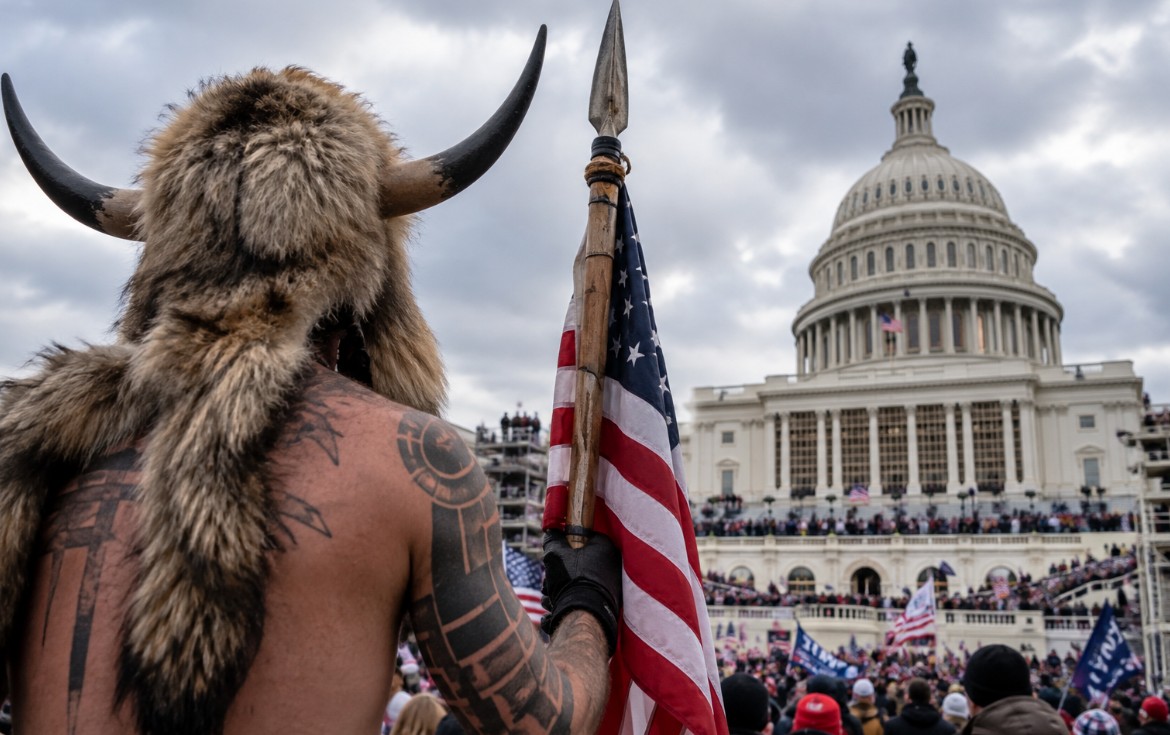
If there was one person who visually embodied the extraordinary events at the U.S. Capitol on January 6, 2021, it was Jacob Chansley.
Shirtless.
His face painted red, white and blue.
A fur headdress with large horns on his head.
An American flag attached to a spear in his hand.
Chansley — who became internationally known as the “QAnon Shaman” — was among the first group of rioters to enter the Capitol. He eventually made his way into the Senate chamber, occupied the vice president's chair and used a bullhorn as other rioters gathered around him.
He became one of the most recognizable symbols of January 6.
Four years later, President Donald Trump pardoned him.
Now Chansley says he doesn't support Trump anymore.
And his criticism has become increasingly severe.
“Are You Still a Trump Supporter?”
CNN's Donie O'Sullivan asked Chansley that question in an interview marking the fifth anniversary of January 6.
Chansley's answer was immediate:
“No.”
The exchange was striking precisely because of who was answering.
Chansley wasn't a conventional Republican voter who gradually became dissatisfied with a president.
He was a man whose image inside the Capitol became inseparable from January 6 and the movement surrounding Trump's effort to overturn his 2020 election defeat.
Trump later granted clemency to Chansley and more than 1,500 other January 6 defendants after returning to the White House.
Chansley initially celebrated.
Then the relationship fell apart.
The Epstein Files Were the Breaking Point
Chansley told CNN that the administration's handling of records connected to Jeffrey Epstein played a major role in his decision to abandon Trump.
Epstein, the wealthy financier and convicted sex offender, died in federal custody in 2019 while awaiting trial on sex-trafficking charges.
For years, Epstein became an important subject within conspiracy-oriented communities that overlapped with parts of Trump's political movement.
Chansley told CNN he had supported Trump in part because he believed Trump would expose powerful people involved in child trafficking.
When Chansley concluded that Trump wasn't fulfilling those expectations, his support collapsed.
His criticism wasn't subtle.
By July 2025, Chansley was publicly attacking Trump online.
By January 2026, he confirmed that he no longer considered himself a Trump supporter.
He subsequently described the administration as a “corrupt disaster.”
Those are Chansley's words, not an assessment of the administration.
Trump Had Pardoned Him
That makes the reversal particularly unusual.
Chansley pleaded guilty in 2021 to obstructing an official proceeding.
A federal judge sentenced him to 41 months in prison.
According to the Justice Department, Chansley had been among the first 30 rioters to enter the Capitol.
He served approximately 27 months before being released from federal custody in 2023.
Then Trump returned to office.
On January 20, 2025 — Trump's first day back in the White House — he issued sweeping clemency covering people prosecuted for conduct related to January 6.
Trump's proclamation granted a “full, complete and unconditional pardon” to most people convicted of offenses connected with the Capitol attack and commuted the sentences of several others.
Chansley was among those pardoned.
His initial reaction was enthusiastic.
Within months, however, one of January 6's most recognizable figures had turned against the president who pardoned him.
This Isn't a January 6 Conversion Story
There is an important distinction.
Chansley's rejection of Trump should not be confused with a wholesale repudiation of his own conduct on January 6.
He has continued to say that he does not regret going to Washington that day.
He has also continued to express unconventional and conspiratorial political beliefs.
And although he has distanced himself from the “QAnon Shaman” label and from QAnon itself, his current political views do not fit neatly into conventional Republican or Democratic politics.
So the story isn't that Chansley suddenly embraced the political establishment he once opposed.
He didn't.
The story is that his faith in Trump collapsed.
And It Didn't Stop With Epstein
Chansley's criticism has expanded beyond the Epstein controversy.
He has attacked the administration's relationship with Israel.
He has criticized American military actions overseas.
In May 2026, he also denounced the administration's Anti-Weaponization Fund, which could provide compensation to some people who say they were improperly targeted by federal law enforcement.
Chansley potentially stood to benefit from a program involving January 6 defendants.
He publicly rejected the idea of accepting money from it and characterized the program as an abuse of presidential power.
Whatever one thinks of Chansley's reasoning — and many of his claims remain unsupported or conspiratorial — his political trajectory is difficult to miss.
He went from one of the most recognizable figures associated with Trump's supporters on January 6...
to celebrating a presidential pardon from Trump...
to publicly attacking Trump...
to saying unequivocally that he no longer supports him.
Now He Wants to Run for Governor
Chansley hasn't withdrawn from politics.
Quite the opposite.
He has announced plans to run for governor of Arizona as an independent.
That places him in an unusual political position.
The man whose horned headdress became one of the enduring images of January 6 is now attempting to build a political identity separate from the president whose supporters marched on the Capitol that day.
Chansley has even argued that other January 6 defendants should reject money offered through the administration's compensation program.
That would have been difficult to imagine when Trump issued his sweeping January 6 pardons in January 2025.
From January 6 to “No”
Political movements change.
Supporters become critics.
Politicians lose allies.
There is nothing historically unusual about any of that.
But Jacob Chansley isn't an ordinary former supporter.
His image was broadcast around the world from inside the Senate chamber.
He went to prison because of his actions that day.
Trump returned to office and pardoned him.
And less than a year after receiving that pardon, Chansley was sitting across from a CNN reporter answering one extraordinarily simple question:
Are you still a Trump supporter?
“No.”
Whatever conclusions Americans draw from Trump's second administration, the transformation of Jacob Chansley provides an unusual measure of how dramatically one prominent January 6 participant's relationship with Trump has changed.
The man in the horns didn't quietly drift away.
He got a presidential pardon — and then became one of Trump's public critics.