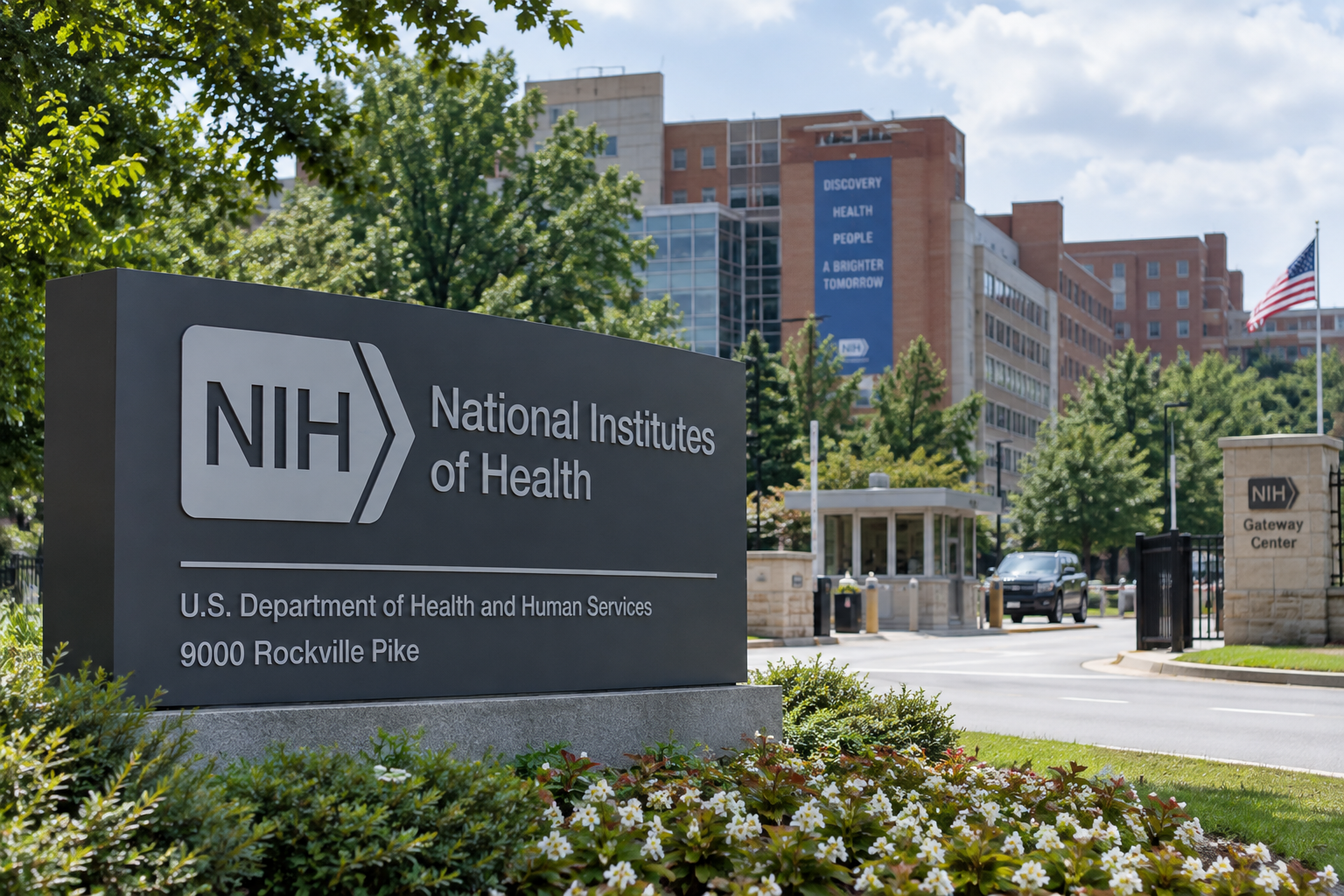
For decades, the National Institutes of Health has relied on scientists and medical experts to evaluate which research proposals deserve federal funding.
The Trump administration is considering a significant change to that system.
President Donald Trump has directed White House budget director Russell Vought to draft an executive order creating a new board that would decide which NIH grants receive funding, according to reporting by Politico cited by Reuters.
The proposed board would include Vought and NIH Director Jay Bhattacharya, and reportedly would have to reach unanimous agreement before grants could move forward.
That would place one of Trump's most powerful political appointees directly into decisions about how congressionally appropriated biomedical-research money is distributed.
And it comes against a political backdrop that has been building for years:
Republican battles with Dr. Anthony Fauci, NIH and the federal scientific establishment that became deeply politicized during the COVID-19 pandemic.
How NIH Research Funding Normally Works
NIH isn't simply a government office where someone looks at a stack of applications and chooses which projects sound interesting.
It operates an extensive peer-review system.
According to NIH's own current guidance, competing grant applications generally undergo two levels of review.
First, scientific review groups — composed primarily of scientists with expertise in relevant fields — examine the scientific and technical merit of proposals.
Reviewers evaluate factors such as the importance of the research, the investigators, methodology and potential impact.
A second level of review considers whether projects fit the missions and priorities of individual NIH institutes and centers.
The stated objective is straightforward:
Research proposals should receive fair, independent and expert scientific review free from inappropriate influence.
The proposed Trump administration system would add a potentially powerful new layer to that process.
Enter Russell Vought
Russell Vought isn't a physician.
He isn't a biomedical researcher.
He isn't an epidemiologist.
He is Trump's director of the Office of Management and Budget.
Under the proposal reported this weekend, Vought would nevertheless receive a direct role in determining whether NIH research grants move forward.
Because the proposed board reportedly would require unanimous approval, Vought's opposition could potentially prevent funding from proceeding even after a proposal had gone through NIH's scientific-review process.
The precise mechanics remain uncertain because the executive order is still being drafted.
But the basic change would be substantial.
A political appointee inside the White House would gain considerably more influence over money Congress appropriated for biomedical research.
The Administration Says NIH Needs Reform
The Trump administration has a different interpretation of what is happening.
It argues that federal research spending has supported misguided priorities and that reforms are necessary to ensure taxpayers finance rigorous science rather than ideological projects.
That argument has already resulted in significant changes.
Since returning to office, the administration has frozen or canceled research grants at numerous institutions and targeted research associated with diversity, gender identity and other subjects it considers inconsistent with administration priorities.
The Supreme Court allowed the administration in 2025 to proceed with the termination of hundreds of millions of dollars in NIH grants involving DEI- and gender-related research while litigation continued.
So the administration's effort to reshape NIH funding isn't hypothetical.
It has already begun.
The proposed White House review board would take that effort considerably further.
Scientists Are Already Suing NIH
Just days before news of the proposed board emerged, scientists filed a class-action lawsuit accusing NIH of improperly screening research grants according to political criteria.
The lawsuit alleges that the agency uses a list containing 235 words and phrases to identify research for additional scrutiny.
Among the terms cited in the complaint are:
“gender.”
“Latinx.”
And “climate change.”
The plaintiffs allege that grants containing flagged terminology can face termination, rejection or demands that researchers modify their proposals.
They argue that the process amounts to unconstitutional viewpoint discrimination.
NIH and the Department of Health and Human Services have declined to comment on the pending litigation.
The allegations therefore remain just that — allegations that will have to be resolved in court.
But their timing is significant.
Researchers are already challenging what they describe as political screening of scientific grants.
Now the administration is reportedly considering giving White House officials even greater authority over those grants.
Then There Is Anthony Fauci
It is difficult to understand the political history surrounding NIH without discussing Dr. Anthony Fauci.
Fauci directed the National Institute of Allergy and Infectious Diseases, part of NIH, from 1984 until his retirement in 2022.
During COVID-19, he became one of the most recognizable — and politically polarizing — public-health officials in America.
Republican lawmakers spent years investigating Fauci, NIH's funding of research involving EcoHealth Alliance and the Wuhan Institute of Virology, federal pandemic policies and Fauci's statements to Congress.
Those investigations raised legitimate oversight questions about research funding, federal records and NIH's supervision of grants.
They also became extraordinarily political.
In 2024, Fauci endured a two-day, roughly 14-hour closed-door congressional interview followed by a nationally televised House hearing.
Republican members accused him of misleading Congress, mishandling the pandemic and failing to properly oversee research funding.
Democrats accused Republicans of turning Fauci into a political target and argued that the investigation had failed to substantiate some of the more sweeping allegations against him.
The fight didn't disappear when Fauci retired.
It intensified.
Fauci Is Still Being Hauled Before Congress
In July 2026 — more than three years after leaving government — Fauci again appeared before Congress.
This time it was the Republican-led Senate Homeland Security and Governmental Affairs Committee.
Sen. Rand Paul, who has publicly battled Fauci for years, pressed him over COVID-19, research funding and the origins of the pandemic.
Fauci invoked his Fifth Amendment rights rather than answer questions.
Paul subsequently said the committee would consider holding him in contempt.
Republicans argued that Fauci still needed to answer for decisions made during the pandemic.
Fauci and his defenders characterized the continuing investigations as politically motivated.
Whatever one's view of that dispute, one fact is difficult to miss:
Years after COVID-19 ceased dominating everyday American life, Fauci remains a recurring subject of Republican congressional investigations and political rhetoric.
Trump Personally Entered the Fauci Fight
Trump's own conflict with Fauci dates to the pandemic.
The two publicly disagreed during Trump's first administration over elements of the federal COVID response.
After returning to office in January 2025, Trump terminated federal security protection that Fauci had continued receiving because of threats against him.
Trump said former government officials could not expect taxpayers to provide security indefinitely and that Fauci could pay for private protection himself.
Fauci wasn't the only former official whose protection Trump ended, and Trump defended the decisions on financial and policy grounds.
But the action demonstrated that the political conflict surrounding Fauci had survived long after both men had left their original pandemic-era roles.
Trump was back in the White House.
Fauci was retired.
The fight continued.
From Fighting Fauci to Reshaping NIH
None of that proves that the proposed NIH grant board exists because of Anthony Fauci.
There is currently no evidence establishing that motive.
But the history matters.
For years, Republican lawmakers and Trump allies have questioned not merely Fauci personally, but the institutions and processes surrounding NIH research.
They have challenged how grants were awarded.
They have investigated what NIH-funded researchers were doing.
They have questioned whether federal health officials were sufficiently accountable.
And they have argued that the scientific bureaucracy sometimes operates with too little political oversight.
The new proposal represents a potential answer to those complaints.
Rather than simply investigate NIH after grants are awarded, political officials could obtain greater influence before the money goes out the door.
That is a fundamentally different kind of power.
The Question Is Bigger Than Fauci
Fauci is no longer running anything at NIH.
He retired four years ago.
The scientists submitting grant applications today aren't Anthony Fauci.
And the research potentially affected by changes to NIH funding stretches far beyond COVID-19.
NIH supports research involving cancer, Alzheimer's disease, heart disease, infectious diseases, mental health, diabetes, neurological disorders, rare diseases and thousands of other medical questions.
The agency describes itself as the world's largest public funder of biomedical research.
That is why the debate over this proposal matters beyond Washington's continuing political battles over COVID.
The central question is no longer whether Anthony Fauci made the right decisions during a pandemic.
It is:
Who should decide which scientific research America pays for?
Scientists chosen for their expertise?
NIH officials operating under congressionally established procedures?
Political officials accountable to an elected president?
Or some combination of all three?
The Trump administration argues that increased oversight can prevent taxpayer money from financing weak or ideologically driven research.
Its critics fear the opposite — that political officials could determine which scientific questions researchers are permitted to investigate with federal money.
Those are competing views of how government-funded science should operate.
A Much Larger Experiment
For years, Republicans investigated the decisions made by Fauci and NIH.
Now the administration is considering changing the system itself.
If the proposed executive order is ultimately signed as reported, Russell Vought wouldn't merely be reviewing the federal budget that funds NIH.
He could become directly involved in deciding which NIH grants receive money.
That would represent a significant shift from a system built primarily around scientific peer review toward one with substantially greater political oversight.
And the consequences wouldn't end with Donald Trump.
Once a president establishes that White House political officials should participate directly in approving individual scientific grants, that authority could potentially be available to future administrations with entirely different political priorities.
The debate, therefore, isn't simply about Trump.
It isn't simply about Republicans.
And despite years of political warfare surrounding him, it isn't really about Anthony Fauci anymore.
It's about whether America's system for deciding which medical research deserves federal support should become more directly controlled by the White House.