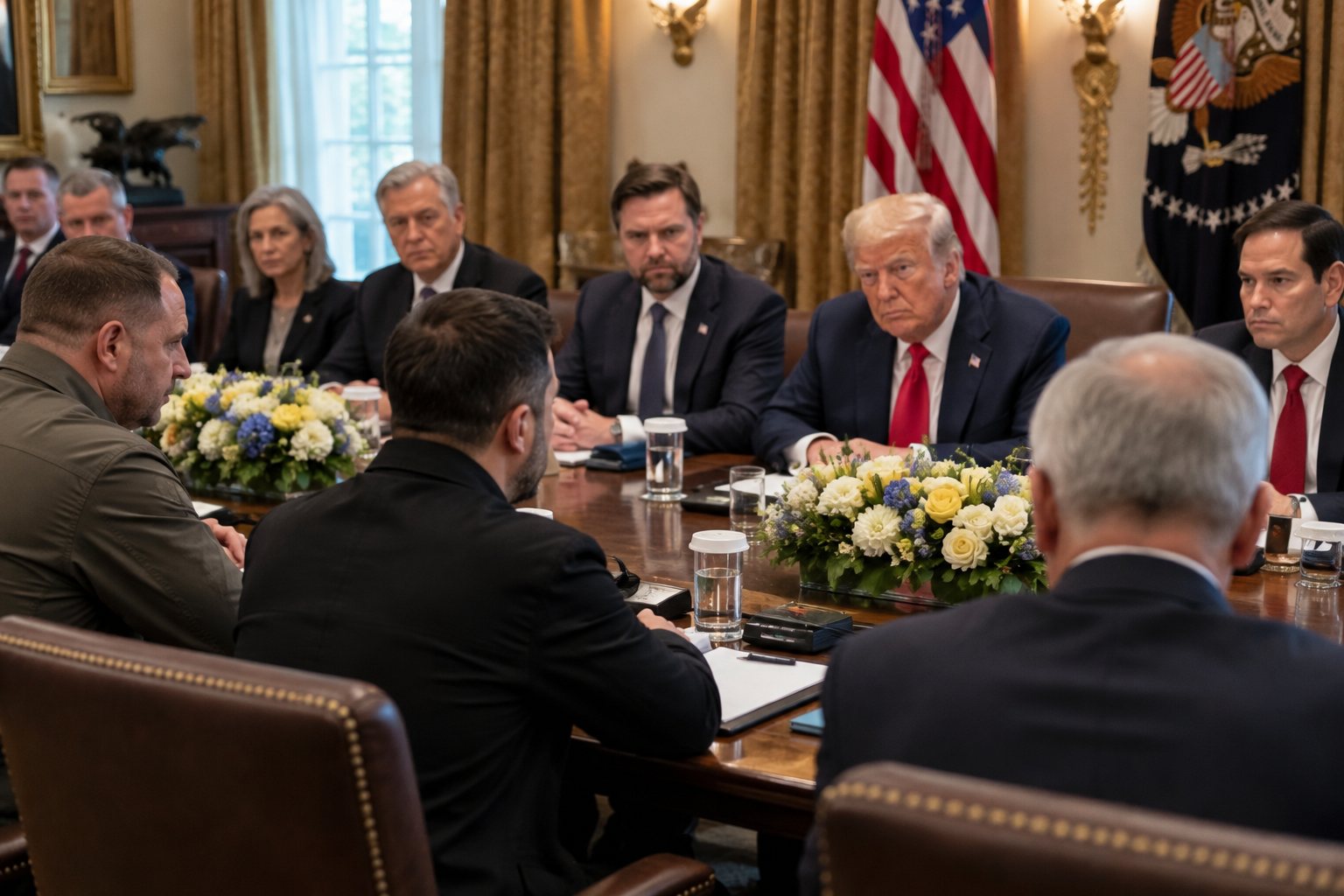
President Donald Trump welcomed Ukrainian President Volodymyr Zelenskyy to the White House on October 17, 2025, for what Ukrainian officials had hoped would be a breakthrough in securing American military support against Russia's continuing invasion.
Instead, Zelenskyy encountered a president whose priorities appeared to have shifted dramatically following a lengthy telephone conversation with Russian President Vladimir Putin the previous day.
Trump declined to commit to providing Ukraine with long-range Tomahawk cruise missiles, emphasized his desire to negotiate directly with Putin, and proposed ending the fighting along existing battlefield lines.
The proposal raised a fundamental concern: Freezing the war where Russian troops currently stood could leave Moscow in control of substantial portions of Ukrainian territory seized during its invasion.
For a president who repeatedly promised to end the war, the meeting exposed a difficult question about his approach to peace.
Was Trump prepared to increase pressure on the country that invaded Ukraine, or was he asking the invaded country to accept the consequences of Russian aggression?
The October 17 meeting offered little reassurance to Ukrainian officials seeking greater leverage against Moscow.
A Meeting That Changed After One Phone Call
In the days leading up to Zelenskyy's visit, the Ukrainian government had reason to believe that the United States might approve additional military assistance.
Trump had publicly discussed the possibility of providing Tomahawk missiles, sophisticated American weapons capable of striking targets deep inside Russian territory.
Ukraine viewed the missiles as a potentially important bargaining tool.
The ability to threaten military infrastructure and weapons production facilities far behind Russian lines could increase the costs of continuing the invasion.
Trump had even suggested that he might warn Putin that the missiles could be supplied unless Russia moved toward serious peace negotiations.
But on October 16, just one day before Zelenskyy's arrival, Trump held a lengthy telephone conversation with Putin.
Following that conversation, Trump announced plans for another summit with the Russian president, potentially in Budapest, Hungary.
The announcement immediately changed the diplomatic atmosphere surrounding Zelenskyy's visit.
Rather than arriving to discuss a possible expansion of American military support, the Ukrainian president found himself facing renewed American emphasis on negotiations with Moscow.
The timing was striking.
The country defending itself against invasion had been seeking additional weapons. The leader responsible for launching the invasion had just secured another direct conversation with the American president.
Putin Objects to Tomahawk Missiles
According to the Kremlin's account of the October 16 conversation, Putin warned Trump against supplying Tomahawk missiles to Ukraine.
Russian officials argued that the weapons would damage relations between Washington and Moscow and complicate efforts to negotiate an end to the war.
The warning was consistent with Russia's longstanding opposition to Western military assistance that increases Ukraine's ability to strike Russian military targets.
Tomahawks would represent a significant expansion of Ukraine's potential long-range strike capabilities.
Trump subsequently expressed reluctance to provide the missiles, citing American military stockpiles and the possibility of escalating the conflict.
The sequence did not establish that Putin controlled Trump's decision.
American presidents have legitimate reasons to consider weapons availability, escalation risks, and the consequences of introducing new military capabilities into an active war.
But the timing created an unavoidable diplomatic question.
Trump had discussed using Tomahawks as leverage against Putin. After speaking with Putin, he declined to make the commitment Ukraine wanted.
For Ukrainian officials, the result was a lost opportunity to strengthen their negotiating position.
For Moscow, it meant that a potentially significant new military threat had not materialized.
Zelenskyy Leaves Without the Weapons He Wanted
The White House meeting reportedly lasted approximately two and a half hours.
According to reporting by Axios, officials familiar with the discussion described it as tense and difficult.
Zelenskyy pressed for Tomahawk missiles and other weapons systems that Ukraine believed could help change the military and diplomatic balance.
Trump resisted those requests.
Sources briefed on the meeting said the president emphasized his preference for diplomacy and expressed concern that supplying the missiles could undermine negotiations with Russia.
The meeting ended without the weapons commitments Zelenskyy had sought.
Afterward, Zelenskyy acknowledged that the two leaders had discussed Tomahawks but indicated that they had agreed not to publicly detail the conversation.
When asked about the possibility of receiving the missiles, the Ukrainian president described himself as realistic.
The restrained response contrasted with the optimism Ukrainian officials had expressed before the meeting.
Zelenskyy had traveled to Washington seeking a stronger position against Russia.
He departed without the military commitments he wanted and with uncertainty surrounding Trump's next diplomatic moves.
Trump's Proposal Could Leave Russia Holding Ukrainian Territory
Following the meeting, Trump publicly called for Russia and Ukraine to stop fighting along their existing positions.
The proposal would effectively freeze the front lines while negotiations proceeded.
At first glance, a ceasefire might appear to offer an obvious humanitarian benefit.
Thousands of soldiers and civilians had been killed, and Ukraine's infrastructure had suffered extensive destruction since Russia launched its full-scale invasion in February 2022.
An immediate halt to the fighting could save lives.
But the territorial implications were substantial.
Russian forces occupied significant areas of internationally recognized Ukrainian territory, including Crimea, which Moscow illegally annexed in 2014, and portions of eastern and southern Ukraine.
A ceasefire along existing lines could leave those areas under Russian military control for an indefinite period.
That would not automatically mean Ukraine legally surrendered the territory or recognized Russian sovereignty over it.
Nevertheless, a prolonged freeze could allow Moscow to consolidate its control while leaving Ukraine divided.
The distinction between stopping the fighting and achieving a durable peace was central to the controversy.
A ceasefire might halt immediate bloodshed.
It would not, by itself, resolve the question of whether Russia should retain territory acquired through military aggression.
Who Was Being Asked to Make Concessions?
The underlying conflict began with Russia's decision to invade Ukraine.
Ukraine did not invade Russia in February 2022.
Russian forces crossed Ukraine's internationally recognized borders in an attempt to impose Moscow's objectives by military force.
That history matters when evaluating competing peace proposals.
A negotiated settlement may require difficult compromises from both sides.
But a proposal that freezes Russian territorial gains without requiring withdrawal raises questions about the incentives it creates.
If an invading country can retain occupied territory after a prolonged war, critics argue, the outcome risks rewarding the original aggression.
Trump's approach emphasized ending the fighting quickly.
Ukraine's position emphasized the need for security guarantees and sufficient military leverage to prevent Russia from using a ceasefire to prepare for future attacks.
Neither objective is trivial.
Ending the killing is urgent.
So is ensuring that any agreement does not simply postpone another invasion.
The challenge for Trump was demonstrating that his proposed negotiations could accomplish both.
Trump's Relationship With Putin Returns to the Spotlight
Trump's interactions with Putin had been controversial long before the October 2025 meeting.
During his first presidency, Trump frequently emphasized the value of maintaining a constructive relationship with the Russian leader.
His remarks at the 2018 Helsinki summit drew bipartisan criticism after he appeared to give considerable weight to Putin's denials of Russian election interference, despite findings by American intelligence agencies.
During the 2024 presidential campaign, Trump repeatedly claimed he could bring the Russia-Ukraine war to a rapid conclusion.
He presented his personal relationships with world leaders as an advantage in resolving international conflicts.
But by October 2025, Russia's invasion continued, and the administration had not secured a lasting peace agreement.
Trump's renewed engagement with Putin therefore invited scrutiny.
Diplomatic contact with an adversary is not inherently improper.
American presidents have negotiated with hostile governments throughout modern history.
The important questions concern the terms of those negotiations, the concessions being considered, and whether American policy gives each party meaningful incentives to compromise.
In the October 17 meeting, Ukraine was being urged to accept a ceasefire along existing lines while Russia faced no newly announced American military pressure comparable to the Tomahawk commitment Kyiv had sought.
That contrast became a central criticism of Trump's approach.
A Familiar Pattern of Pressure on Ukraine
The October 2025 meeting also recalled earlier tensions between Trump and Zelenskyy.
During Trump's first presidency, a 2019 telephone conversation with Zelenskyy became central to his first impeachment.
Trump had asked the Ukrainian president to pursue investigations involving political rival Joe Biden and his family while American military assistance to Ukraine was being withheld.
The House of Representatives impeached Trump on charges of abuse of power and obstruction of Congress.
The Senate subsequently acquitted him.
Trump denied wrongdoing.
The 2025 dispute was different in both its circumstances and the decisions involved.
Nevertheless, the history added significance to another high-profile encounter in which Ukraine sought American assistance while Trump pursued objectives of his own.
In February 2025, a contentious Oval Office meeting involving Trump, Vice President JD Vance, and Zelenskyy had already exposed serious disagreements over American support and Ukraine's diplomatic position.
By October, those tensions had not disappeared.
The latest meeting again demonstrated how dependent Ukraine's military and diplomatic position remained on decisions made in Washington.
Why Ukraine Wanted Tomahawks
Ukraine's interest in Tomahawk missiles was not simply a request for more powerful weapons.
The missiles represented a potential change in the strategic calculations facing Moscow.
With long-range precision-strike capabilities, Ukraine could threaten certain military facilities, logistics infrastructure, and weapons production sites located far from the front lines.
Ukrainian officials argued that such capabilities could increase pressure on Russia to negotiate.
The argument was based on leverage.
If Russia believed it could continue attacking Ukraine without facing significant new costs, Moscow might have little incentive to compromise.
If Ukraine gained the ability to impose additional military costs, negotiations could become more attractive to Russian leaders.
However, supplying Tomahawks would also involve genuine challenges.
The United States would need to consider its own stockpiles, launch systems, training requirements, and the possibility of Russian retaliation or escalation.
Those concerns deserved serious examination.
The central criticism of Trump's October 17 decision was not that every Ukrainian weapons request had to be approved.
It was that Trump appeared to abandon a potential source of pressure on Russia while simultaneously encouraging a ceasefire that could preserve Russian territorial gains.
European Allies Respond to the Meeting
Following the White House discussions, Zelenskyy spoke with European leaders about the outcome.
According to contemporary reporting, some European officials were surprised by Trump's apparent change in direction after his conversation with Putin.
European governments continued to emphasize support for Ukraine and the importance of protecting its sovereignty.
The United Kingdom and other allies explored diplomatic approaches that could support negotiations without abandoning Ukraine's security interests.
European leaders faced a difficult balancing act.
They wanted an end to the war, but they also feared that an agreement lacking credible security guarantees could leave Ukraine vulnerable to renewed Russian attacks.
A settlement that merely paused the fighting would not necessarily provide the stability that Europe and Ukraine needed.
The uncertainty surrounding American policy complicated those discussions.
Trump's Argument: End the Killing
Trump defended his approach by emphasizing the human cost of the war.
He argued that both sides should stop fighting and that diplomacy offered the best opportunity to end the bloodshed.
His reluctance to provide Tomahawks also reflected concerns about military escalation and preserving American weapons supplies.
Those considerations were not without merit.
The war had caused enormous casualties, displaced millions of people, and created continuing risks of escalation between Russia and Western countries.
A negotiated settlement could offer substantial humanitarian benefits if it produced a durable and enforceable peace.
But critics questioned whether Trump's strategy offered sufficient pressure on Moscow to make such a settlement possible.
Russia had already demonstrated a willingness to continue the war despite extensive casualties and economic costs.
Putin had repeatedly maintained demands that Ukraine and its allies considered unacceptable.
Without additional pressure or credible security guarantees, a ceasefire could leave the underlying causes of the conflict unresolved.
The central issue was not whether peace was desirable.
It was whether Trump's proposed path would produce lasting peace or merely suspend the war on terms advantageous to Russia.
The Difference Between Ending a War and Rewarding an Invasion
A successful peace agreement must address more than the immediate cessation of fighting.
It must establish conditions under which the parties have sufficient reason to comply.
For Ukraine, that means credible protection against another Russian attack.
For Russia, it means accepting limits on the military objectives it can achieve through force.
For the United States and its European allies, it means preserving regional stability and discouraging future wars of territorial conquest.
Trump's October 17 proposal left many of those questions unanswered.
He wanted the fighting to stop.
But the public details of his approach did not explain how Ukraine would regain occupied territory, what security guarantees it would receive, or what consequences Russia would face if it resumed military operations.
Nor did the meeting produce the additional weapons commitments Ukraine had sought to strengthen its position.
That combination created the appearance of an uneven negotiating process.
The country that launched the invasion retained occupied territory.
The country defending itself was asked to consider freezing the battlefield.
And the American president declined, at least for the moment, to provide a weapon that Ukrainian officials believed could increase pressure on Moscow.
October 17, 2025: A Revealing Diplomatic Turning Point
The White House meeting ended without a breakthrough.
Zelenskyy did not receive the Tomahawk commitment he wanted.
Trump renewed his emphasis on negotiations with Putin.
And the American president publicly advocated a ceasefire along existing front lines.
The events did not prove that Trump was secretly coordinating with Moscow or that Putin controlled American foreign policy.
They did, however, establish a sequence of decisions that warranted scrutiny.
Trump had considered using long-range weapons as leverage against Russia.
Putin objected to those weapons during a telephone conversation.
Trump subsequently declined to commit to providing them and emphasized a diplomatic settlement that could leave Russian forces in control of occupied Ukrainian territory.
For Ukraine, the immediate result was disappointment and uncertainty.
For Russia, the prospect of facing American-supplied Tomahawk missiles had receded.
For Trump, the meeting highlighted the difficulty of reconciling his promise to end the war with the competing demands of peace, deterrence, and Ukrainian sovereignty.
The central question left unanswered on October 17 was whether Trump's diplomacy would compel Russia to end its aggression—or whether Ukraine would be expected to accept the territorial consequences of that aggression in the name of peace.
A ceasefire can stop the shooting.
Whether it produces a just and lasting settlement depends on what happens next.