Less than thirty days before the 2026 midterm elections, Donald Trump is confronting some of the worst polling of his political career.
His approval rating has fallen to 32 percent in the latest Reuters/Ipsos poll.
Democrats lead Republicans 44 percent to 37 percent among registered voters.
Republicans are suddenly fighting to defend Senate seats in states Trump carried comfortably two years ago, while Democrats have expanded the House battlefield into territory that wasn't supposed to be competitive.
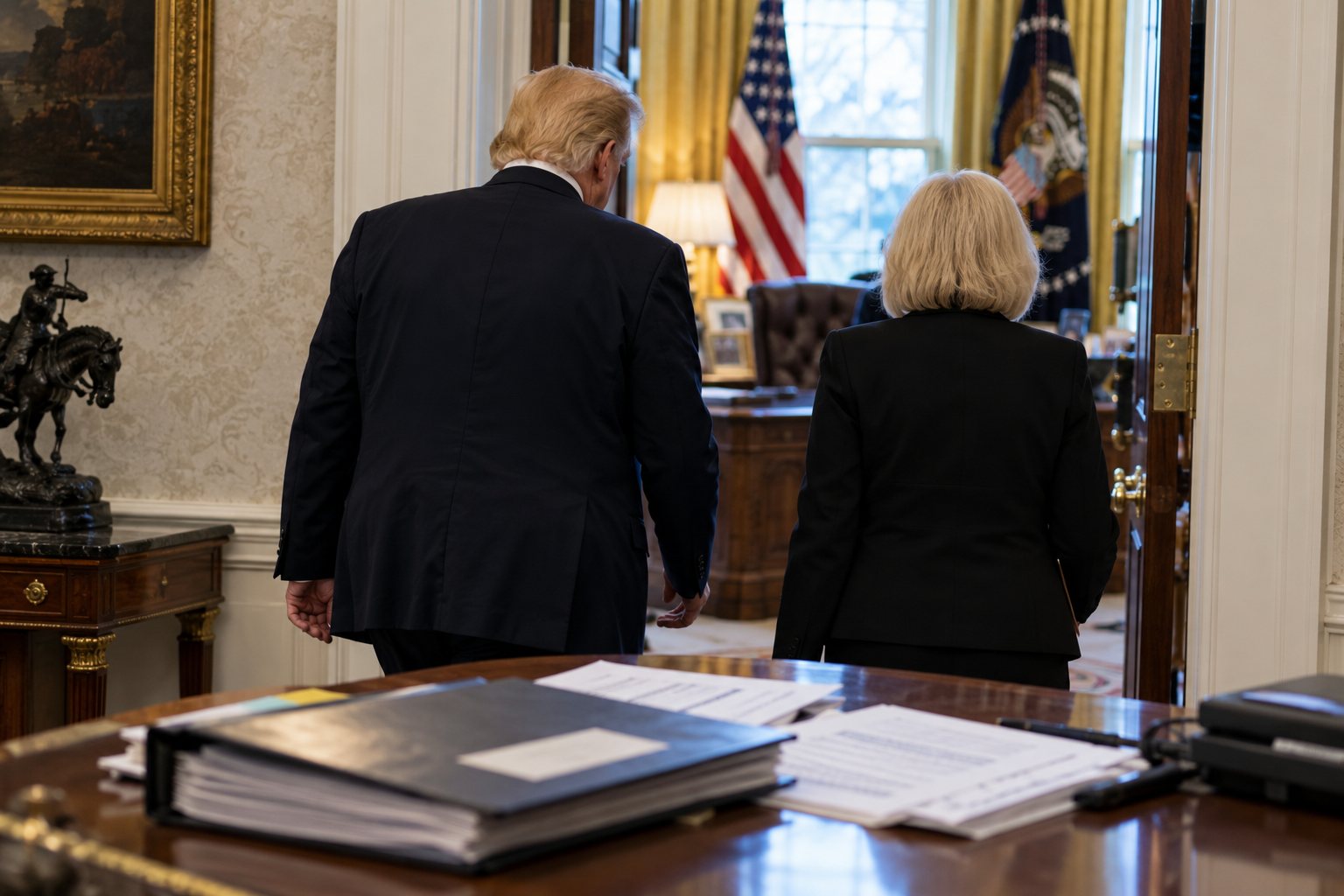
And amid all of that, Trump apparently decided this was a good time to invite Tina Peters into the Oval Office to discuss America's elections.
Not just elections.
According to former Trump Justice Department official Ed Martin, Peters and Trump were discussing “the plans.”
That's an extraordinary choice of words considering who Tina Peters is.
Tina Peters Isn't Simply an “Election Skeptic”
Peters is the former Republican clerk of Mesa County, Colorado.
After Trump lost the 2020 presidential election, Peters embraced claims that voting machines had been manipulated.
She didn't simply post about those suspicions on social media.
Prosecutors said Peters participated in a scheme that allowed an unauthorized person access to secure election equipment during a trusted software update and facilitated copies of voting-system hard drives.
A Colorado jury convicted her in 2024 of multiple crimes.
She was initially sentenced to nearly nine years in prison.
Her convictions survived appeal, although an appeals court later ordered her resentenced because it found problems with the original sentencing process.
Colorado Gov. Jared Polis eventually commuted her sentence, and Peters was released from prison in June 2026.
Trump had spent months publicly demanding her release and even purported to pardon her, despite presidents having no constitutional authority to pardon state crimes.
Now Peters has made it all the way from a Colorado jail cell to the Oval Office.
“They Were Talking About the Plans”
Martin revealed the meeting Monday during an appearance on Eric Bolling's program.
He said Peters had been in the Oval Office just hours earlier meeting with Trump about “election integrity.”
Then came the remarkable part.
According to Martin:
“They were talking about the plans.”
Exactly what those plans involve remains unclear.
There is no evidence that Trump and Peters discussed illegally interfering with the midterm election, changing vote totals or preventing legitimate votes from being counted.
But Peters has hardly been quiet about what she wants the federal government to do.
She has promoted a “100-Day Risk Mitigation Election Plan” calling for sweeping changes to election procedures, including moving away from ballot-marking devices, expanding hand-marked paper ballots and requiring a full hand count of federal ballots before certification.
Peters has also argued publicly that Trump should use executive authority to eliminate voting machines and mail-in ballots and has advocated greater federal involvement in elections traditionally administered by states.
Martin suggested Monday that Trump may act if Congress does not approve election legislation sought by the administration.
“If the Congress won't pass the SAVE America Act, and they won't,” Martin said, “then the president's going to have to do what he's going to do.”
That statement becomes considerably more consequential when made immediately after revealing that Trump and Peters were discussing “the plans.”
We've Seen This Movie Before
The reason the meeting deserves scrutiny isn't simply Tina Peters.
It is Trump's history following the 2020 election.
Trump claimed repeatedly that massive election fraud had stolen the presidency from him.
Those claims failed in court after court.
His Justice Department found no fraud on a scale capable of changing the election.
Nevertheless, Trump and people around him pursued multiple strategies attempting to prevent Joe Biden's victory from becoming final.
One involved alternate slates of Republican electors in states Biden had won.
Republicans in seven states signed certificates purporting to cast electoral votes for Trump.
The effort subsequently produced criminal investigations and prosecutions across several states.
Some of those cases have since been dismissed or remain unresolved, and people charged in them are entitled to the presumption of innocence.
But others resulted in guilty pleas.
Sidney Powell Pleaded Guilty
Former Trump attorney Sidney Powell became one of the most recognizable promoters of Trump's claims that voting machines had secretly manipulated the election.
She promised explosive evidence.
It never materialized.
In Georgia's election-interference prosecution, Powell eventually pleaded guilty in 2023 to six misdemeanor counts of conspiracy to commit intentional interference with the performance of election duties.
She received probation and agreed to cooperate with prosecutors.
Kenneth Chesebro Pleaded Guilty
Trump campaign attorney Kenneth Chesebro played an important role in developing the alternate-elector strategy.
He too was charged in Georgia.
Chesebro pleaded guilty in 2023 to conspiracy to commit filing false documents and agreed to cooperate with prosecutors.
That means two attorneys associated with Trump's effort to challenge the 2020 result didn't merely face accusations.
They pleaded guilty.
Fake Electors Faced Criminal Cases Across the Country
The alternate-elector effort wasn't confined to Georgia.
Republicans claiming to be legitimate Trump electors signed certificates in seven states Trump had lost.
Criminal cases followed in Arizona, Michigan, Nevada and other states, although the legal landscape has changed considerably since then.
Some cases have been dismissed.
Others continue.
Arizona prosecutors, for example, dismissed their original case in June 2026 while announcing their intention to seek new indictments. The defendants—including former Trump associates Rudy Giuliani and Mark Meadows—denied wrongdoing.
Whatever ultimately happens in those individual prosecutions, the underlying historical fact remains:
After losing the 2020 election, Trump and his allies pursued an organized effort to substitute Republican electoral votes in states officially won by Biden.
Rudy Giuliani's Election Claims Cost Him Dearly
Then there is Rudy Giuliani.
Giuliani became one of Trump's loudest promoters of election-fraud accusations after the 2020 election.
Two Georgia election workers, Ruby Freeman and Shaye Moss, sued him after he falsely accused them of participating in election fraud.
A federal jury ordered Giuliani to pay approximately $148 million in damages.
The women weren't election criminals.
They were election workers falsely accused of crimes.
Giuliani eventually reached a settlement with them in 2025.
The episode is an important reminder of what happened after 2020: claims of enormous election fraud were broadcast to millions of Americans, while some of the people accused of committing that fraud were themselves innocent.
Trump Has His Own History With Fraud Cases
Trump's legal history extends beyond elections.
In New York, Attorney General Letitia James brought a civil fraud case accusing Trump, his company and executives of repeatedly inflating the value of assets in financial statements.
A judge found Trump liable for fraud before trial.
The case ultimately produced a massive financial judgment against him, although subsequent appeals significantly changed the monetary consequences while leaving the underlying fraud finding intact.
Trump denied wrongdoing and repeatedly characterized the case as politically motivated.
Trump's company has also encountered criminal consequences.
The Trump Organization was convicted in New York in 2022 of tax fraud and related offenses involving an executive-compensation scheme.
Trump himself was not personally charged in that corporate tax-fraud case.
And in an entirely separate criminal prosecution, Trump was convicted in 2024 of 34 felony counts of falsifying business records involving reimbursement payments connected to the 2016 election.
Those cases involve different laws, different conduct and different standards of proof.
They shouldn't be casually lumped together as though they are the same crime.
But they are relevant when a president who has spent years alleging massive fraud by his opponents surrounds himself with people who have themselves been convicted, pleaded guilty or faced substantial legal consequences arising from election-related conduct and other forms of deception.
And Now Tina Peters Is in the Oval Office
That brings us back to Monday.
Tina Peters isn't sitting outside the political system posting conspiracy theories online.
She reportedly sat inside the Oval Office with the president of the United States.
Discussing election integrity.
Discussing “the plans.”
And this isn't happening two years before an election.
It is happening less than thirty days before Americans vote.
The Political Timing Could Hardly Be Worse
Trump's political position makes the meeting even more striking.
Reuters/Ipsos now has Trump's approval rating at just 32 percent, the lowest measured by that poll during his political career.
His disapproval rating stands at 65 percent.
Among registered voters, Democrats lead Republicans 44 percent to 37 percent in the congressional vote.
Other polling also shows Democrats with substantial generic-ballot advantages.
The Senate map has expanded dramatically.
Democrats are competitive in Texas.
They're competitive in Alaska.
They're competitive in Ohio.
Polling has even shown close contests in Iowa and Kansas.
In the House, Democrats have expanded their list of targets as Trump's low approval rating hangs over Republican candidates.
None of this guarantees a Democratic victory.
Polls are snapshots, not election results.
Four weeks is enough time for campaigns to change.
Turnout matters.
Individual candidates matter.
And Republicans retain structural advantages in several races.
But there is no reasonable way to describe the current environment as good for Republicans.
They are badly losing in the polls.
And the possibility of a Republican midterm bloodbath has become a legitimate concern for a party that entered 2026 controlling the White House and Congress.
Trump Is Already Questioning the Election System
Against that backdrop, Trump is again attacking mail voting and raising doubts about election security.
He continues alleging vulnerabilities in voting systems despite repeated findings that widespread fraud is exceedingly rare.
Ironically, Trump has simultaneously encouraged his own supporters to vote by mail when convenient.
His administration has also pushed election-related measures involving proof of citizenship, voter databases and federal oversight while election officials and voting-rights organizations have questioned whether some proposals could improperly interfere with state-run elections.
Now add Tina Peters to that picture.
A former county election official convicted of crimes arising from unauthorized access to election equipment is meeting privately with the president.
She has already proposed major changes to how the midterms should be conducted.
She has publicly advocated presidential intervention.
And one of Trump's allies emerged from the meeting saying they were discussing “the plans.”
The Question Isn't Whether Trump Has Already Done Something Illegal
There is currently no evidence that Monday's meeting itself involved a crime.
There is no evidence that Trump and Peters developed a plan to alter votes.
There is no evidence they agreed to prevent legitimate ballots from being counted.
Those distinctions matter.
But Americans shouldn't have to invent conspiracy theories to find this situation extraordinary.
The established facts are remarkable enough.
Donald Trump tried for years to overturn the public understanding of his 2020 defeat with claims of widespread fraud that were never substantiated.
People involved in efforts surrounding that election subsequently pleaded guilty to crimes.
Fake electors faced prosecutions in multiple states.
Election workers falsely accused of fraud won enormous judgments against Trump's former attorney.
And Tina Peters went to prison after being convicted of crimes connected to her own pursuit of supposed election fraud.
Now, with Trump's approval rating at a record low, Republicans trailing nationally and potentially facing enormous midterm losses, Peters has been welcomed into the Oval Office to discuss America's elections.
Less than thirty days before voting ends.
And according to Trump's own former Justice Department official:
They were talking about “the plans.”
Given what happened after the last election Donald Trump feared he had lost, Americans have every reason to demand to know exactly what those plans are.