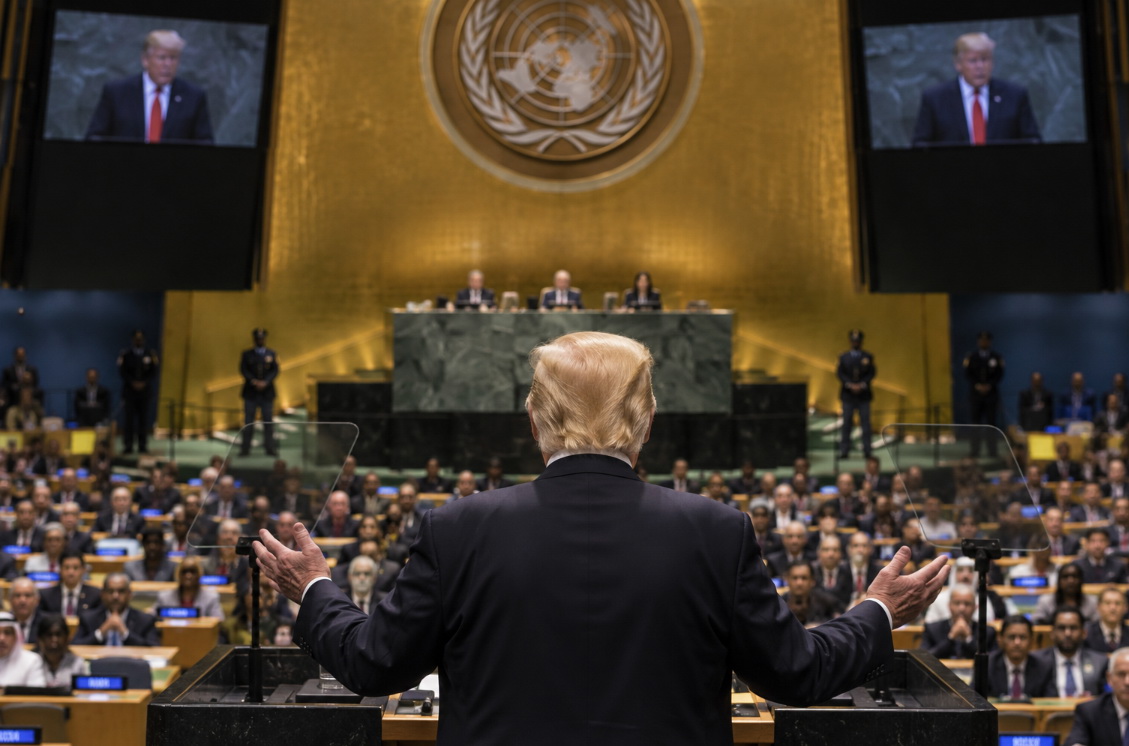
Donald Trump stood before world leaders at the United Nations on Tuesday and delivered a sweeping account of America, his presidency and his foreign-policy record.
There was one major problem.
A number of the claims he presented as fact were false, misleading, exaggerated or unsupported.
Independent fact-checkers examining Trump's address identified numerous problems with his statements — including familiar claims that he has repeated at rallies, press conferences and White House events.
This time, however, the audience wasn't a campaign crowd.
It was the United Nations General Assembly.
Here are some of the claims that did not survive scrutiny.
THE CLAIM: TRUMP HAS 'MADE PEACE'
Trump portrayed himself as a president who has succeeded where diplomats and previous administrations failed.
"While others have spoken of peace, I have made peace," Trump declared.
The reality is considerably more complicated.
Some diplomatic agreements and ceasefires have been reached during Trump's presidency, and his administration has participated in negotiations involving several international conflicts.
But describing that record simply as having "made peace" leaves out ongoing wars and unresolved disputes.
Most obviously, the United States is currently involved in a war with Iran — a conflict Trump spent a substantial portion of the same U.N. speech defending.
During the address, Trump even threatened to "annihilate" the Islamic Republic if an agreement cannot be reached.
That is difficult to reconcile with the sweeping picture of a world being brought to peace under his leadership.
THE CLAIM: AMERICA IS STRONGER THAN EVER
Trump opened his remarks by declaring that the United States is "stronger today than ever before."
That is political rhetoric, not a measurable factual conclusion.
America remains the world's largest economy by nominal GDP and possesses extraordinary military, technological and diplomatic power.
But "stronger than ever" cannot simply be established as fact.
The country also faces a national debt exceeding $40 trillion, major international conflicts, strained relationships with some traditional allies and continuing economic concerns at home.
Calling America stronger than at any previous point in its history is an opinion presented as a fact.
THE CLAIM: HIS ADMINISTRATION HAS VIRTUALLY STOPPED DRUGS ARRIVING BY SEA
Trump offered one of the speech's most striking numerical claims while discussing his administration's campaign against drug trafficking.
He claimed U.S. military operations had eliminated approximately 97 percent of drugs entering the United States by sea.
There is no reliable evidence establishing that figure.
Drug trafficking is inherently difficult to measure because authorities cannot count shipments they never detect.
Government seizure statistics can document drugs intercepted by authorities, but they cannot establish with precision what percentage of all maritime drug trafficking has been eliminated.
A claim as specific as 97 percent therefore requires evidence that has not been publicly demonstrated.
THE CLAIM: DRUG CARTELS ARE THE EQUIVALENT OF ISIS
Trump compared major drug cartels to ISIS while defending aggressive American action against trafficking organizations.
Cartels unquestionably engage in murder, kidnapping, extortion and other extreme violence.
But drug cartels and ISIS are fundamentally different types of organizations.
ISIS is an ideological terrorist organization seeking political and religious control.
Drug cartels are primarily criminal enterprises whose central purpose is making money through illegal markets.
Both can be extraordinarily violent.
Calling them equivalent, however, blurs important distinctions between terrorism, organized crime and insurgency.
THE CLAIM: THE UNITED NATIONS PROMOTES 'MASS MIGRATION'
Trump also attacked international organizations over immigration, accusing what he called "globalists" of promoting mass migration that destroys national cultures.
The United Nations does work extensively with refugees and migrants.
Its agencies provide humanitarian assistance to people displaced by war, persecution, famine and natural disasters.
That is not the same thing as advocating the destruction of national borders or encouraging unrestricted illegal immigration.
Trump turned a complicated international humanitarian system into a much broader political accusation.
THE CLAIM: ARTIFICIAL INTELLIGENCE SAFETY CONCERNS ARE A HOAX
Trump used the U.N. stage to announce that his administration would begin referring to artificial intelligence as "super intelligence."
He also dismissed many concerns surrounding AI regulation and safety.
But concerns about artificial intelligence are not inventions of Trump's political opponents.
Researchers, technology companies, governments and universities around the world are actively studying risks involving cybersecurity, misinformation, employment disruption, autonomous weapons, privacy and the possibility of increasingly powerful AI systems behaving unpredictably.
Experts disagree strongly about the severity and immediacy of some risks.
That debate is real.
Calling the broader subject a hoax does not make it one.
THE CLAIM: TRUMP HAS SOLVED PROBLEMS OTHERS COULD NOT
Throughout the speech, Trump repeatedly presented his presidency as uniquely successful at resolving problems previous leaders had allowed to fester.
There are legitimate accomplishments his administration can point to.
But several of the world's largest conflicts remain unresolved.
Russia's war with Ukraine continues.
The United States remains involved in the Iran war.
Tensions with Cuba remain intense.
Relations with several traditional American allies have been strained.
And Trump's own speech contained threats of additional military action.
That doesn't mean every Trump foreign-policy initiative has failed.
It does mean that presenting the administration as having solved decades of international problems is a substantial exaggeration.
THIS WASN'T A CAMPAIGN RALLY
American presidents have always used speeches to emphasize their accomplishments.
They select favorable statistics.
They frame events in ways that support their policies.
They take credit when things go well and assign blame when they don't.
But factual claims remain factual claims regardless of who makes them.
And several assertions in Trump's U.N. address went beyond ordinary political spin.
They were contradicted by available evidence, lacked evidence capable of supporting them, or transformed complicated subjects into sweeping declarations that did not accurately describe reality.
That matters even more when an American president is speaking internationally.
The audience Tuesday included presidents, prime ministers, diplomats and representatives of nearly every country on Earth.
Trump used that stage to tell them that America was stronger than ever, that he had made peace where others merely talked about it, that his administration had virtually eliminated maritime drug trafficking and that international institutions were threatening American sovereignty and culture.
Some of those statements were political opinions.
Some were exaggerations.
And some were simply not supported by the facts.
The setting didn't change that.
A false claim does not become true because it is delivered from behind the podium of the United Nations.