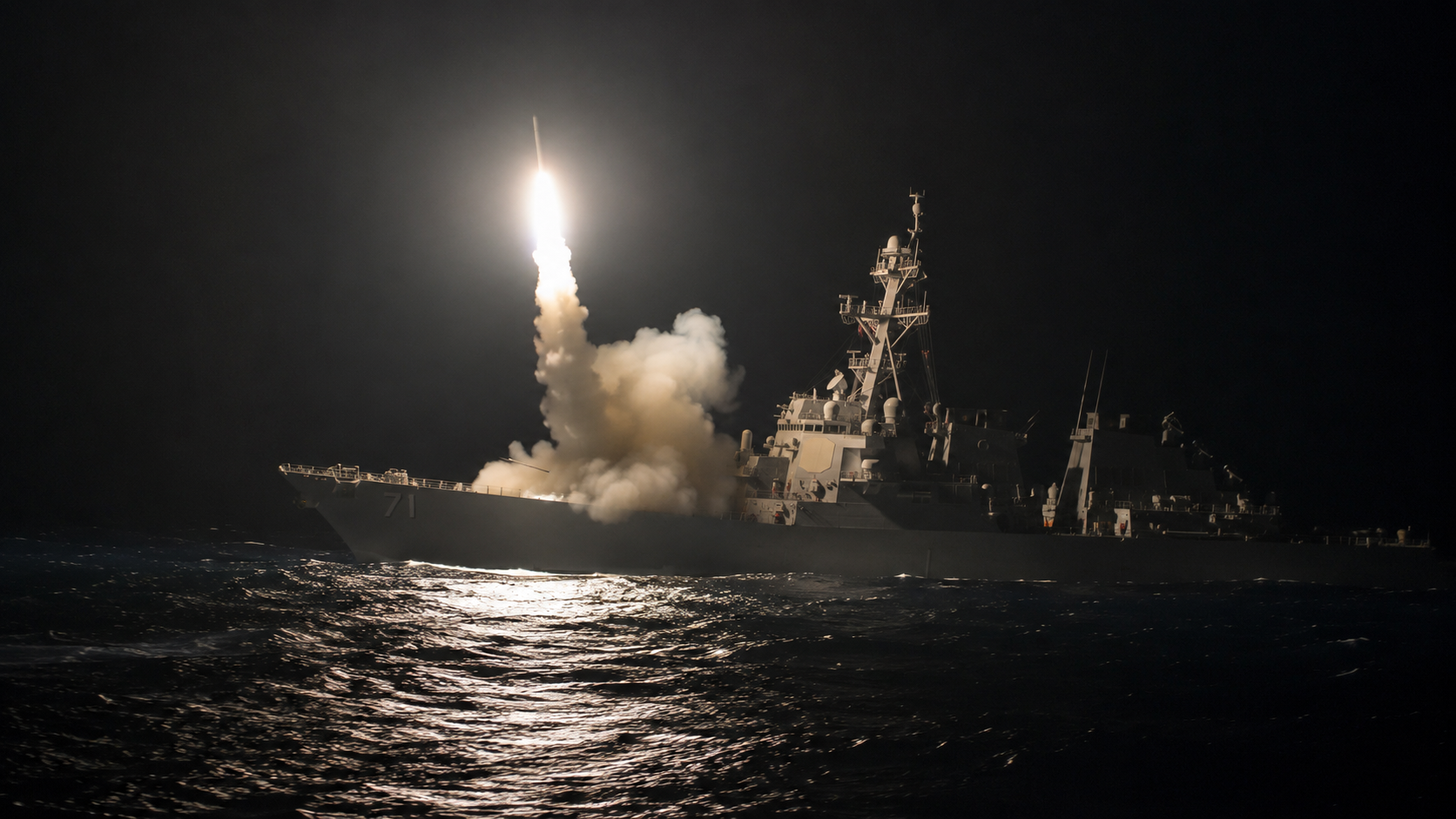
Less than three months into his presidency, Donald Trump ordered the United States military to launch dozens of cruise missiles at a Syrian government airfield, abruptly drawing Washington deeper into one of the world's most complicated wars.
The attack came in response to a devastating chemical-weapons attack two days earlier in Khan Shaykhun, a rebel-held town in Syria's Idlib province.
Men, women and children were exposed to the nerve agent sarin. Images of victims struggling to breathe and emergency workers attempting to treat the wounded spread around the world.
The Organisation for the Prohibition of Chemical Weapons would later confirm that sarin had been used. A subsequent United Nations-OPCW investigation concluded that the Syrian Arab Republic was responsible for the release.
59 Tomahawks
On the evening of April 6, Trump ordered the U.S. Navy to strike Shayrat Air Base in western Syria.
The destroyers USS Ross and USS Porter, operating in the eastern Mediterranean, launched 59 Tomahawk cruise missiles toward the base.
The Pentagon said the installation had been used by Syrian forces connected to the chemical attack.
The missiles targeted aircraft, hardened aircraft shelters, fuel and logistical facilities, ammunition bunkers, air-defense equipment and radar systems.
It was a major change in America's involvement in Syria.
The United States had already been conducting extensive military operations against ISIS, but the Shayrat attack represented the first deliberate American strike against forces belonging to Syrian President Bashar al-Assad's government.
Trump Says America Must Act
Trump argued that preventing the use and spread of chemical weapons was a vital American national-security interest.
Two days after the attack, he formally notified Congress that he had ordered the strike to degrade Syria's ability to conduct additional chemical attacks and discourage the Assad government from using chemical weapons again.
But the strike also raised an important question that would follow Trump's presidency: How much authority does a president have to launch military action without first obtaining authorization from Congress?
Trump relied on his constitutional authority as commander in chief rather than seeking a new congressional authorization specifically covering military action against the Syrian government.
The administration described the attack as limited and focused on deterring further chemical-weapons use.
A Dramatic Shift
The decision was particularly notable because Trump had campaigned on skepticism toward American military intervention overseas.
For years before becoming president, he had publicly warned against deeper American involvement in Syria.
Now, only 77 days after taking office, Trump had ordered American missiles fired directly at a sovereign government's military installation.
The contradiction highlighted a reality that would repeatedly confront the new administration: campaign promises about avoiding foreign conflicts could collide quickly with the decisions facing a president once in office.
The strike also risked confrontation with Russia, which was militarily supporting Assad.
U.S. officials notified Russia before the missiles were launched in an effort to reduce the possibility that Russian personnel would be killed and prevent the attack from escalating into a confrontation between Washington and Moscow.
What Did the Strike Accomplish?
Pentagon officials said approximately 20 Syrian aircraft were destroyed and that other equipment and infrastructure at Shayrat were damaged.
But the strike did not remove Assad from power, end the Syrian civil war or permanently eliminate Syria's ability to conduct military operations.
It was instead intended as a warning.
And Syria's chemical-weapons problem did not disappear.
Almost exactly one year later, another suspected chemical attack in Douma would trigger another military response from Trump — this time involving the United States, Britain and France.
The April 2017 attack therefore became something larger than a single night of missile launches.
It marked the moment when a president who had repeatedly criticized American intervention in Middle Eastern conflicts ordered his first major military action — and demonstrated how quickly the United States could become more deeply involved in a war Trump had once argued America should stay out of.
Category: Foreign Policy / National Security
Tags: Donald Trump, Syria, Bashar al-Assad, Shayrat Air Base, Tomahawk Missiles, Khan Shaykhun, Chemical Weapons, U.S. Military, Foreign Policy, 2017