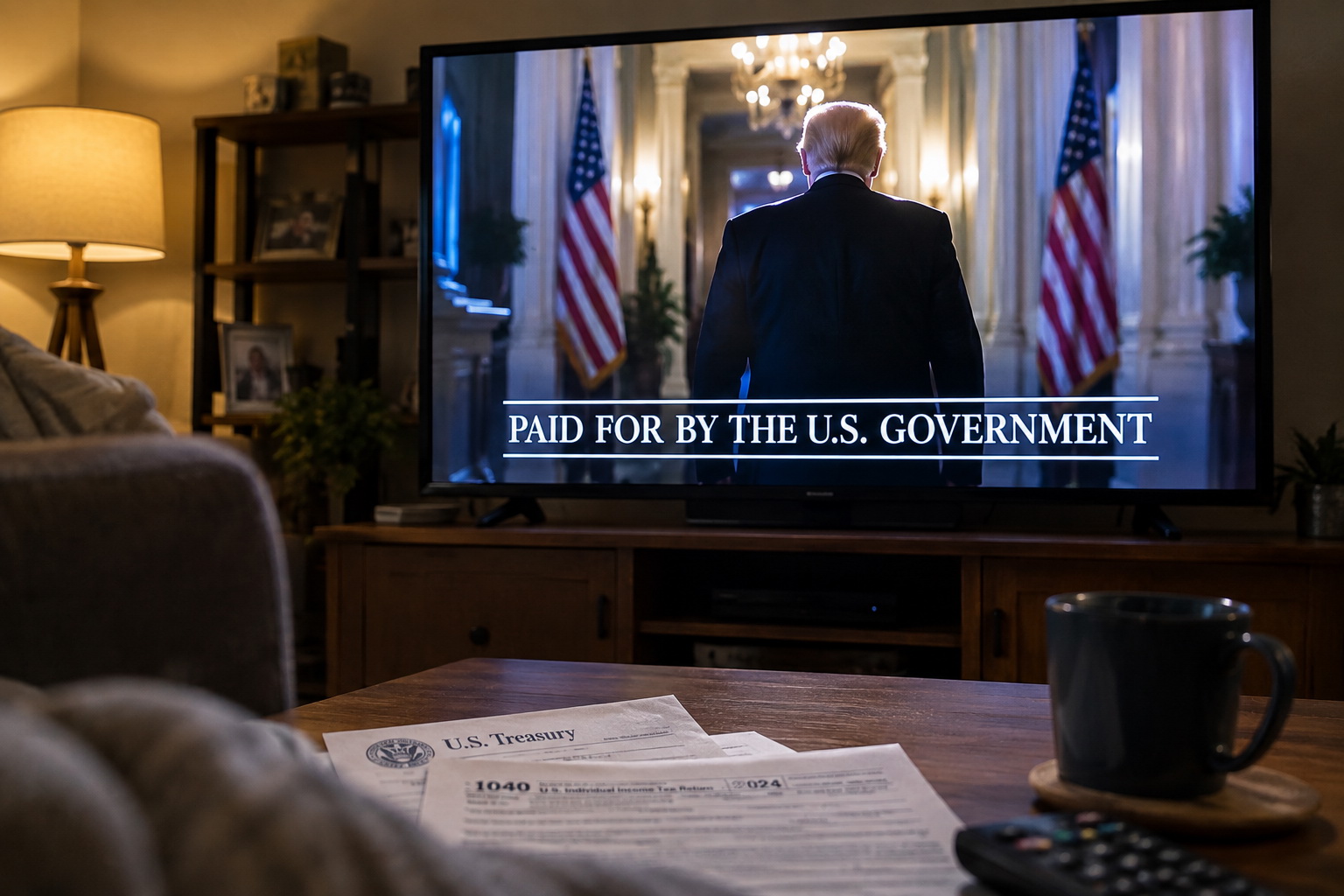
Donald Trump has hundreds of millions of dollars available through Republican political organizations to promote himself and his agenda.
But weeks before the 2026 midterm elections, Americans are seeing Trump-focused television advertisements paid for another way:
By the United States government.
And newly reported federal spending records raise an even bigger question about the campaign.
The Department of Homeland Security awarded a $20 million contract for a “national media campaign” after federal officials moved money into an account designated for “commemorative events.”
Congress had described that money as funding for things such as memorials for officers killed in the line of duty, department anniversaries and commendation ceremonies.
Instead, Americans turning on their televisions are seeing advertisements featuring Donald Trump.
Every one ends with an extraordinary disclaimer:
“Paid for by the U.S. Government.”
The Money Trail
The sequence happened remarkably quickly.
On September 19, the White House Office of Management and Budget increased a Department of Homeland Security budget account for “commemorative events” by $20 million.
The following day, DHS awarded Maryland advertising firm LMD Agency a $20 million contract for what federal contracting records described as a “national media campaign.”
Days later, the Trump advertisements began appearing on television.
DHS and OMB had originally planned to spend approximately $1 million on commemorative events.
The additional money came from a much larger pool of Customs and Border Protection funding approved by Congress.
That funding had specified purposes including inspection equipment at ports of entry, air and marine operations, border surveillance technology, biometric systems, screening at the border and enhanced efforts against drug trafficking.
Now some of that money has been redirected into the account being used for the advertising campaign.
One Ad Is Almost a Trump Campaign Commercial
Calling these advertisements ordinary government public-service announcements becomes especially difficult when looking at one of them.
The advertisement features black-and-white footage of Trump walking through a hallway while delivering familiar political rhetoric.
Trump promises a “final battle” against what he calls the “deep state,” “globalists,” “warmongers” and a “sick political class.”
He also attacks the news media.
If it sounds like a Trump campaign advertisement, there is a reason.
It is nearly identical to an advertisement produced for Trump's 2024 presidential campaign.
The biggest difference is at the end.
The old version was political advertising.
The new version says:
“Paid for by the U.S. Government.”
Trump Reportedly Picked the Ads Himself
The advertisements weren't simply created somewhere deep inside a federal agency.
Axios reported that Trump personally became involved in selecting them.
According to the report, the White House digital team had been producing aggressive social-media videos similar to political campaign material.
Trump liked them.
He posted some on Truth Social.
Then he decided he wanted them on television.
Trump reportedly selected the videos he wanted aired.
The Department of Homeland Security handled the advertising purchases.
The result is an unusual arrangement in which the sitting president reportedly chose promotional videos featuring himself and the federal government paid to broadcast them nationally.
They're Showing Up During Football Games
This isn't a small government information campaign buried on an agency website.
The advertisements have aired thousands of times.
They have appeared on broadcast television, cable networks and streaming services.
They have run during NFL games.
They have appeared during college football.
They have aired during Saturday Night Live.
AdImpact estimated earlier this week that the government had already spent at least $2.5 million airing the advertisements, and administration officials have indicated that more are coming.
“This is just the beginning,” an administration official told Axios.
Even Republicans Are Objecting
Criticism isn't coming exclusively from Democrats.
Senate Majority Leader John Thune, a Republican from South Dakota, said he liked the message of the advertisements but objected to how they were financed.
His distinction was simple:
The message was fine.
Taxpayers shouldn't be paying for it.
Republican Senator John Kennedy of Louisiana made essentially the same argument, saying public officials shouldn't spend public money promoting themselves.
Senator Mike Rounds, another Republican, also said it wasn't something he would have done.
That bipartisan criticism matters because this isn't fundamentally a dispute over whether someone likes Donald Trump.
The question is whether presidents should be allowed to use government money to advertise themselves.
The White House Says They're Public Service Announcements
The White House rejects the criticism.
Administration officials describe the commercials as public-service announcements promoting patriotism.
They point out that Trump isn't personally on the ballot in November and that the advertisements don't explicitly tell viewers to vote Republican.
The White House has also cited government-funded advertising campaigns under previous presidents.
Those comparisons aren't entirely without precedent.
Republican and Democratic administrations have spent taxpayer money advertising government programs.
George W. Bush's administration promoted Medicare prescription-drug coverage.
Barack Obama's administration promoted enrollment under the Affordable Care Act.
Joe Biden's administration funded advertisements encouraging COVID vaccinations.
Governments routinely spend money telling citizens about programs and services.
The dispute is over whether these Trump advertisements serve the same purpose.
What Is the Public Service?
That's where the comparison becomes difficult.
An advertisement telling seniors how to obtain Medicare benefits has an identifiable government service.
An advertisement telling Americans where to receive a vaccine has one too.
An advertisement explaining how to enroll in health insurance provides citizens with information they can use.
What government service is provided by a president promising to defeat “globalists,” “the deep state” and the “sick political class”?
That's the question ethics experts are asking.
Federal appropriations laws have long prohibited government money from being used for “publicity or propaganda purposes.”
The Government Accountability Office has interpreted those restrictions to include communications that are purely partisan or designed to benefit a political party or candidate.
Several legal experts have said the Trump advertisements may cross that line.
That hasn't yet been established by a court or definitive government ruling.
But the resemblance between at least one taxpayer-funded advertisement and Trump's own 2024 campaign commercial makes the legal question difficult to dismiss.
Congress Is Asking Where the Money Went
Democratic lawmakers are now demanding an investigation.
Senators Patty Murray and Chris Murphy have asked DHS to disclose exactly how much taxpayer money has been spent, which accounts supplied it, what contracts were issued and whether government attorneys reviewed the advertising campaign beforehand.
House lawmakers have separately requested a Government Accountability Office investigation.
They argue the campaign could implicate several federal restrictions, including laws governing political activity by federal employees and congressional control over appropriated funds.
Whether investigators ultimately conclude those laws were violated remains to be seen.
But Congress now has a straightforward accounting question to answer:
Why was money appropriated for Homeland Security being used to purchase television advertisements promoting the president?
Trump Didn't Need Taxpayer Money
Perhaps the strangest part of the story is that Trump and his political allies weren't desperate for advertising money.
Republican-aligned organizations already have enormous financial resources available for the midterms.
Trump-linked political organizations have hundreds of millions of dollars available.
Those organizations are legally allowed to purchase political advertising.
They can praise Trump.
They can attack Democrats.
They can promote Republican candidates.
They can broadcast Trump's “final battle” message as often as their money allows.
That's how American political advertising normally works.
Campaign money pays for campaign ads.
Government money pays for government business.
The controversy surrounding Trump's new advertisements exists because that line has become increasingly difficult to see.
One Disclaimer Says It All
Americans have seen countless political advertisements featuring Donald Trump.
They have seen Trump walking through dramatic hallways.
They have heard him attack globalists, the media and the political establishment.
They have heard him promise to destroy the deep state.
None of that is new.
What is new is the sentence appearing at the end:
“Paid for by the U.S. Government.”
That means the person watching the advertisement helped pay for it.
Democrat.
Republican.
Independent.
Trump supporter.
Trump opponent.
Everyone.
And just weeks before Americans vote in a national midterm election, that raises a question far larger than the $20 million contract behind the campaign:
Should any president be able to turn the federal government's advertising budget into a vehicle for promoting himself?