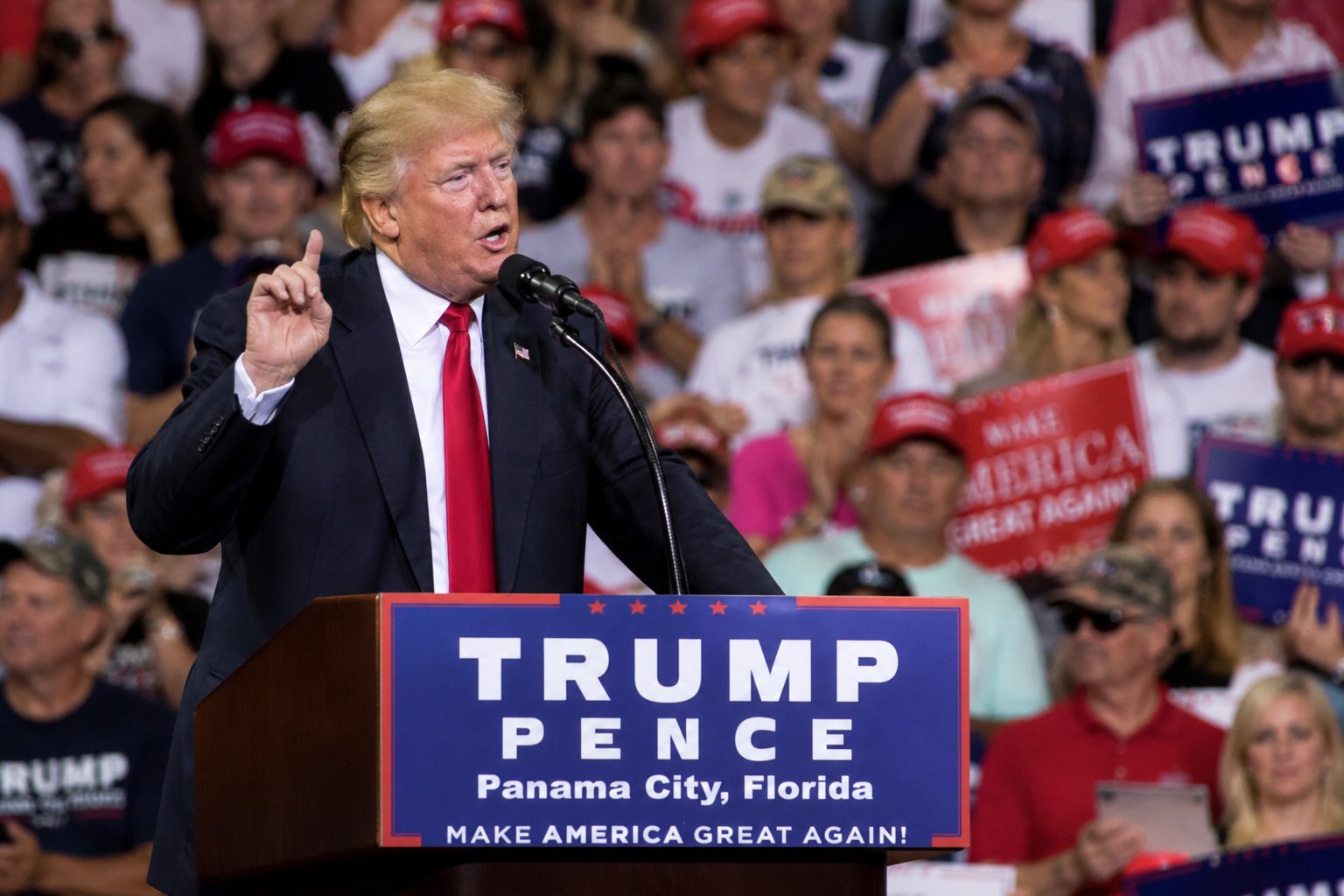
Twenty-eight days before the 2016 presidential election, Donald Trump was already preparing his supporters to distrust the system that would determine the winner.
At a campaign rally in Panama City, Florida, on October 11, Trump repeatedly portrayed the political process surrounding the election as “rigged” against him.
“The media's rigged,” Trump told the crowd.
Later, discussing hacked Democratic emails released by WikiLeaks, Trump returned to the same theme, describing the media as an extension of Hillary Clinton's campaign and saying it was “just one more way that the system is rigged.”
Those remarks came only one day after Trump had gone considerably further at rallies in Pennsylvania.
“We don't want this election stolen from us,” Trump had warned supporters.
It was not an isolated line.
It was becoming a central part of his closing argument.
“We Don't Want This Election Stolen”
On October 10, campaigning in Ambridge, Pennsylvania, Trump urged his supporters not only to vote but to watch what was happening elsewhere.
“So important that you watch other communities,” he said, “because we don't want this election stolen from us.”
Later that day in Wilkes-Barre, Trump specifically raised suspicions about Philadelphia.
He said he had heard troubling reports about the city and warned that the vote needed to be watched carefully.
Trump did not present evidence showing that Philadelphia officials were preparing to steal the election.
But the implication was unmistakable: his supporters should be prepared for the possibility that legitimate-looking election results could actually be fraudulent.
By the time Trump arrived in Florida the following day, the rhetoric had expanded into a broader argument.
The media was rigged.
The political establishment was rigged.
The Democratic primary had been rigged against Bernie Sanders.
And the system surrounding the general election was working against Trump.
The Evidence Didn't Match the Warning
Election fraud does exist in the United States.
People have occasionally voted when they were not eligible, attempted to vote more than once, submitted fraudulent ballots or committed other election-related crimes.
Those cases should be investigated and prosecuted.
But that is very different from Trump's suggestion that fraud was occurring on a scale capable of stealing a presidential election.
Research available at the time provided little support for such a claim.
One extensive examination of voter impersonation identified only 31 credible incidents between 2000 and 2014 out of more than 1 billion ballots cast.
Other investigations similarly found in-person voter impersonation — the type of fraud that Trump's calls for supporters to monitor polling places appeared designed to detect — to be extraordinarily rare.
There was no evidence in October 2016 of an organized effort capable of secretly manufacturing enough fraudulent votes to determine the presidential election.
Yet Trump was warning his supporters about exactly that possibility.
Philadelphia Becomes a Target
Trump's focus on Philadelphia was particularly significant.
The city was heavily Democratic and had a large Black population.
Four years earlier, some overwhelmingly Democratic Philadelphia precincts had reported virtually no votes for Republican presidential nominee Mitt Romney.
That unusual-looking result became fuel for fraud allegations.
But an unusual result is not evidence of fraud.
Those precincts were located in neighborhoods where support for Barack Obama was extraordinarily high.
Trump nevertheless repeatedly suggested that his supporters needed to watch what happened in places like Philadelphia.
The message created a simple framework for interpreting the coming election:
If Trump won, his movement had overcome a hostile establishment.
If he lost, supporters had already been given a reason to question whether the result was legitimate.
The “Rigged” Argument Keeps Expanding
At the October 11 Florida rally, Trump also attacked the news media.
“The media's rigged,” he said.
He argued that journalists were effectively helping Clinton's campaign.
Trump had legitimate grounds to criticize individual news organizations or stories he believed were unfair. Candidates have complained about biased coverage throughout American political history.
But Trump increasingly connected those complaints to something larger.
It wasn't merely that individual reporters were unfair.
The system itself was rigged.
That distinction mattered.
A candidate complaining about negative coverage is ordinary politics.
A presidential nominee repeatedly suggesting that the mechanisms surrounding an election cannot be trusted carries much broader implications.
Trump Would Win — And Still Claim Fraud
The November 8 election produced a complicated result.
Trump won the Electoral College and became president.
Hillary Clinton won the national popular vote by nearly 2.9 million votes.
Even after winning the presidency, Trump continued making unsupported claims about election fraud.
Later that month, he claimed that he would also have won the popular vote “if you deduct the millions of people who voted illegally.”
No evidence established that millions of illegal votes had been cast.
Subsequent examinations found nothing remotely approaching that scale.
A later Brennan Center review of 42 jurisdictions covering 23.5 million votes found election officials had referred only about 30 suspected incidents of noncitizen voting for further investigation or prosecution.
Trump nevertheless created a presidential commission to investigate election integrity in 2017.
It was dissolved less than a year later without producing evidence supporting his claim that millions had voted illegally.
Four Years Before 2020
The October 2016 rhetoric became much more significant in retrospect.
Four years later, Trump would again warn before an election that the process could not be trusted.
This time, the focus would increasingly fall on mail-in voting during the COVID-19 pandemic.
After losing the 2020 election to Joe Biden, Trump claimed the election had been stolen through widespread fraud.
His campaign and allies pursued lawsuits, recounts, audits and investigations.
Those efforts did not establish widespread fraud sufficient to overturn the result.
Trump continued insisting that he had actually won.
The effort ultimately culminated in attempts to prevent or delay certification of Biden's victory and the January 6, 2021 attack on the U.S. Capitol by Trump supporters as Congress met to count the electoral votes.
The language heard in 2020 had not suddenly appeared after Trump lost.
Its foundations were visible years earlier.
The Warning Came Before the Votes
That is what makes October 11, 2016 important.
Trump wasn't responding to evidence discovered after Election Day.
The ballots had not been counted.
Election Day was still four weeks away.
There was no result to challenge.
Yet Trump was already telling Americans that the political system around the election was rigged against him.
A day earlier, he had warned that the election itself could be stolen.
Then, on October 11, he carried the larger “rigged system” argument into Florida.
At the time, it was one theme among many in an extraordinarily contentious presidential campaign.
Four years later, the same basic argument — that an election Trump might lose could not necessarily be trusted — would become one of the defining political conflicts in modern American history.