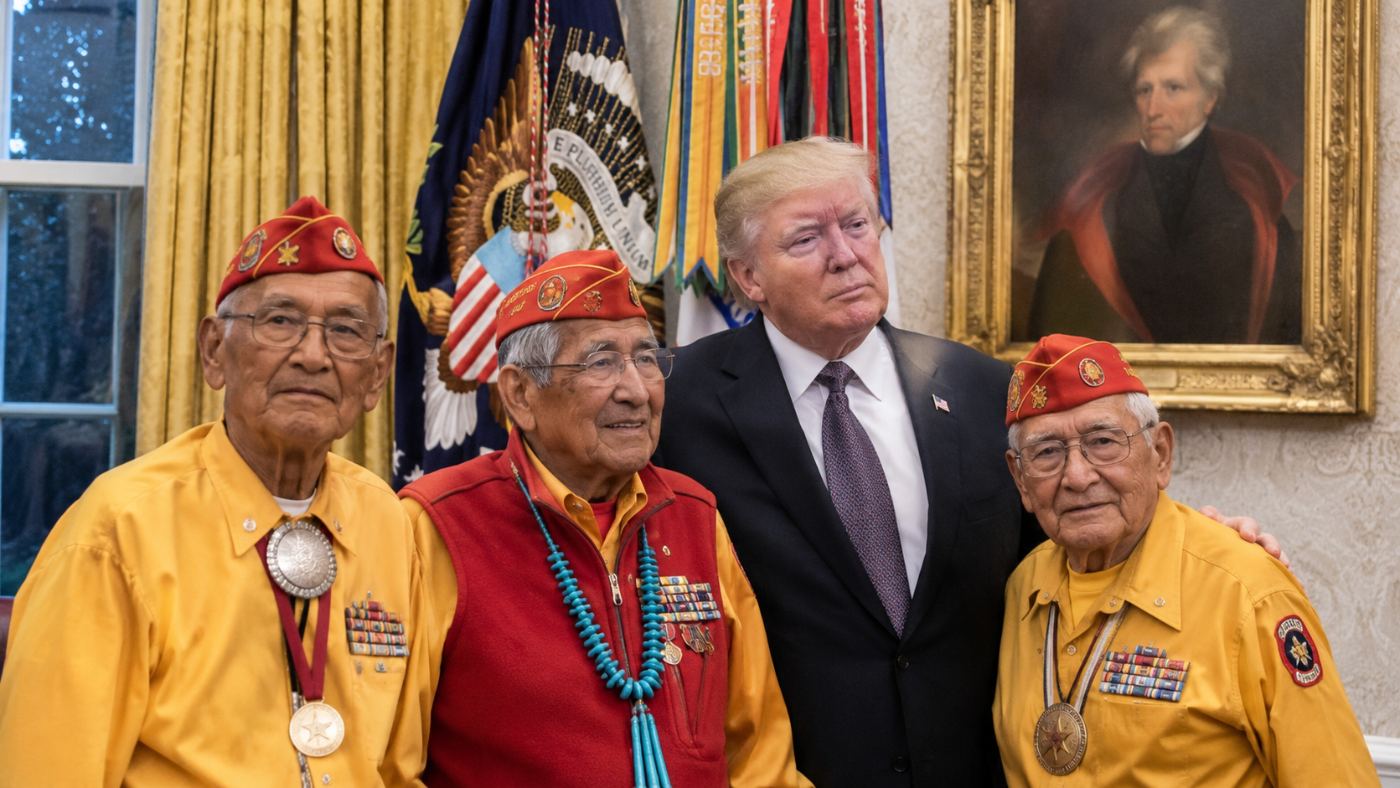
A White House ceremony intended to honor Native American heroes of World War II became a national controversy on November 27, 2017, when President Donald Trump used the occasion to mock Democratic Senator Elizabeth Warren with the nickname "Pocahontas."
The remark came as three surviving Navajo Code Talkers visited the Oval Office to receive recognition for their extraordinary military service during World War II. Instead of keeping the focus entirely on their wartime contributions, Trump introduced a personal political insult that Native American leaders condemned as inappropriate and disrespectful.
The Navajo Code Talkers were among the most remarkable contributors to the American war effort in the Pacific. Recruited by the United States Marine Corps, they developed and operated a communications system based on the Navajo language that Japanese intelligence officers were unable to decipher.
Their work helped American forces communicate sensitive battlefield information during major operations, including Guadalcanal, Tarawa, Saipan, and Iwo Jima.
Three of the thirteen surviving Navajo Code Talkers attended the White House ceremony: Peter MacDonald, Fleming Begaye, and Thomas Begay.
These men had served their country under extraordinarily dangerous conditions, helping protect American lives while contributing to the Allied victory over Japan.
The ceremony should have been an opportunity to recognize their sacrifices and preserve their place in American military history.
Instead, Trump turned part of his remarks toward a political opponent.
"You were here long before any of us were here," Trump told the veterans. He then added, "Although we have a representative in Congress who they say was here a long time ago. They call her 'Pocahontas.'"
The comment referred to Senator Elizabeth Warren, whom Trump had repeatedly targeted over her claims of Native American ancestry.
Trump had used the nickname throughout his presidential campaign and continued employing it after taking office.
Native American organizations had previously criticized the nickname for using the name of a historical Indigenous woman as a political insult.
The timing and location of the remark made the controversy particularly significant.
The veterans were standing beneath a portrait of President Andrew Jackson, whose administration signed the Indian Removal Act of 1830.
That legislation enabled the forced relocation of Native American nations from their ancestral homelands, contributing to the suffering and deaths of thousands during the removals remembered as the Trail of Tears.
The combination of Trump's remark and Jackson's portrait drew criticism from Native American representatives who questioned the appropriateness of the setting.
Navajo Nation President Russell Begaye described the incident as an example of cultural insensitivity while emphasizing that the Navajo Nation appreciated the recognition given to its veterans.
A Navajo Nation spokesman also objected to using the name of a Native American historical figure as the punchline of a political joke.
Senator Warren responded by accusing Trump of introducing a racial insult into a ceremony meant to honor American military heroes.
Other political leaders expressed similar concerns.
Republican Senator John McCain, himself a decorated Navy veteran, criticized the politicization of the ceremony and emphasized the debt America owed the Navajo Code Talkers.
The White House defended the president.
Press Secretary Sarah Huckabee Sanders rejected the suggestion that Trump intended a racial slur and redirected criticism toward Warren's statements about her ancestry.
The administration maintained that the ceremony had been organized to honor the veterans and their contributions to American history.
The controversy nevertheless overshadowed much of the intended recognition.
For decades, the Navajo Code Talkers received limited public acknowledgment because their wartime communications program remained classified after World War II.
Their achievements eventually received national recognition, including congressional honors acknowledging the importance of their service.
By 2017, the surviving veterans were elderly men whose experiences represented an irreplaceable part of American military history.
Their visit to the White House was therefore an important opportunity to preserve their stories and celebrate their contributions.
Instead, national headlines focused heavily on Trump's comments about Warren.
The incident became another example of how Trump's confrontational political rhetoric could enter occasions traditionally reserved for national unity and recognition.
It also renewed discussion about the treatment of Native Americans throughout American history and the responsibility of public officials to recognize Indigenous communities with respect.
The events of November 27, 2017, remain a documented moment in Trump's first presidency.
Three American war heroes entered the Oval Office to be honored for helping defeat Japan during World War II.
The president acknowledged their service but also used the occasion to ridicule a political opponent, drawing criticism from the very communities the ceremony was intended to recognize.
The controversy illustrated the tension between presidential political rhetoric and the expectations of dignity surrounding ceremonies honoring America's military veterans.