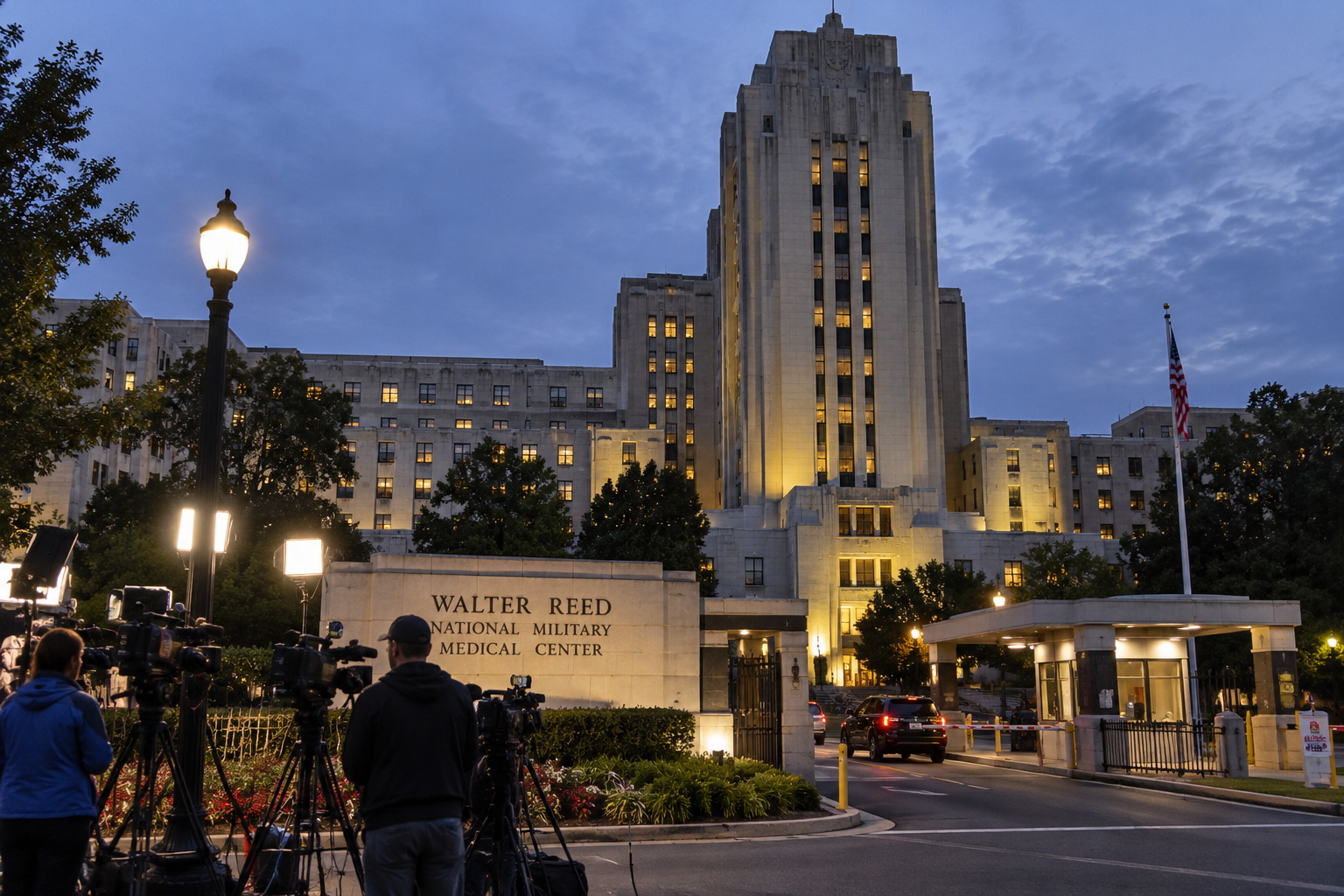
President Donald Trump spent his first full day at Walter Reed National Military Medical Center Saturday as conflicting statements from his doctors and White House officials created growing uncertainty about the severity of his case of COVID-19.
Trump was flown by Marine One to Walter Reed Friday evening, hours after the White House announced that the president had tested positive for the coronavirus.
By Saturday morning, a team of physicians emerged from the hospital to provide the first detailed public briefing on his condition.
Their message was reassuring.
“This morning, the President is doing very well,” White House physician Dr. Sean Conley told reporters.
But within minutes, another account emerged from inside the White House that painted a considerably more serious picture.
“The president's vitals over the last 24 hours were very concerning and the next 48 hours will be critical in terms of his care,” a source familiar with Trump's condition told the White House press pool.
“We're still not on a clear path to a full recovery.”
The comments were later attributed to White House Chief of Staff Mark Meadows.
Suddenly, Americans were left with two very different descriptions of the health of the president.
Questions About Oxygen
Much of Saturday's medical briefing focused on one seemingly simple question:
Had President Trump required supplemental oxygen?
Conley repeatedly said Trump was not receiving oxygen at the time of the briefing.
But reporters pressed him about whether Trump had received oxygen earlier.
Conley initially avoided giving a direct answer.
“The President this morning is not on oxygen,” another member of Trump's medical team, Dr. Sean Dooley, said.
When reporters continued asking about previous oxygen use, Conley said Trump had not been on oxygen Thursday and was not on oxygen Saturday.
His answers left Friday conspicuously unclear.
Reports later Saturday indicated that Trump had received supplemental oxygen at the White House Friday before he was transported to Walter Reed.
The uncertainty added to questions about whether the White House had initially understated the seriousness of Trump's illness.
A Confusing Timeline
The doctors also created confusion about when Trump was diagnosed.
Conley told reporters that Trump was “72 hours into the diagnosis.”
That immediately raised questions.
Seventy-two hours earlier would place Trump's diagnosis sometime Wednesday — considerably earlier than the timeline previously provided by the White House.
Trump traveled to Minnesota Wednesday for campaign events and attended a fundraiser at his golf club in Bedminster, New Jersey, on Thursday.
The president publicly announced shortly before 1 a.m. Friday that he and First Lady Melania Trump had tested positive.
Later Saturday, Conley issued a clarification saying he had misspoken.
He said he meant that Trump was on “day three” of his diagnosis rather than 72 hours into it.
Another member of the medical team said Trump had received an experimental antibody treatment approximately “48 hours ago,” creating still more confusion about the timeline.
That statement was also later corrected.
Trump Receiving Remdesivir
Doctors confirmed Saturday that Trump is being treated with remdesivir, an antiviral drug being used to treat hospitalized COVID-19 patients.
Trump received his first dose Friday night and is expected to undergo a five-day course of treatment.
He also received an experimental antibody cocktail produced by Regeneron before leaving the White House.
Doctors said Saturday that Trump's kidney and liver functions were normal and that he was walking around the presidential medical suite at Walter Reed.
His earlier symptoms included fatigue, nasal congestion and a mild cough, according to his medical team.
Those symptoms were improving, doctors said.
Meadows Offers a Much Darker Assessment
But the optimistic medical briefing was quickly overshadowed by Meadows' comments.
While Trump's doctors described a president making progress, Meadows said officials had been concerned by Trump's condition during the previous 24 hours.
The difference between the two accounts was striking.
Later Saturday, Meadows said Trump's condition Friday had caused serious concern among White House officials and physicians.
The president's blood oxygen level had dropped, according to Meadows, helping prompt the decision to move Trump to Walter Reed.
The president's hospitalization had initially been described by the White House as a precautionary measure.
Trump Releases Video From Walter Reed
Saturday evening, Trump released a video recorded inside Walter Reed.
Wearing a suit jacket and open-collared shirt, the president sat behind a table and said he was feeling better.
“I came here, wasn't feeling so well,” Trump said. “I feel much better now.”
Trump acknowledged that the coming days would be important.
“I guess that's the real test,” he said. “So we'll be seeing what happens over those next couple of days.”
The president also said he hoped to return to campaigning soon.
An Extraordinary Moment
Trump's hospitalization comes just one month before Election Day and amid an outbreak that has spread through his political circle and the White House.
First Lady Melania Trump has tested positive but remains at the White House.
Former New Jersey Gov. Chris Christie announced Saturday that he has also tested positive and has entered a hospital.
Several other people connected to the White House and Trump's recent events have tested positive as well.
For now, the president remains at Walter Reed under continuous medical supervision.
His doctors say he is improving.
His chief of staff says the previous 24 hours were deeply concerning.
His physician says Trump is not currently receiving oxygen, while reports indicate he required oxygen before arriving at the hospital.
And after Saturday's contradictory statements and corrections, one of the most important questions facing the country remains surprisingly difficult to answer:
Just how sick is the president of the United States?