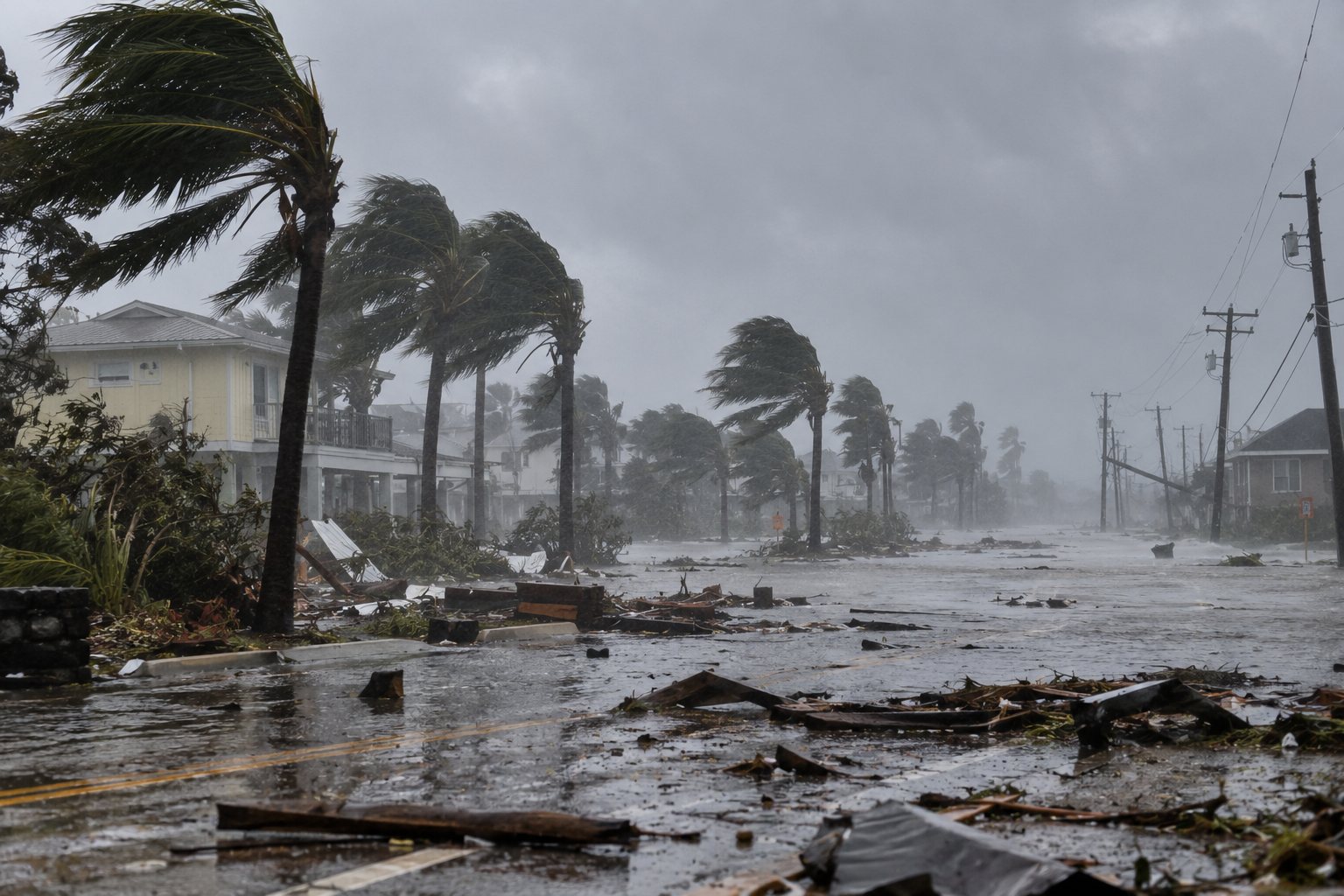
As one of the most powerful hurricanes ever to strike the United States tore into the Florida Panhandle, President Donald Trump faced a decision.
Cancel a political campaign rally and remain focused publicly on the unfolding catastrophe—or fly to Pennsylvania and take the stage before thousands of cheering supporters.
Trump went to the rally.
On October 10, 2018, Hurricane Michael slammed ashore near Mexico Beach, Florida, producing catastrophic winds and storm surge. Later analysis by the National Hurricane Center determined that Michael had reached Category 5 strength at landfall, with maximum sustained winds of approximately 160 mph.
It was the first Category 5 hurricane to make landfall in the United States since Hurricane Andrew in 1992.
Hours later, the president of the United States was onstage at a Make America Great Again rally in Erie, Pennsylvania.
“I Cannot Disappoint” Them
Trump knew before leaving Washington that the hurricane was extraordinarily dangerous.
That morning, the National Hurricane Center was warning of a potentially catastrophic storm approaching the Florida Panhandle.
Trump met at the White House with Homeland Security Secretary Kirstjen Nielsen and FEMA Administrator Brock Long and discussed the federal response.
He also acknowledged the extraordinary size and strength of the hurricane.
But Trump had another event on his schedule.
A political rally.
The president considered postponing the trip but ultimately decided to go.
His explanation centered on the supporters already waiting for him in Pennsylvania.
Before departing Washington, Trump wrote that he could not disappoint the thousands of people who were already there or planning to attend.
When he arrived in Erie, he again defended the decision.
Thousands of people, Trump said, had begun arriving the previous night.
Canceling, he argued, would have been unfair to them.
And so, while communities along the Florida Panhandle were beginning to comprehend the scale of the destruction, Trump walked onto the stage of the Erie Insurance Arena.
Florida Was Being Torn Apart
The timing created a striking contrast.
Hurricane Michael had made landfall near Mexico Beach and Tyndall Air Force Base at approximately 1:30 p.m. Eastern time.
Homes were being destroyed.
Trees and power lines were coming down.
Storm surge was inundating coastal communities.
The hurricane remained powerful as it moved inland, carrying destructive winds into Georgia.
The National Weather Service would later describe the damage along portions of the Florida Panhandle as catastrophic.
Michael ultimately caused approximately $25 billion in damage in the United States and was directly responsible for 16 deaths, according to the National Hurricane Center's post-storm report.
Yet by that evening, the president was more than 800 miles away at a campaign rally.
Trump Acknowledges the Disaster — Then the Rally Begins
Trump did not ignore Hurricane Michael entirely.
He opened his remarks by addressing it.
He offered the nation's thoughts and prayers to people in the hurricane's path, particularly those in the Florida Panhandle.
He described Michael as an enormous storm and promised that his administration would provide affected states with federal assistance.
Trump said the government would provide its “full resources and steadfast support.”
Then the political rally proceeded.
Trump praised Republican candidates.
He celebrated the confirmation of Supreme Court Justice Brett Kavanaugh.
He attacked Democrats.
He warned supporters about Democratic control of Congress.
And he urged Pennsylvania voters to elect Republicans in the approaching midterm elections.
The president had acknowledged the natural disaster.
But he had also made a conscious decision that the political event would continue.
A Decision That Drew Criticism
Critics quickly questioned whether a president should be holding a partisan campaign rally while Americans were experiencing a catastrophic natural disaster.
The criticism was sharpened by Trump's own history.
Six years earlier, after Hurricane Sandy devastated portions of the Northeast during the 2012 presidential campaign, Trump had criticized President Barack Obama for returning to the campaign trail.
Now Trump was president.
And on the very day Hurricane Michael struck Florida, he was doing precisely what critics said a president should not be doing: traveling to a political rally while a major disaster was unfolding.
The White House emphasized that Trump remained in contact with officials.
Administration officials said the president was making calls aboard Air Force One to governors in affected states and that federal emergency officials were coordinating the response.
Trump also promised that he would visit the damaged areas.
Those facts matter.
The president was not completely disengaged from the federal response.
But neither was he willing to cancel the rally.
Two Very Different Scenes
The images from October 10, 2018 told two dramatically different stories.
In Florida, Hurricane Michael was tearing buildings apart and pushing enormous amounts of water into coastal communities.
In Pennsylvania, thousands of supporters wearing red hats packed an arena while Trump stood beneath campaign signs and delivered another political speech.
Both were happening on the same day.
Both demanded the president's attention.
Trump chose to do both.
He monitored the hurricane, spoke with officials and promised federal assistance.
And then he boarded Air Force One, flew to Pennsylvania and held his MAGA rally anyway.
His stated reason was remarkably simple.
Thousands of supporters were waiting.
He didn't want to disappoint them.