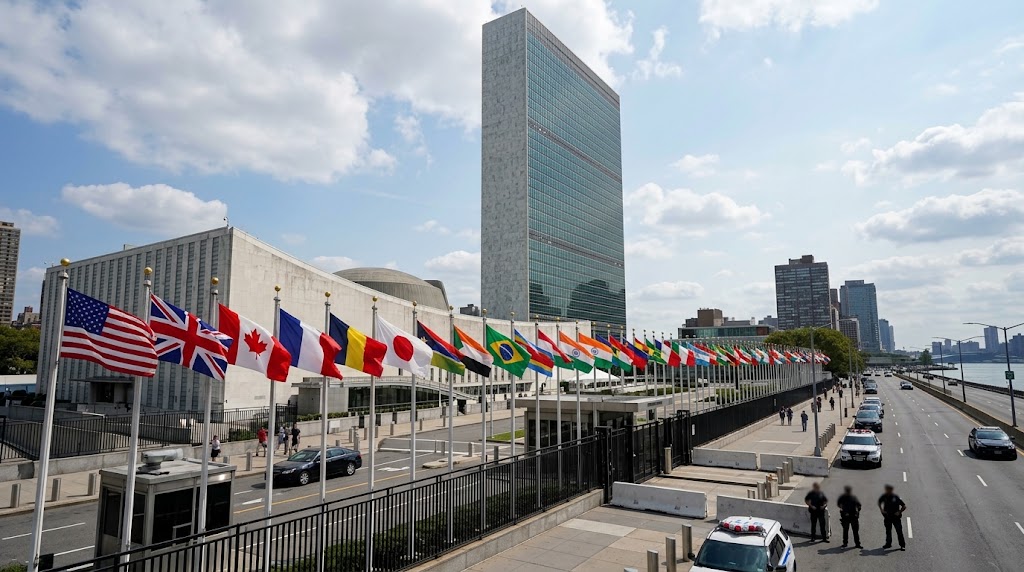
President Donald Trump heads to the United Nations this week facing an unusual problem for an American president arriving at the world's largest diplomatic gathering:
Some of America's closest traditional allies are increasingly learning how to operate without Washington.
Trump is scheduled to address the United Nations General Assembly on Tuesday as nearly 130 heads of state gather in New York. His administration is presenting the week as an opportunity to advance American interests, confront Iran, pursue diplomacy and hold meetings with foreign leaders.
But Trump arrives after months of confrontations with countries that previous American presidents generally treated as partners.
Canada has been hit with tariffs and repeated threats against its sovereignty.
Denmark and Greenland spent months dealing with Trump's demands for American control over Greenland.
European governments have been forced to reconsider how much they can depend on Washington.
And the United States is seeking international cooperation on Iran at the same time that Trump's approach to other allies has complicated some of the relationships traditionally used to build international coalitions.
The result is an extraordinary backdrop for an American president arriving at the United Nations.
Trump will be surrounded by allies.
But increasingly, some of those allies are preparing for a world in which they cannot automatically rely on the United States.
Canada Is Looking Somewhere Else
Perhaps nowhere is the change more obvious than Canada.
For decades, the United States and Canada developed one of the world's most integrated economic relationships.
Trump has dramatically challenged that relationship.
His administration imposed tariffs on Canadian goods, and Trump has repeatedly talked about Canada becoming America's 51st state.
Canadian Prime Minister Mark Carney has responded by trying to reduce Canada's economic dependence on the United States.
Canada is now pursuing significantly closer economic relations with Europe, including discussions that could make it the European Union's first associate member.
Carney has made the reasoning explicit.
There is now a cost associated with Canada's dependence on the American market, he said Sunday, pointing to tariffs and other U.S. demands.
Trump has responded by suggesting Canada's closer relationship with Europe could itself constitute a “hostile act” and threatening additional tariffs.
Think about how remarkable that is.
One of America's closest allies is trying to diversify its economy partly because of pressure coming from Washington — and Trump is threatening it for attempting to become less vulnerable to that pressure.
Then There Is Greenland
Trump's campaign to gain control over Greenland has also strained relations with Denmark and other European allies.
For months, Trump insisted that the United States needed control of the enormous Arctic territory and at times refused to rule out military or economic coercion.
Denmark and Greenland rejected the idea that Greenland was for sale.
The dispute became serious enough that European governments rushed to demonstrate their commitment to Arctic security.
Now the United States, Denmark and Greenland have negotiated an agreement allowing a significantly expanded American military presence on the island.
Trump has characterized the agreement as giving the United States “permanent control.”
Denmark and Greenland describe it differently.
Danish officials say Greenland's sovereignty remains intact and emphasize that Arctic security will remain a NATO responsibility rather than becoming an exclusively American one.
The agreement may ultimately reduce tensions.
But those tensions existed because Trump spent months demanding control over territory belonging to a NATO ally.
America Is Asking for Cooperation After Picking Fights With Its Partners
The contradiction becomes particularly visible at the United Nations.
The Trump administration wants other countries to cooperate with the United States on major international problems.
Iran is one of the most immediate examples.
Washington wants countries to enforce sanctions and help increase pressure on Tehran.
There are legitimate American interests involved.
But international pressure works best when other countries are willing to coordinate with Washington.
That becomes more difficult when Washington is simultaneously threatening tariffs against those countries, questioning long-standing alliances or demanding concessions from them.
Trump's supporters argue that this is precisely the point of his foreign policy.
They contend that previous presidents allowed allies to take advantage of American military protection and access to the enormous U.S. economy. From that perspective, Trump's threats force other governments to contribute more to defense, open their markets and negotiate agreements more favorable to the United States.
There have been instances where Trump's pressure has produced concessions.
But pressure also has consequences.
And one increasingly visible consequence is that America's partners are looking for alternatives.
China Has an Opportunity
There is another country watching these disputes closely.
China.
Trump has long portrayed China as America's greatest economic competitor.
Yet many of the countries Washington would normally want standing alongside it in dealing with Beijing are simultaneously managing disputes with Trump.
European countries face their own serious concerns about Chinese industrial competition.
Japan and South Korea have major security concerns about China's growing military power.
Canada has its own complicated relationship with Beijing.
Those shared interests could provide the foundation for a coordinated strategy.
Instead, governments are also spending time figuring out how to protect themselves from unpredictable American tariffs and demands.
Meanwhile, Chinese President Xi Jinping has been cultivating relationships with countries across Asia, Africa and other regions.
Trump is scheduled to host Xi in Washington later this week.
The symbolism is difficult to ignore.
The American president has spent months applying extraordinary pressure to traditional allies while preparing an elaborate reception for the leader of America's principal geopolitical competitor.
The Cost of Going It Alone
None of this means America's alliances have disappeared.
The United States remains a NATO member.
American troops remain stationed throughout Europe and Asia.
The United States continues extensive intelligence, military and economic cooperation with dozens of countries.
And foreign governments will continue working with Washington because the United States remains one of the world's largest economies and most powerful military powers.
But alliances are not simply treaties written on paper.
They depend on trust.
Countries make long-term military, economic and diplomatic decisions based partly on whether they believe their partners will remain dependable.
Canada's effort to deepen its relationship with Europe demonstrates what happens when that confidence begins to weaken.
So does Europe's push for greater strategic independence.
Trump argues that his approach represents strength — that allies should contribute more, trade arrangements should benefit Americans and other governments should understand that Washington will aggressively defend its interests.
His critics see something very different: an American president spending decades of accumulated diplomatic capital while competitors such as China gain opportunities to expand their influence.
The long-term outcome remains uncertain.
But as Trump arrives at the United Nations this week, one change is already visible.
For generations, American presidents arrived at major international gatherings with an enormous strategic advantage: a network of wealthy, powerful democratic allies that generally wanted the United States leading them.
Trump still has those allies.
What has changed is that some of them are increasingly asking themselves a question they rarely needed to ask before:
What do we do if we can no longer depend on the United States?