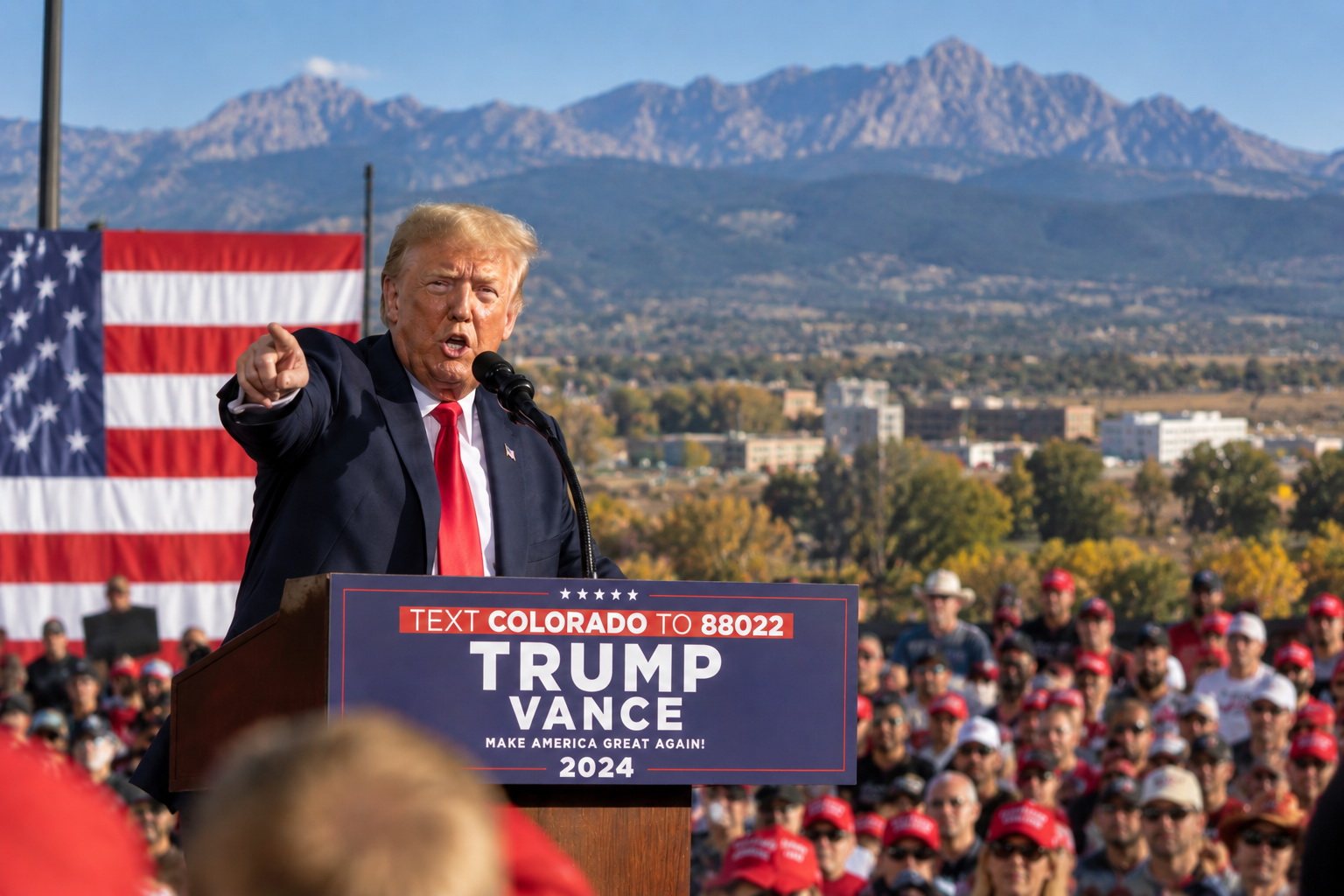
Donald Trump traveled to Aurora, Colorado, on October 11, 2024, to visit a city he had repeatedly portrayed as an example of what he said uncontrolled immigration was doing to America.
From the campaign stage, Trump described Aurora as a community that had been “invaded and conquered.”
He promised to “liberate” it.
He announced a federal deportation initiative he called Operation Aurora.
He promised to deploy federal law-enforcement officers to pursue undocumented gang members.
And he said he would invoke a wartime law passed in 1798 — the Alien Enemies Act — as part of the effort.
But there was a fundamental problem with Trump's description of Aurora.
The city had experienced real criminal activity involving members or suspected members of the Venezuelan gang Tren de Aragua.
But Aurora had not been conquered.
It had not been occupied.
And the city's Republican mayor said Trump's portrayal of the problem had been “grossly exaggerated.”
Aurora Becomes a National Political Symbol
Aurora's transformation into a presidential campaign issue had begun months earlier.
The Denver suburb had received a significant number of Venezuelan migrants, and local authorities had investigated crimes involving individuals suspected of ties to Tren de Aragua, a Venezuelan gang that had expanded into other countries and parts of the United States.
Then a disturbing video circulated nationally.
It showed armed men walking through an apartment building in Aurora.
The footage was real.
Concerns about criminal gang activity were real.
Aurora police investigated.
Suspected gang members were identified and arrested.
But the story quickly expanded far beyond what local authorities said the evidence supported.
Online claims suggested that Venezuelan gangs had seized entire apartment buildings.
Soon, Aurora itself was being described as a city under gang control.
Trump amplified that version dramatically.
During his September presidential debate against Kamala Harris, he declared:
“You look at Aurora in Colorado. They are taking over the towns. They're taking over buildings.”
By October, Aurora had become one of Trump's most frequently cited examples of what he called a migrant “invasion.”
Then Trump Came to Aurora
On October 11, Trump arrived in the city.
He held his rally at the Gaylord Rockies Resort and Convention Center, near Denver International Airport and well away from the apartment complexes at the center of the controversy.
The stage itself reinforced his message.
Trump spoke with large images of alleged migrant criminals displayed nearby.
The presentation framed Aurora not merely as a city dealing with a localized crime problem, but as territory that had effectively fallen to hostile outsiders.
“I will rescue Aurora and every town that's been invaded and conquered,” Trump told the crowd.
“These towns have been conquered.”
He promised:
“I will liberate Colorado.”
Aurora's Republican Mayor Said That Wasn't True
One of the strongest rebuttals came not from a Democratic campaign surrogate but from Aurora's Republican mayor.
Mike Coffman was a former Republican congressman and Marine Corps veteran.
He acknowledged that Aurora had problems involving Venezuelan gang activity.
He did not claim that nothing had happened.
Instead, Coffman argued that the scale of the problem had been badly distorted.
“The reality is that the concerns about Venezuelan gang activity in our city — and our state — have been grossly exaggerated and have unfairly hurt the city's identity and sense of safety,” Coffman said.
He directly rejected the language Trump was using.
“The city and state have not been ‘taken over’ or ‘invaded’ or ‘occupied’ by migrant gangs.”
Coffman said the incidents were limited to a handful of apartment complexes in a city of approximately 400,000 people.
Aurora police similarly said their initial investigative work indicated Tren de Aragua's influence in the city was isolated.
That distinction was important.
There was gang crime.
There were suspects with alleged connections to Tren de Aragua.
There were legitimate law-enforcement concerns.
But those facts were very different from claiming that Venezuelan gangs had conquered an American city.
Trump Announces “Operation Aurora”
Trump used the rally to unveil a federal immigration-enforcement proposal.
He called it:
Operation Aurora.
Trump said the program would target undocumented immigrants associated with criminal gangs.
He promised to send what he described as elite teams of Immigration and Customs Enforcement agents, Border Patrol personnel and federal law-enforcement officers to find, arrest and deport undocumented gang members.
He also proposed severe penalties for those who returned to the United States after being deported.
But the most consequential part of the proposal involved a law more than two centuries old.
Trump said:
“I will invoke the Alien Enemies Act of 1798.”
The Alien Enemies Act
The Alien Enemies Act was enacted during the presidency of John Adams as part of the Alien and Sedition Acts.
It gives presidents extraordinary authority involving citizens or subjects of hostile foreign nations during a declared war or when a foreign government has perpetrated, attempted or threatened an invasion or “predatory incursion” against the United States.
The law has historically been associated with wartime powers.
Most notably, it was invoked during World War II.
Trump proposed using it against migrant criminal networks.
That would represent a dramatically different application of the statute.
Venezuela and the United States were not at war.
Tren de Aragua was a criminal organization, not the Venezuelan government.
Trump nevertheless framed migration and gang crime using the language of military conflict.
America was being invaded.
Cities were being conquered.
Territory needed to be liberated.
And a law written for foreign enemies during wartime would help accomplish that liberation.
“Occupied America”
The rhetoric went beyond Aurora.
Trump declared that the problem represented a national occupation.
“We are now known, all throughout the world, as occupied America,” he said.
He promised that Election Day would mark the beginning of something different.
“November 5th, 2024 will be liberation day in America.”
Those weren't accidental words.
Trump repeatedly used the vocabulary of warfare.
Occupied.
Invaded.
Conquered.
Liberation.
The political argument was no longer simply that the Biden administration's immigration policies had failed or that the border needed stronger enforcement.
Trump was describing immigration as an invasion of American territory.
The Same Message in Reno
Trump wasn't finished when he left Colorado.
Later that day, he traveled to Reno, Nevada.
There, he repeated the theme.
America, Trump again declared, was an “occupied country.”
And Election Day would be “liberation day.”
The repetition demonstrated that Aurora wasn't merely a local campaign stop.
The city had become the centerpiece of a national political narrative.
Trump was presenting the 2024 election as an opportunity to reclaim American territory from an invading population.
The Crime Picture Was More Complicated
Aurora's actual crime statistics also complicated the portrayal of the city as a collapsing war zone.
Associated Press reporting at the time found that major crimes in Aurora were down compared with the previous year.
That didn't mean residents had nothing to worry about.
Gang activity remained a legitimate concern.
Crimes committed by migrants were real crimes with real victims.
And local authorities had identified individuals with suspected Tren de Aragua connections.
But the existence of gang members in a city did not establish that the gang controlled the city.
That was precisely the distinction Coffman and Aurora officials were trying to make.
They were simultaneously saying:
Yes, there is a problem.
And:
No, Aurora has not been taken over.
Why Aurora Mattered Politically
Aurora provided Trump with something more powerful than another immigration statistic.
It provided a place.
A city Americans could visualize.
An apartment building.
A video of armed men.
A foreign gang with a frightening reputation.
Trump could connect those images to his broader argument about immigration.
Instead of talking about border encounters, asylum procedures or immigration court backlogs, he could tell voters that an American city had been conquered.
That was much easier to understand.
It was also far more dramatic than what Aurora's own officials said had actually occurred.
A Campaign Built Around Mass Deportation
The Aurora speech fit into Trump's broader immigration platform for the 2024 campaign.
He had promised the largest deportation operation in American history.
He proposed using federal, state and local law-enforcement resources to identify and remove undocumented immigrants.
He talked about detention facilities.
He discussed expanding the role of Immigration and Customs Enforcement.
And he repeatedly described unauthorized migration not primarily as a regulatory or humanitarian challenge but as an invasion.
Operation Aurora gave that strategy a name.
Trump wasn't merely promising stronger border enforcement.
He was promising an internal campaign to locate and remove people already living inside the United States.
October 11, 2024
There was a real story in Aurora.
Venezuelan migrants had arrived in significant numbers.
There were genuine pressures on housing and local services.
There were crimes.
There were suspected members of Tren de Aragua.
There were legitimate concerns among residents.
Aurora police were investigating them.
But that wasn't the story Donald Trump told on October 11.
He described an American city as territory that had been invaded and conquered.
The Republican mayor of that city said it wasn't true.
Trump announced Operation Aurora.
He promised to invoke a law written in 1798 for wartime enemies.
He described the United States as an “occupied country.”
And he told Americans that November 5 would be:
“Liberation Day.”
Aurora had become more than a Colorado suburb.
For Donald Trump's campaign, it had become the symbol used to transform immigration from a debate over borders, laws and enforcement into something much larger:
A story about invasion, occupation and taking the country back.