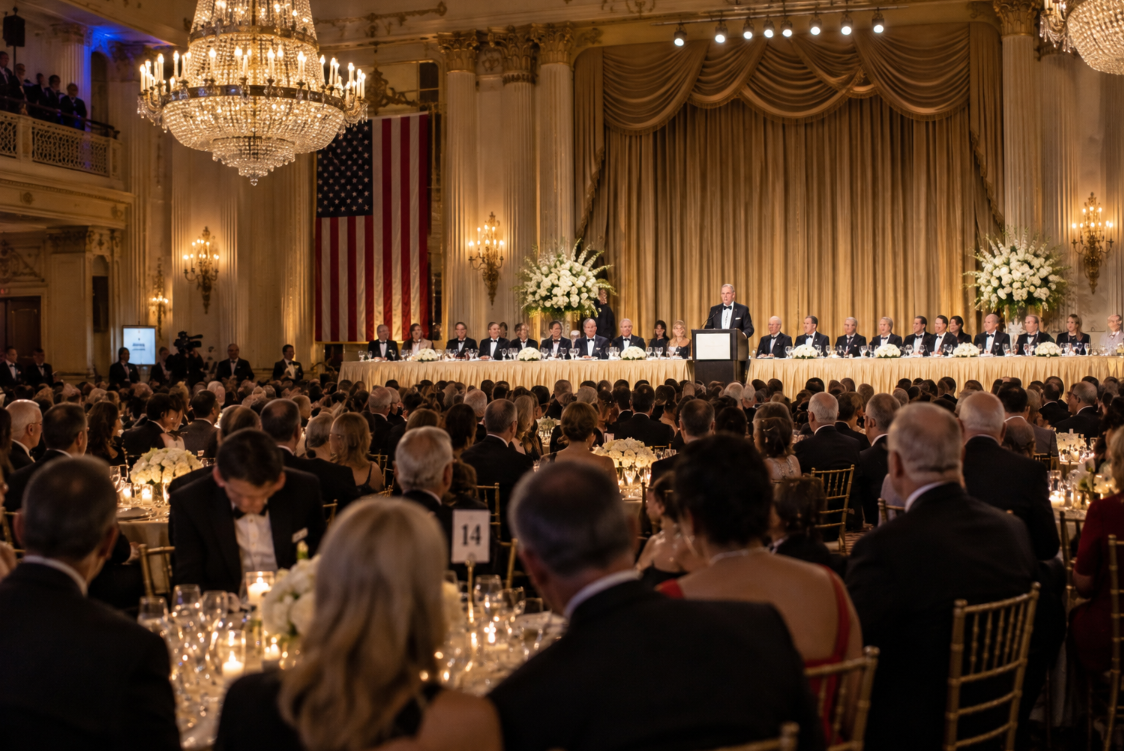
The Al Smith Dinner is supposed to be one of the rare nights when presidential candidates stop behaving like presidential candidates.
They wear white tie.
They make fun of themselves.
They make fun of each other.
And for a few hours, the bitterness of a presidential campaign is supposed to give way to humor and charity.
On October 20, 2016, Donald Trump and Hillary Clinton tried.
For a while, it worked.
Then Trump began attacking Clinton.
The laughter faded.
The room grew uncomfortable.
And eventually, guests at one of New York's most prestigious Catholic charity events began booing the Republican nominee for president.
One Night After the Debate
The 71st Alfred E. Smith Memorial Foundation Dinner was held at the Waldorf Astoria in New York City.
It came just one night after Trump and Clinton had faced each other in their third and final presidential debate.
That debate had been particularly hostile.
Trump had called Clinton a “nasty woman.”
He had refused to promise that he would accept the election result if he lost.
Clinton had attacked Trump's temperament and qualifications for office.
The candidates hadn't even shaken hands.
Now they were sitting only a few feet apart.
Between them sat Cardinal Timothy Dolan, the Archbishop of New York.
The setting could hardly have been more formal.
The evening's purpose could hardly have been more different from a campaign rally.
The dinner was raising millions of dollars for charitable programs benefiting children and families in need.
Candidates were expected to roast one another.
But they were also expected to know where the line was.
Trump Starts Strong
Trump initially seemed to understand the assignment.
He began with a joke about himself.
Candidates traditionally open with self-deprecating humor, Trump explained.
That might be difficult for him, he joked, because he was actually an extremely modest person.
Then he added that many people considered modesty perhaps his greatest quality — even greater than his temperament.
The audience laughed.
Trump followed with one of his better jokes of the evening.
He referenced the controversy surrounding Melania Trump's Republican convention speech, portions of which closely resembled Michelle Obama's 2008 Democratic convention speech.
Trump joked that Michelle Obama could give a speech and receive universal praise.
Then:
“My wife Melania gives the exact same speech and people get on her case.”
The room erupted in laughter.
Melania laughed.
Trump was doing exactly what the occasion called for.
He was making fun of himself, his campaign and one of its embarrassing episodes.
Then the tone began to change.
The Jokes Become Campaign Attacks
Trump turned toward Clinton.
Some of the early jokes at her expense still landed.
But gradually the material began sounding less like a roast and more like one of Trump's campaign speeches.
He brought up Clinton's emails.
He brought up the FBI investigation.
He brought up WikiLeaks.
He attacked Clinton's honesty.
Then Trump said:
“Hillary is so corrupt...”
The audience began booing.
Trump continued.
He accused Clinton of having one political position in public and another in private.
More boos followed.
Trump appeared surprised by the reaction.
But he kept going.
“Pretending Not to Hate Catholics”
Then came the line that produced one of the strongest reactions of the evening.
The event was a Catholic charity fundraiser.
Cardinal Dolan was sitting between the two candidates.
Trump referenced hacked emails involving Clinton campaign aides that had generated controversy over comments about Catholics.
Then he said of Clinton:
“Here she is tonight, in public, pretending not to hate Catholics.”
The room erupted in boos and groans.
There was little ambiguity about the audience's reaction.
Trump had accused his opponent of secretly hating members of the faith whose charity dinner they were attending.
At an event built around good-natured political humor, the line landed as a direct accusation.
The Room Turns Against Him
Trump continued with attacks involving the Clinton Foundation and Haiti.
He accused Clinton of corruption.
The audience continued reacting negatively.
It was an extraordinary scene.
This wasn't a Trump campaign rally filled with supporters.
It wasn't a presidential debate where confrontation was expected.
It was a formal charity dinner where political opponents traditionally demonstrate that they can laugh at themselves and treat each other civilly for one evening.
Trump had successfully done exactly that during the beginning of his speech.
Then he abandoned it.
The distinction was visible in the audience's response.
They laughed when Trump was funny.
They booed when they believed he had crossed the line.
Clinton Wasn't Gentle Either
Clinton spoke after Trump.
She attacked him too.
She joked about Trump's relationship with Russian President Vladimir Putin.
She mocked his businesses.
She joked about his refusal the previous night to commit to accepting the election result.
And she made a joke about the Statue of Liberty in which she portrayed Trump as judging the statue's physical attractiveness.
Some of Clinton's jokes produced groans and scattered boos as well.
This was not an evening in which Clinton remained above the political fight while Trump alone participated in it.
Both candidates used the dinner to attack each other.
But contemporary accounts noted a difference in the audience reaction.
Trump received particularly loud boos as portions of his speech moved away from jokes and toward accusations.
Even the Setting Made It Awkward
The visuals made the evening stranger.
Trump was standing in formal white tie.
Clinton was seated only a few feet away.
Cardinal Dolan was between them.
Hundreds of formally dressed guests were sitting at tables expecting a traditional political roast.
And Trump was effectively delivering portions of his campaign argument against Clinton.
It wasn't simply that the jokes were harsh.
Some barely functioned as jokes at all.
Calling Clinton corrupt was one of Trump's central campaign accusations.
Accusing her of pretending not to hate Catholics was another political attack presented in the format of a punchline.
The audience recognized the difference.
And they let Trump know.
A Tradition Built Around Civility
The Alfred E. Smith Memorial Foundation Dinner is named for former New York Gov. Al Smith.
In 1928, Smith became the first Roman Catholic nominated for president by a major American political party.
The dinner eventually became an election-year tradition in which presidential candidates could demonstrate that bitter political opponents were still capable of sharing a room, laughing at themselves and recognizing something larger than their campaigns.
That tradition was particularly meaningful in 2016.
The election had become intensely personal.
Trump and Clinton had spent months attacking each other's character.
Only twenty-four hours earlier, they had stood on a debate stage and refused to shake hands.
The Al Smith Dinner offered them a chance to behave differently.
For portions of the evening, they did.
For other portions, they didn't.
Trump Had Shown He Could Do It
Perhaps the most striking part of Trump's performance was that his opening jokes demonstrated that he understood exactly how the dinner worked.
His joke about his own modesty worked.
His joke about Melania's convention speech worked extremely well.
The audience wasn't hostile to him from the beginning.
Quite the opposite.
They laughed.
The boos came later.
They came as Trump's remarks became increasingly indistinguishable from his campaign attacks.
That sequence made it difficult to dismiss the audience reaction simply as a room full of people opposed to Trump.
The same audience that laughed with him minutes earlier eventually booed him.
An Uncomfortable Night
Clinton and Trump did eventually shake hands.
The dinner also accomplished its most important purpose.
It raised a record sum — more than $6 million for charity.
And Trump ended his remarks on a considerably more gracious note, praising the work supported by the dinner and speaking about the importance of helping children.
But those weren't the moments that defined the evening politically.
The enduring image was of a presidential candidate standing at a white-tie Catholic charity dinner while members of the audience booed.
Trump had entered a room where the expectation was simple:
Be funny.
Make fun of yourself.
Make fun of your opponent.
Don't turn it into another campaign rally.
For a few minutes, Trump followed that tradition.
Then the jokes became accusations.
The laughter became groans.
And at a dinner famous for temporarily putting politics aside, Donald Trump managed to bring the campaign fight directly to the table.