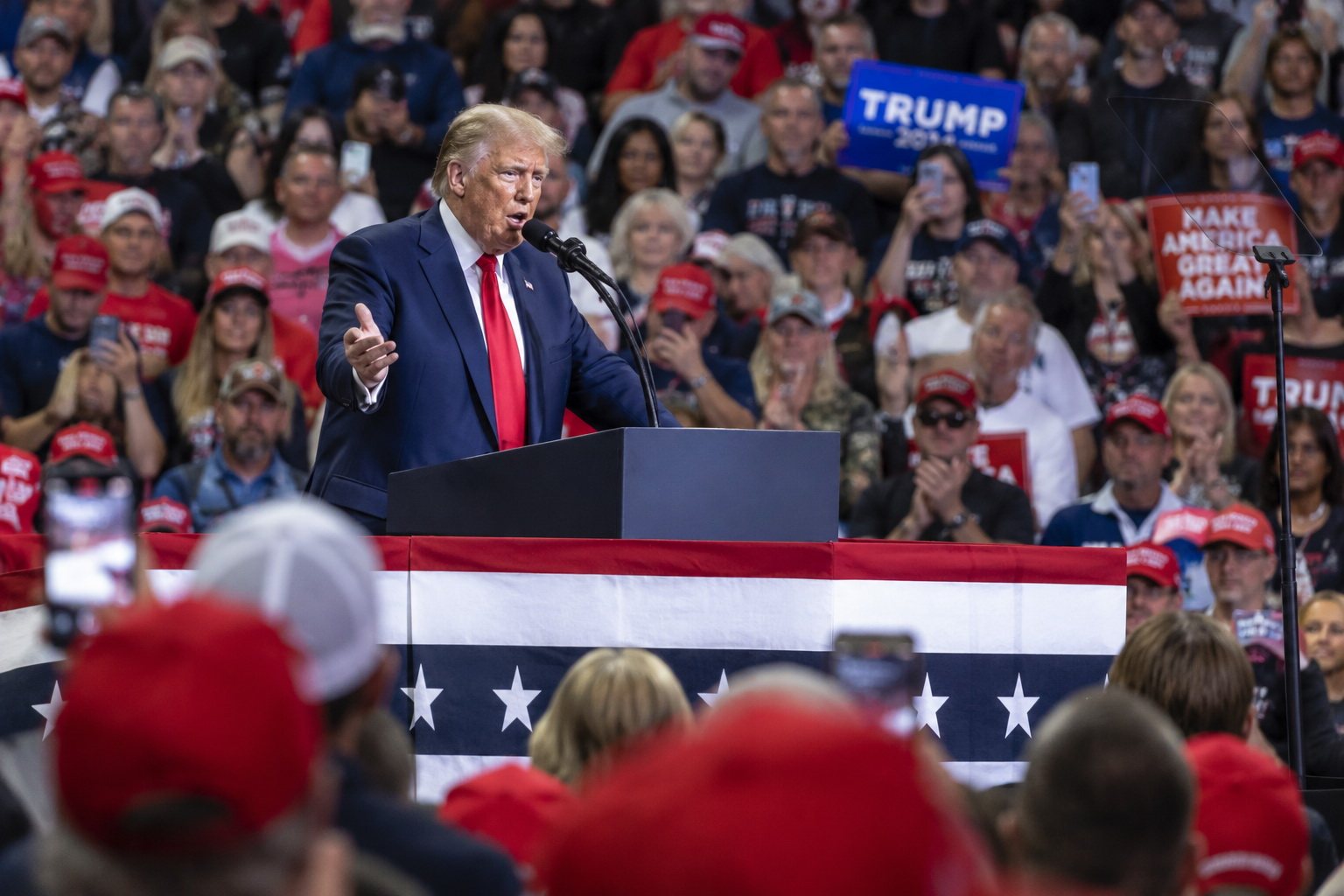
With less than four weeks remaining before Election Day, Donald Trump spent October 9, 2024, campaigning across Pennsylvania, holding rallies in Scranton and Reading as he fought for one of the most important battleground states in the country.
Trump talked about energy, immigration, crime, the economy and his opponent, Vice President Kamala Harris.
He also delivered a barrage of claims that distorted or misrepresented the facts.
Some involved familiar campaign subjects.
Others involved something far more immediate.
As Trump spoke in Pennsylvania, Hurricane Milton was slamming into Florida while communities across the Southeast were still recovering from Hurricane Helene.
Trump used the disasters to attack the Biden administration—and repeated misinformation about the government's response.
Trump Says Disaster Money Was Spent on Migrants
One of Trump's most consequential claims involved the Federal Emergency Management Agency.
Trump and his allies had been claiming that FEMA did not have enough money to help hurricane victims because the Biden administration had spent disaster money housing undocumented immigrants.
That was false.
The money Congress appropriated for FEMA's Disaster Relief Fund was separate from money provided for programs assisting communities dealing with migrant arrivals.
Disaster relief money had not simply been taken away from hurricane victims and handed to migrants.
Yet Trump continued using the claim to portray the administration as abandoning Americans during a catastrophe.
President Joe Biden publicly pushed back against the allegation that disaster money had been diverted to migrants, calling the claim false and warning that misinformation could interfere with recovery efforts.
The dispute was not merely political theater.
People in disaster zones needed accurate information about where to obtain food, shelter, financial assistance and emergency services.
Trump Attacks the Hurricane Response
At his Pennsylvania appearances, Trump again criticized the federal response to Hurricane Helene.
“This administration has not done a proper job at all,” he told the crowd in Reading.
There were legitimate difficulties responding to Helene.
The storm devastated communities, destroyed roads and bridges, knocked out communications and isolated mountain towns.
But Trump's broader portrayal of an absent federal government was misleading.
Federal emergency personnel, military personnel, National Guard units, state agencies and local first responders were already conducting rescue and recovery operations.
The Biden administration had approved major disaster declarations, and federal assistance was flowing into affected states.
That didn't mean every victim received help immediately.
It meant Trump's suggestion that the federal government essentially wasn't responding did not match what was actually happening on the ground.
Immigration and Crime
Trump also returned to one of the central themes of his campaign: immigration.
He portrayed the United States as being overwhelmed by violent criminals entering the country illegally and repeatedly connected immigration with murder and other serious crimes.
One statistic being used by Trump at the time claimed that more than 13,000 undocumented immigrants convicted of homicide had been released into the United States.
The underlying government data were real.
Trump's interpretation of them was not.
The figures involved noncitizens on Immigration and Customs Enforcement's non-detained docket and accumulated over many years—including during administrations before Biden's.
Being listed on the non-detained docket also did not necessarily mean someone was freely walking the streets.
Some were serving sentences in federal, state or local prisons.
Others could not immediately be deported for legal or diplomatic reasons.
The statistic therefore did not show that the Biden-Harris administration had simply released more than 13,000 convicted murderers into American communities.
Trump's Energy Promise
Energy was particularly important during Trump's Scranton appearance.
Pennsylvania is a major natural gas producer, and Trump repeatedly emphasized fracking.
He promised that Pennsylvania would become an energy supplier to the world and declared:
“Frack, frack, frack” and “drill, drill, drill.”
Trump also promised voters that he would cut their energy prices in half.
That was a campaign promise—not something a president could guarantee.
Presidents can influence energy policy through regulations, leasing decisions, taxes and other policies, but oil, natural gas, gasoline and electricity prices are also determined by global commodity markets, production decisions, refining capacity, transportation costs, weather and consumer demand.
The United States was also already producing record quantities of oil during the Biden administration.
The country was not starting from a position in which domestic energy production had stopped.
Harris and Fracking
Trump also attacked Harris over fracking.
There was a legitimate issue behind the attack.
During her unsuccessful 2019 campaign for the Democratic presidential nomination, Harris supported banning hydraulic fracturing.
By 2024, however, Harris said she no longer supported a fracking ban.
Trump used her earlier position to argue that she would eventually eliminate fracking regardless of what she was telling Pennsylvania voters.
Her change in position was fair political territory.
But predicting with certainty that Harris would ban fracking after she had explicitly said she would not was not a statement of established fact.
It was Trump's prediction about what she might do.
Personal Attacks Take Over the Message
Trump's Pennsylvania appearances weren't limited to policy arguments.
He repeatedly attacked Harris personally.
He called her incompetent and unintelligent.
He also targeted women from ABC's The View after Harris had appeared on the program the previous day.
Trump attacked co-host Sunny Hostin, calling her “dumber than Kamala.”
Later in Reading, he attacked Whoopi Goldberg, calling her “demented” and describing her in insulting terms.
Trump acknowledged that advisers had apparently suggested he moderate his language toward women.
He rejected the idea.
“I don't want to be nice,” Trump said.
He told the audience that someone had warned him:
“You should be nicer. Women won't like it.”
Trump's response was simple:
“I don't care.”
He argued that women were more interested in restoring the country than in his rhetoric.
Harris's Answer Gives Trump an Opening
Trump did have a legitimate political opening that day.
During her appearance on The View, Harris had been asked whether she would have done anything differently from Biden during the previous four years.
“Not a thing comes to mind,” Harris answered.
Trump seized on the statement.
His campaign had spent months trying to connect Harris directly to Biden's record on inflation, immigration, Afghanistan and other unpopular issues.
Her answer made that argument easier.
Trump called it disqualifying and used it repeatedly during his Pennsylvania appearances.
That was ordinary political campaigning.
But throughout the rallies, legitimate criticism was repeatedly mixed with exaggeration, speculation and claims that were demonstrably false.
Pennsylvania Was Crucial
There was a reason Trump was spending so much time in the state.
Pennsylvania had 19 electoral votes and was one of the most fiercely contested states of the 2024 election.
Trump had visited Pennsylvania only days earlier.
Now he was back.
“If we win Pennsylvania, we win the whole thing,” Trump told supporters in Scranton.
The remark demonstrated how central the state had become to his campaign strategy.
Scranton offered Trump an opportunity to appeal to working-class voters in Biden's birthplace.
Reading provided another audience in a heavily contested part of the state.
Trump emphasized manufacturing, energy production, tariffs and immigration—all issues his campaign believed could move Pennsylvania voters.
But those policy arguments repeatedly shared the stage with misinformation.
A Familiar Campaign Strategy
By October 2024, the pattern was well established.
Trump would begin with a legitimate issue.
Immigration was a legitimate issue.
Inflation was a legitimate issue.
Hurricane recovery was a legitimate issue.
Energy policy was a legitimate issue.
Then the rhetoric frequently went much further than the available evidence supported.
Statistics lost their context.
Predictions were presented as certainties.
Complicated government programs were reduced to simple accusations.
Political opponents weren't merely wrong; they were portrayed as incompetent, corrupt or deliberately destroying the country.
And corrections rarely caused the claims to disappear.
They were simply repeated at the next rally.
October 9, 2024
That is what made Trump's Pennsylvania campaign swing on October 9 worth remembering.
It wasn't remarkable because politicians exaggerated during an election.
Politicians have done that for generations.
It was the volume and repetition of the claims—and the willingness to continue using them even after government agencies, journalists and public officials had provided contrary evidence.
Trump mixed legitimate policy disagreements with false or misleading claims about disaster relief, immigration and the condition of the country.
He mixed proposals about energy and tariffs with personal attacks against Harris and women in the media.
And he did it while asking Pennsylvania voters to return him to the White House.
Less than four weeks remained before Election Day.
Trump's closing argument was taking shape.
It was an argument built around immigration, inflation, energy and dissatisfaction with the Biden administration.
But it was also built around something that had become a defining feature of Trump's political career:
When the facts complicated the story he wanted to tell, he often told the simpler story anyway.