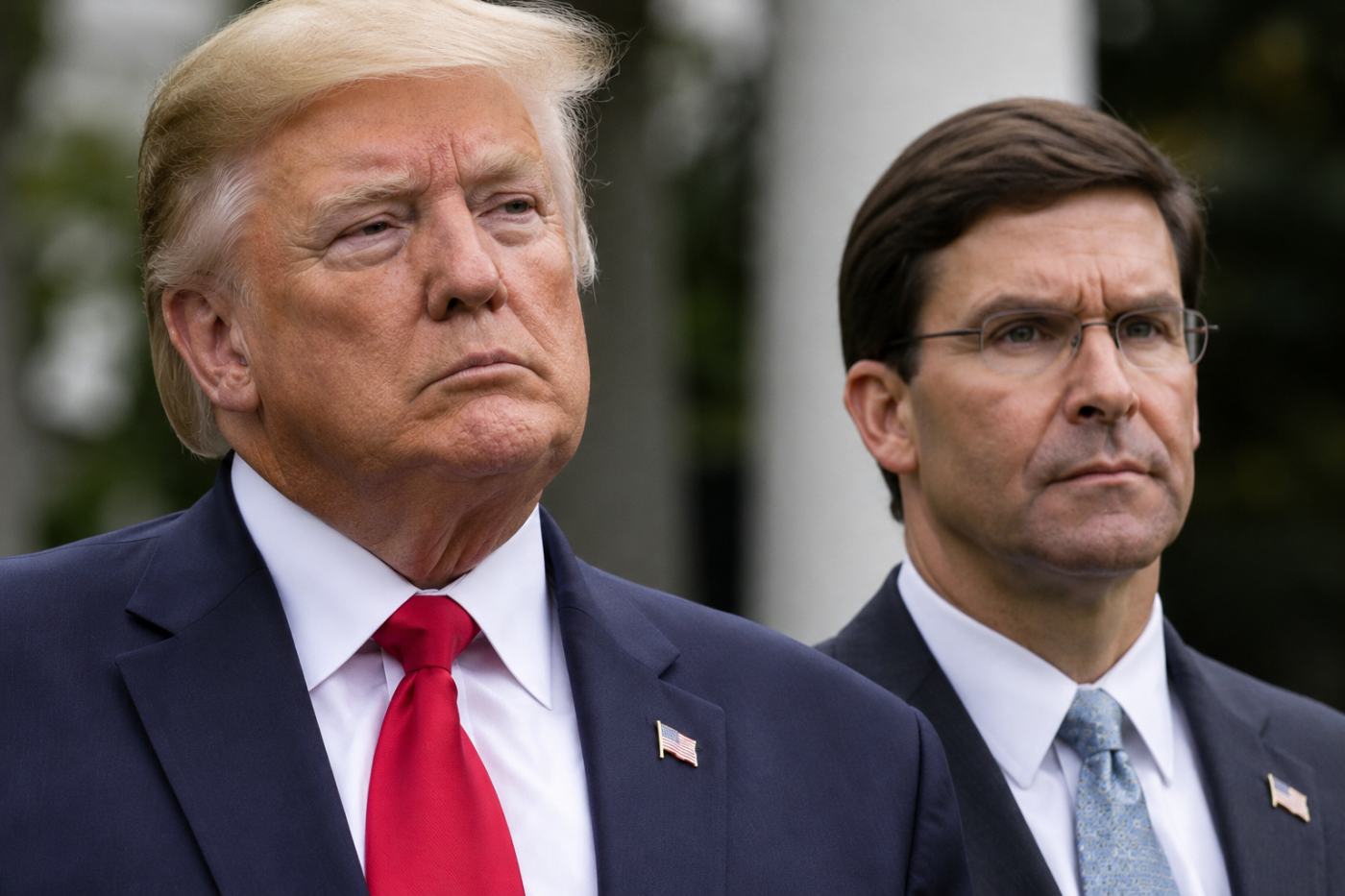
President Donald Trump abruptly fired Defense Secretary Mark Esper on Monday, just two days after Joe Biden was declared the projected winner of the presidential election, triggering fresh concerns about instability at the Pentagon during an already contentious presidential transition.
Trump announced the dismissal on Twitter, writing that Esper had been terminated and thanking him for his service.
The president simultaneously announced that Christopher Miller, director of the National Counterterrorism Center, would become acting defense secretary immediately.
The dismissal removes one of the administration's most senior national security officials at a moment when Trump is refusing to concede the election and his administration has yet to authorize the customary transition process for Biden's incoming team.
A Defense Secretary Who Challenged Trump
Esper's relationship with Trump deteriorated significantly during the summer following nationwide protests over the police killing of George Floyd.
As demonstrations spread across American cities, Trump threatened to invoke the Insurrection Act and deploy active-duty military personnel to suppress unrest.
Esper publicly opposed that approach.
During a June Pentagon news conference, Esper said active-duty military forces should be used for domestic law enforcement only under the most exceptional circumstances.
His remarks directly contradicted Trump's public threats and reportedly angered the president.
According to The Washington Post, Trump considered firing Esper during the summer but was persuaded to delay the decision.
Esper also supported efforts to address racial discrimination within the military, including restrictions on Confederate flag displays and openness to renaming military installations honoring Confederate officers.
Those positions created additional disagreements with Trump.
A Pentagon Leadership Shake-Up
Esper's dismissal is particularly unusual because it comes after an election in which the incumbent president has been projected to lose.
Traditionally, outgoing administrations preserve continuity in senior national security positions during presidential transitions.
Trump instead is replacing the official responsible for overseeing the world's most powerful military establishment.
Miller, the incoming acting secretary, is a former Army Special Forces officer with extensive counterterrorism experience. However, he has not previously led an organization comparable in size and complexity to the Defense Department.
The decision immediately drew criticism from lawmakers concerned about national security.
Representative Adam Smith, the Democratic chairman of the House Armed Services Committee, warned that removing experienced Pentagon leadership during a presidential transition could create unnecessary risks.
Former White House chief of staff John Kelly, himself a retired Marine general, defended Esper's commitment to constitutional responsibilities.
The White House has not publicly provided a detailed explanation for the firing.
Loyalty Versus Military Independence
Esper's departure highlights a longstanding conflict within the Trump administration over the relationship between presidential authority and the military's obligation to remain politically neutral.
As commander in chief, Trump has the authority to replace his defense secretary.
But critics question the timing and circumstances of this particular dismissal, especially given Esper's previously stated opposition to using active-duty troops against domestic protesters.
The Washington Post reports that officials familiar with the relationship believe Esper's resistance to Trump's demands was a major source of the president's anger.
There is no publicly established evidence that the firing is part of a plan to use military forces to challenge the election results. Nevertheless, the removal has prompted lawmakers to demand assurances that the armed forces will remain outside partisan political disputes.
With Biden preparing for a January inauguration and Trump continuing to contest the election, the Pentagon now faces another leadership transition of its own.
The immediate question is whether the change will disrupt military operations and national security planning during the remaining weeks of Trump's presidency.