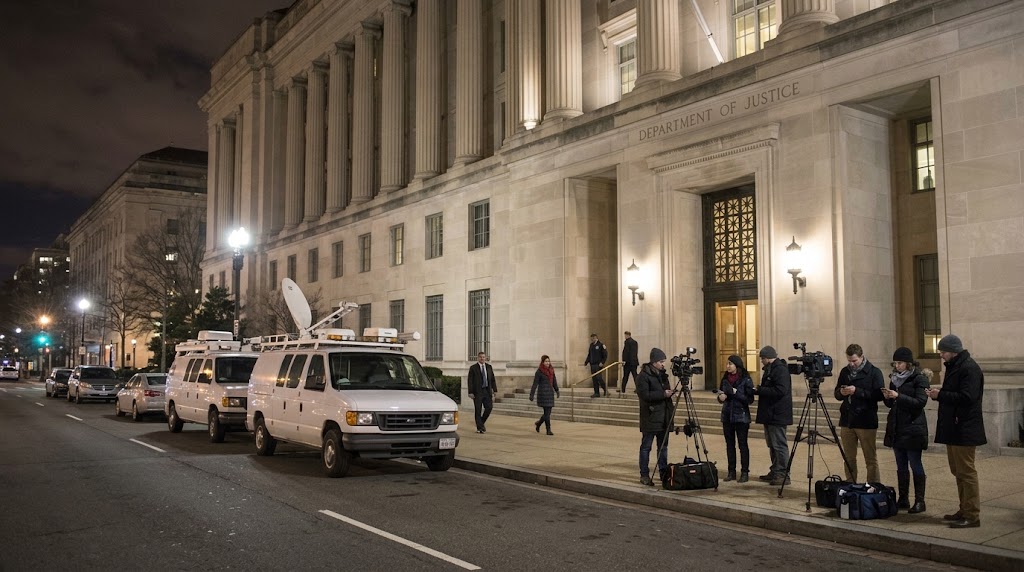
Three days after President Donald Trump signed his controversial travel restrictions, the dispute reached the highest levels of the Justice Department.
Acting Attorney General Sally Yates instructed Justice Department lawyers not to defend the executive order in court.
Hours later, Trump fired her.
It was an extraordinary confrontation between a newly inaugurated president and the official temporarily leading the Department of Justice.
Yates Had Been Asked to Stay
Yates was not a Trump appointee.
A career federal prosecutor, she had joined the Justice Department in 1989 and had been confirmed by the Senate as deputy attorney general during the Obama administration.
When Trump took office, Yates remained temporarily as acting attorney general while the Senate considered Trump's nominee for attorney general, Jeff Sessions.
That placed her in charge of the Justice Department when Trump signed Executive Order 13769 on January 27.
The order temporarily restricted entry into the United States for many nationals of seven countries and suspended the refugee admissions program.
Within hours, travelers were being detained at airports and lawsuits challenging the order were being filed.
The Justice Department was expected to defend the president's order in court.
Yates had reservations about doing so.
“I Am Not Convinced”
On January 30, Yates sent a memorandum to Justice Department lawyers explaining her position.
She emphasized that the attorney general's responsibility went beyond determining whether a legal argument could be constructed in defense of a presidential action.
The Justice Department, she wrote, also had a responsibility to ensure that its position was legally sound and consistent with the department's obligation to seek justice.
Yates said she was “not convinced” that defending the executive order was consistent with those responsibilities.
She also said she was not convinced the order was lawful.
Her directive was clear:
As long as she remained acting attorney general, the Justice Department would not present arguments defending the executive order.
The Justice Department Had Already Conducted a Different Legal Review
There was an important distinction in the dispute.
The Justice Department's Office of Legal Counsel had reviewed the proposed executive order before Trump signed it and determined that it was lawful on its face and properly drafted.
But that review was limited.
It did not resolve every possible legal challenge to the order or determine how courts would ultimately rule on its provisions.
Yates was making a broader decision about whether the Justice Department should defend the order in ongoing litigation.
The disagreement therefore placed the acting attorney general directly at odds with the president whose administration she was temporarily serving.
Trump Fires Her
The confrontation did not last long.
That evening, the White House announced that Trump had removed Yates as acting attorney general.
The administration sharply criticized her decision and appointed Dana Boente, the U.S. attorney for the Eastern District of Virginia, to replace her.
At approximately 9 p.m., Boente was asked to serve as acting attorney general.
He quickly reversed Yates's directive.
Boente instructed Justice Department lawyers to defend the executive order, citing the Office of Legal Counsel's determination that the order was lawful on its face and properly drafted.
Within a matter of hours, the Justice Department's position had changed twice.
A Rare Confrontation
Presidents have broad authority to remove executive-branch officials serving in acting positions.
But the circumstances surrounding Yates's dismissal made the episode notable.
The president had issued a major immigration order.
Federal courts were already reviewing challenges to it.
The acting attorney general concluded that the Justice Department should not defend it.
The president responded by removing her.
The new acting attorney general then ordered the department to defend the policy.
The disagreement was not taking place quietly inside the administration.
It was unfolding publicly while the travel restrictions themselves were generating protests and litigation around the country.
The “Monday Night Massacre” Comparison
The firing quickly drew comparisons to one of the most famous confrontations between a president and the Justice Department in American history.
Some commentators called the episode the “Monday Night Massacre.”
The phrase deliberately echoed the “Saturday Night Massacre” of October 1973, when President Richard Nixon ordered the firing of Watergate special prosecutor Archibald Cox, leading Attorney General Elliot Richardson and Deputy Attorney General William Ruckelshaus to leave their positions rather than carry out the order.
The circumstances were substantially different.
Yates was an acting attorney general temporarily remaining from the previous administration, and Trump had the authority to replace her.
But the historical comparison reflected the unusual spectacle of a president removing the Justice Department's acting leader during a public dispute over whether the department should defend his policy.
Ten Days Into the Trump Presidency
Trump had been president for only ten days.
Already, his travel restrictions had generated airport demonstrations, emergency lawsuits, federal court orders and now a confrontation with the acting attorney general.
The underlying legal battle over immigration policy would continue.
But January 30 produced a separate institutional question:
What happens when the official temporarily leading the Justice Department concludes that the department should not defend a president's executive order?
In this case, the answer came within hours.
President Trump replaced her.