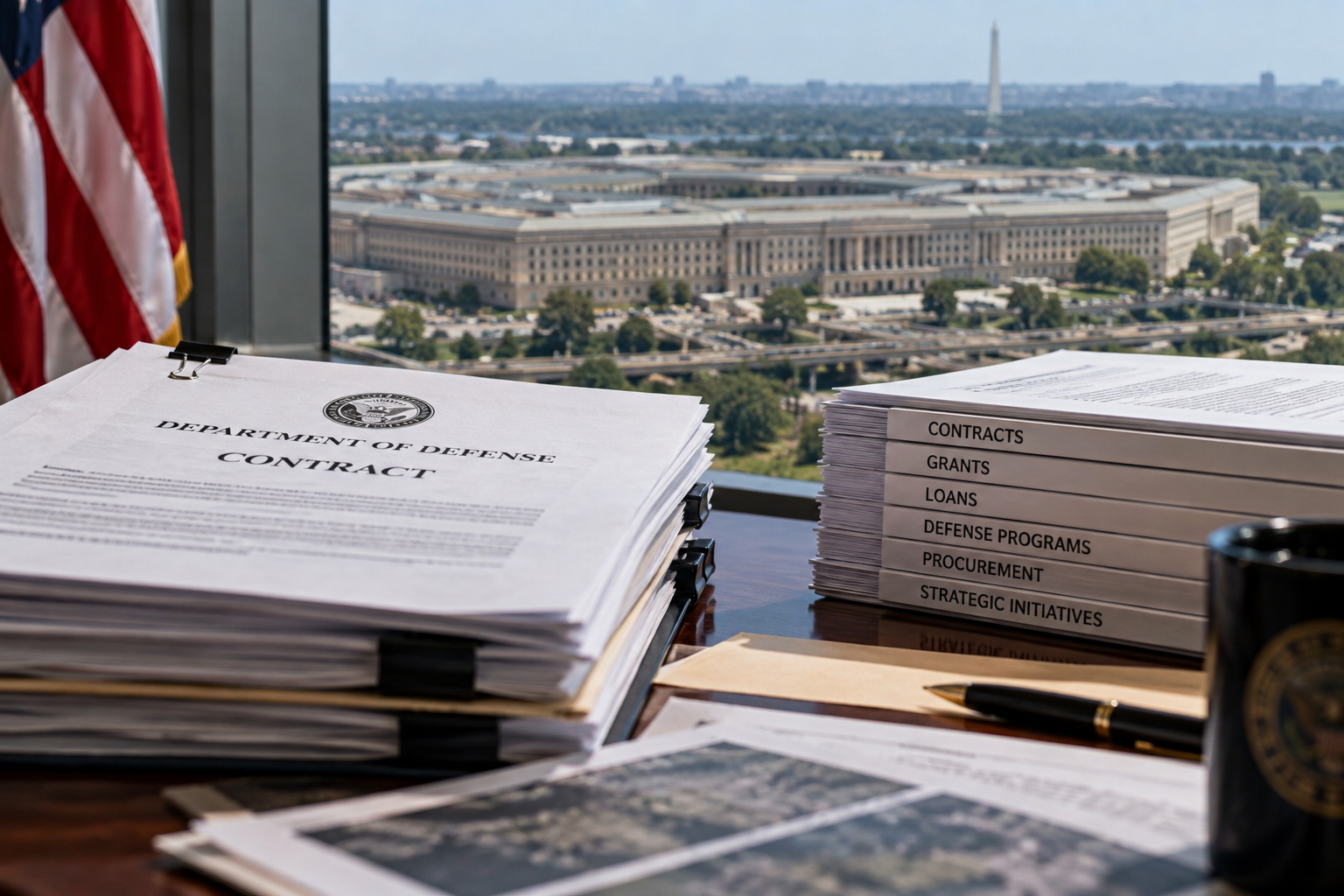
The Trump family's expanding business empire could become the subject of sweeping congressional investigations next year, with lawmakers preparing to examine billions of dollars in government contracts, Pentagon financing, cryptocurrency ventures and foreign investments involving companies connected to President Donald Trump's relatives.
Democratic lawmakers say that if their party gains control of either chamber of Congress in November, they intend to use congressional subpoena power to investigate whether members of the president's family have financially benefited from decisions made by the federal government.
The questions extend far beyond the Trump Organization's traditional hotels, golf courses and real estate holdings.
Donald Trump Jr. and Eric Trump have become involved with investment firms holding stakes in defense contractors and technology companies that do business with the federal government. The Trump family has also moved aggressively into cryptocurrency, while Jared Kushner's investment firm has attracted billions of dollars from foreign governments and sovereign wealth funds.
None of that, by itself, proves corruption.
But the sheer overlap between the Trump family's private financial interests and the government controlled by Donald Trump has created a sprawling collection of potential conflicts that lawmakers say deserve examination.
And some of the companies involved are already preparing for subpoenas.
$3.2 Billion in Government Business
One of the largest questions involves companies connected to investment funds associated with Donald Trump Jr. and Eric Trump.
A Washington Post investigation identified 15 companies linked to the brothers that collectively received at least $3.2 billion in direct federal government business after the Trump sons invested in them.
Those companies also secured approximately $3.1 billion in additional potential contract options.
The numbers require some context.
Two established defense companies — SpaceX and Anduril — accounted for the overwhelming majority of the $3.2 billion in direct government business. Both were major government contractors independently of the Trump family, and several companies identified by the Post had federal contracts before Trump returned to office.
Ten of the 15 companies had previously done government business, while eight had contracts during the Biden administration.
But five received their first federal contracts after the Trump sons invested and while their father was president.
The Trump sons have said they are minority or passive investors and have not participated in federal contracting decisions.
Companies contacted by the Post similarly said their contracts were awarded through legitimate government procurement procedures based upon their products and capabilities.
The question for congressional investigators would be whether those safeguards operated as intended.
The $620 Million Vulcan Elements Deal
One transaction has attracted particular attention.
In August 2025, 1789 Capital — a venture-capital firm in which Donald Trump Jr. is a partner — invested in Vulcan Elements, a North Carolina company manufacturing rare-earth magnets.
Approximately three months later, the Pentagon announced plans for a $620 million loan to the company.
The timing immediately raised questions.
Then ProPublica uncovered another piece of the story.
According to its investigation, White House officials intervened to accelerate the Vulcan Elements deal, with senior Trump adviser Peter Navarro pushing Pentagon officials to prioritize the project.
Trump Jr. has said through representatives that he played no role in obtaining the government financing.
Vulcan Elements has also said it never asked 1789 Capital or its investors to lobby the government on its behalf.
There has been no finding that Donald Trump Jr. improperly influenced the loan.
Nevertheless, Democratic lawmakers have demanded documents and called for an investigation into how the financing was approved.
The sequence is precisely the kind of transaction congressional investigators want to examine:
A firm associated with the president's son invests in a company.
Months later, that company receives hundreds of millions of dollars in federal financing.
White House officials reportedly intervene to accelerate the deal.
Whether those events are merely coincidental or connected is the question investigators want answered.
Defense Contractors Become Family Investments
The Trump sons' growing involvement in defense technology has created another unusual situation.
Their investment interests include companies developing drones, artificial intelligence, quantum computing and other technologies increasingly sought by the Pentagon.
Donald Trump Jr. has also served as an adviser to drone manufacturer Unusual Machines.
Meanwhile, the Trump administration has made expanding domestic drone manufacturing and reducing America's dependence on Chinese technology a federal priority.
Again, supporting American defense manufacturing is not inherently improper.
Nor is investing in defense companies.
The potential conflict arises because the president controls an executive branch spending enormous amounts of taxpayer money in an industry in which his children now have significant private financial interests.
Congressional investigators want to determine whether political relationships influenced any of those decisions.
Then There Is Crypto
Defense contracting is only part of the story.
The Trump family has transformed itself into a major cryptocurrency player during Trump's second presidency.
Trump and his sons have interests in World Liberty Financial and other digital-asset ventures, while the administration has simultaneously pursued policies favorable to the cryptocurrency industry.
Those ventures have generated enormous wealth for the family.
They have also attracted investment from foreign individuals and entities, creating questions that would have been difficult to imagine when Trump's business empire consisted primarily of buildings, resorts and licensing deals.
One particularly controversial transaction involved World Liberty Financial and investors connected to Sheikh Tahnoon bin Zayed al-Nahyan, the United Arab Emirates' national security adviser and a member of Abu Dhabi's ruling family.
Lawmakers have questioned whether foreign governments or politically connected investors could potentially gain influence by investing in businesses benefiting the president's family.
The existence of those investments does not establish that U.S. policy was exchanged for financial benefit.
That is precisely what lawmakers say they want to investigate.
Jared Kushner Could Face Questions Too
Trump's son-in-law Jared Kushner may also find himself under congressional scrutiny.
After leaving the White House following Trump's first term, Kushner created Affinity Partners, a private-equity firm that attracted billions of dollars from foreign investors, including Saudi Arabia's sovereign wealth fund.
Kushner has also participated in diplomatic efforts involving the Middle East.
Democratic Rep. Jamie Raskin has identified Affinity Partners as one of the businesses lawmakers could examine.
Kushner's representatives reject suggestions that his activities are improper and argue that critics have failed to identify laws or regulations he has violated.
But congressional investigations do not require prosecutors to establish that a crime has already occurred.
Congress can investigate conflicts of interest, government contracting, foreign influence and the operation of federal agencies.
And if control of Congress changes, lawmakers intend to do exactly that.
Companies Are Already Preparing
Perhaps the clearest indication that the threat is being taken seriously comes from the companies themselves.
Reuters reported that corporations connected to Trump-family business interests are already preparing for possible congressional investigations.
Some have conducted internal reviews.
Others have hired lawyers and crisis-communications specialists.
Donald Trump Jr.'s 1789 Capital has retained Quinn Emanuel, one of the country's most prominent litigation firms, to assist with potential congressional investigations.
That preparation is happening before a single subpoena has been issued.
The Question Congress May Soon Ask
There is an important distinction between conflicts of interest and proven corruption.
Billions of dollars flowing to companies in which members of the president's family have investments does not automatically demonstrate that government contracts were improperly awarded.
Foreign investors putting money into Trump-family businesses does not automatically demonstrate that American foreign policy was sold.
And a company receiving federal financing after a Trump-family investment does not, by itself, establish political interference.
But those transactions create questions that are extraordinarily difficult to ignore when the president of the United States controls the executive branch responsible for many of the decisions affecting those investments.
The Trump family's business interests now stretch across defense technology, artificial intelligence, cryptocurrency, real estate, private equity and foreign investment.
At the same time, the federal government controlled by Donald Trump regulates, finances, contracts with and makes policy affecting many of those same industries.
If congressional control changes in November, Democrats say they intend to start pulling those threads.
And with billions of dollars involved, they may have a great many threads to pull.