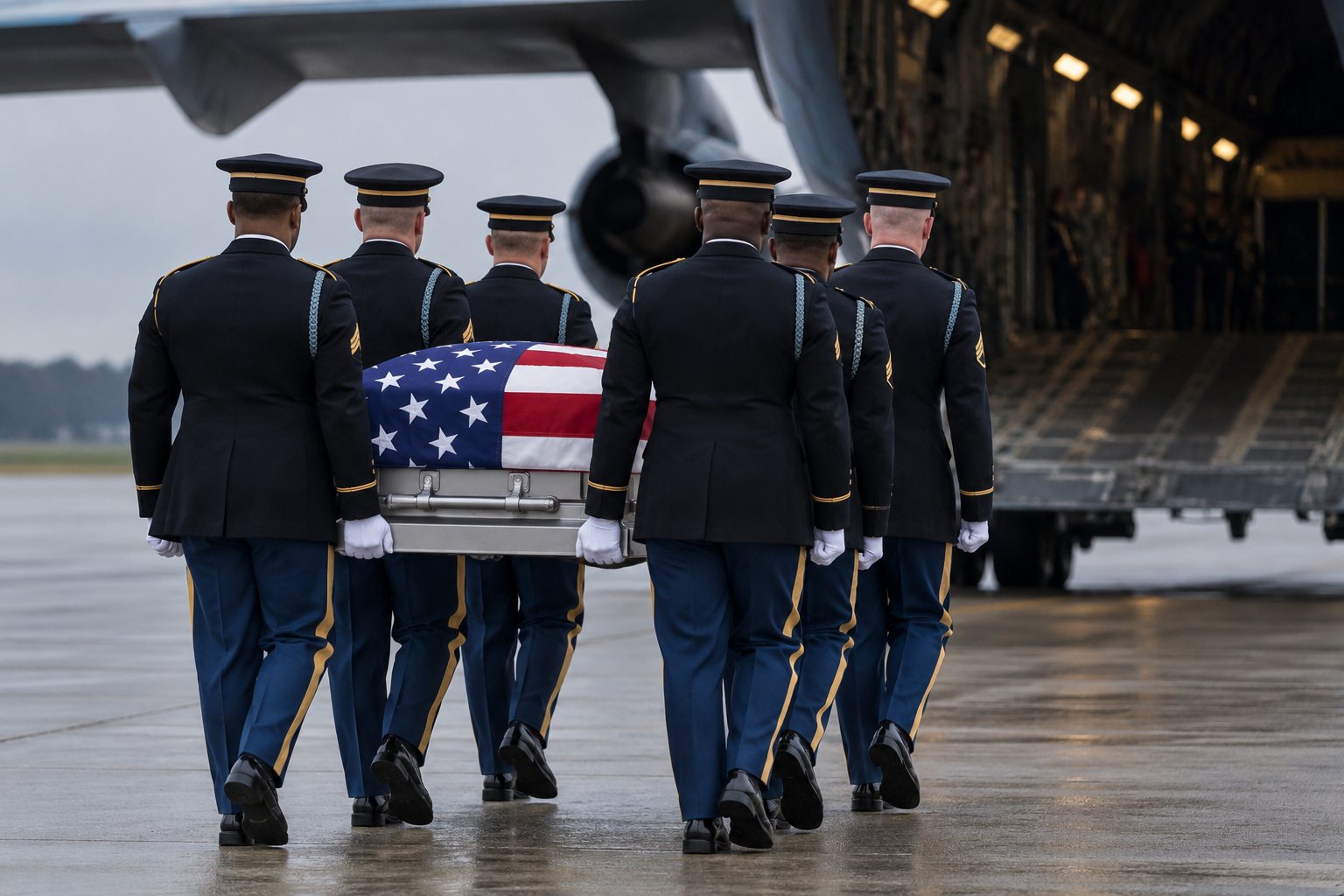
President Donald Trump became embroiled in a controversy on October 17, 2017, after Representative Frederica Wilson of Florida accused him of making insensitive remarks during a condolence call to the widow of a U.S. Army soldier killed in Niger.
Sergeant La David Johnson, 25, was one of four American service members killed during an October 4 ambush in the West African nation. His death left behind his pregnant wife, Myeshia, and their two young children.
The president's telephone call was intended to offer comfort to a grieving military family. Instead, it became the center of a national dispute over Trump's words, his treatment of fallen service members, and the responsibilities of a commander in chief.
Wilson, who was present when the call was received, said Trump told Johnson's widow that her husband knew what he was signing up for when he joined the military.
The White House disputed Wilson's characterization of the conversation. But Johnson's mother, who also heard the call, supported the congresswoman's account.
Four American Soldiers Killed in Niger
On October 4, 2017, American and Nigerien troops were ambushed by militants affiliated with the Islamic State while conducting a military operation near the village of Tongo Tongo, Niger.
Four American soldiers were killed: Staff Sergeant Bryan Black, Staff Sergeant Jeremiah Johnson, Staff Sergeant Dustin Wright, and Sergeant La David Johnson.
The attack raised questions about the mission, intelligence failures, and the circumstances that left American troops vulnerable to a larger enemy force.
Johnson's body was not recovered immediately, prompting additional scrutiny of the military's response to the ambush.
The deaths also drew attention to an American military deployment that many members of the public had known little about.
Johnson, a Miami Gardens native, had served in the Army since 2014. His family and community remembered him as a devoted husband, father, and soldier.
The Phone Call That Sparked a National Controversy
On October 17, Trump called Myeshia Johnson as she traveled to receive her husband's remains.
Representative Wilson was accompanying the family and heard the conversation over the vehicle's speakerphone.
Wilson told reporters that Trump said Johnson knew what he was signing up for, but that his death must still hurt.
According to Wilson, the remarks upset the grieving widow, who was already struggling with the loss of her husband.
Wilson criticized the president's language as inappropriate for a condolence call.
The congresswoman also alleged that Trump appeared to have difficulty recalling Johnson's name during the conversation.
The president subsequently disputed Wilson's account, maintaining that he had spoken respectfully to the family.
Because no publicly available recording established every word spoken during the call, the dispute initially depended on the accounts of those who participated in or overheard the conversation.
Johnson's Mother Supports the Congresswoman's Account
The controversy intensified when Johnson's mother, Cowanda Jones-Johnson, confirmed that she had heard the president's call.
Speaking to The Washington Post, she supported Wilson's account and said Trump had disrespected her son and his family.
Her statement directly challenged the White House's suggestion that Wilson had misrepresented the conversation.
Days later, Myeshia Johnson appeared on ABC's Good Morning America and publicly described her experience.
She confirmed that Trump had said her husband knew what he signed up for and expressed frustration that the president had appeared to struggle with her husband's name.
She also said the call had made her cry even more.
Trump responded by disputing her account, saying he had spoken Johnson's name without hesitation.
The disagreement had now expanded beyond a dispute between the president and a member of Congress. The fallen soldier's own widow and mother were publicly challenging the president's description of a condolence call intended for their family.
Trump Had Already Attacked Obama's Treatment of Military Families
The controversy unfolded against another dispute involving Trump and former President Barack Obama.
On October 16, Trump had been asked why he had not publicly addressed the deaths of the four soldiers sooner.
He responded by claiming that previous presidents, including Obama, had not always called the families of fallen service members.
Trump suggested that he personally made a greater effort to contact grieving military families.
The assertion immediately drew criticism from former Obama administration officials and military families who said the former president had regularly contacted or met with relatives of fallen troops.
Trump subsequently qualified his remarks, acknowledging that he did not know whether Obama had called every family.
The exchange raised questions about why the president had introduced comparisons with his predecessors into a discussion about soldiers killed under his own command.
Rather than focusing exclusively on the fallen service members and their families, the administration found itself defending the president's claims about previous commanders in chief.
A Growing Confrontation With a Gold Star Family
The dispute recalled an earlier controversy involving Trump and the parents of Army Captain Humayun Khan, who was killed in Iraq in 2004.
During the 2016 presidential campaign, Khizr and Ghazala Khan criticized Trump's proposed restrictions on Muslim immigration.
Trump responded with personal remarks about the family, prompting widespread criticism from veterans, military families, and members of both political parties.
The Johnson controversy renewed concerns about how Trump responded when grieving military families or their representatives publicly challenged him.
Supporters of the president argued that condolence calls are inherently difficult and that Trump's words may have been misunderstood or taken out of context.
Critics countered that the president's public arguments with people connected to fallen service members risked adding to the families' distress.
The White House Defends the President
White House officials defended Trump's intentions and rejected accusations that he had deliberately insulted Johnson's widow.
They argued that the president had attempted to express sympathy and acknowledge the dangers inherent in military service.
Trump also accused Wilson of inaccurately describing the call.
The administration's position was that the president had sought to console the family and that the resulting controversy had been politicized.
Wilson maintained that she was accurately reporting what she heard.
The dispute continued for days, eventually drawing White House Chief of Staff John Kelly, a retired Marine general whose own son had been killed in Afghanistan, into the controversy.
Kelly defended the president's intentions and criticized Wilson's role in publicizing the call.
His involvement demonstrated how a private condolence conversation had developed into a confrontation involving the White House, Congress, military families, and senior administration officials.
The Family at the Center of the Controversy
Throughout the public dispute, the Johnson family was preparing to bury a husband, father, and son.
Myeshia Johnson was pregnant with the couple's third child.
The family faced the immediate consequences of a military death while political leaders debated the meaning and appropriateness of the president's remarks.
For many military families, the controversy highlighted the importance of how government officials communicate with relatives who have lost loved ones in service.
A presidential condolence call carries unusual significance. It represents not only the personal sympathy of the commander in chief but also the nation's recognition of a service member's sacrifice.
Whether Trump's words were intended as an acknowledgment of military risk or were delivered insensitively became the central disagreement.
What was not disputed was that members of Johnson's family were deeply upset by the conversation.
A Controversy About Presidential Responsibility
The October 17 episode exposed the tension between the president's account of his intentions and the family's description of its experience.
Trump insisted that he had attempted to express sympathy and respect.
Wilson and Johnson's relatives maintained that the remarks had been hurtful.
The administration's subsequent public arguments kept the controversy in the national spotlight, drawing additional attention to the president's relationship with military families.
The incident also demonstrated how quickly a private exchange could become a major political dispute when the president challenged the accounts of those directly involved.
For the Johnson family, however, the underlying tragedy remained unchanged.
A 25-year-old American soldier had been killed during an overseas military mission, leaving behind a wife and young children.
The lasting significance of October 17, 2017, was not simply a dispute over presidential wording. It was the public confrontation that followed a condolence call, leaving a grieving military family at the center of a national political controversy.