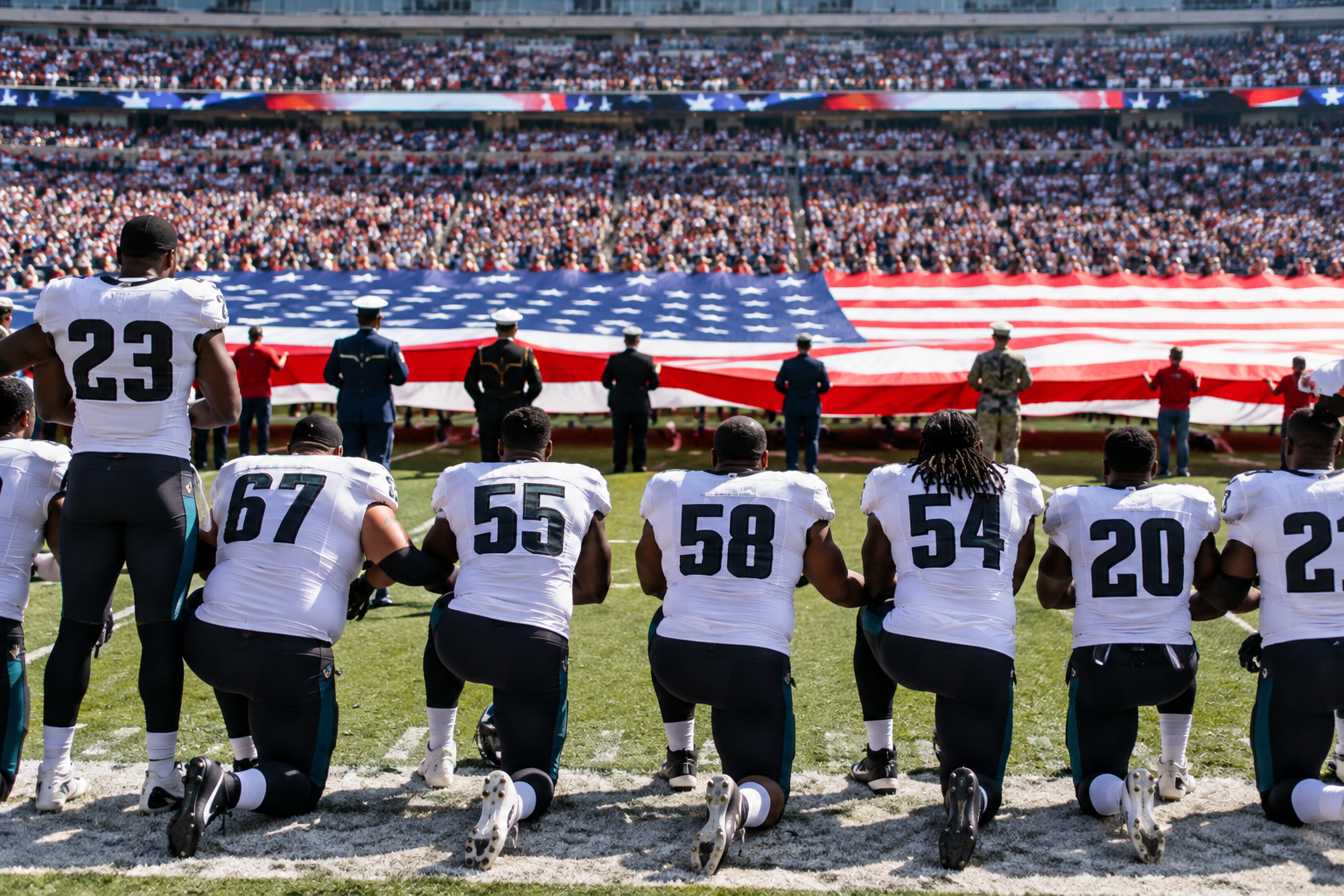
What began with one football player kneeling during the national anthem became a confrontation involving the president of the United States, the National Football League and hundreds of professional athletes.
On September 22, 2017, President Donald Trump stood before a political rally in Huntsville, Alabama, and turned his attention away from politics and toward professional football.
Trump criticized NFL players who refused to stand during the national anthem and called on team owners to remove them from the field.
Then he put it in language that immediately reverberated across the country.
“Get that son of a bitch off the field right now,” Trump told the crowd, describing what he wanted an NFL owner to say about a protesting player.
“He's fired. He's fired!”
Within 48 hours, Trump's remarks had transformed a protest involving a relatively small number of professional football players into a league-wide confrontation.
More than 200 players would kneel or sit during the national anthem that Sunday, while other players, coaches and team owners locked arms in demonstrations of solidarity.
The president had entered the NFL anthem controversy.
And the controversy exploded.
From Colin Kaepernick to the White House
The dispute had begun more than a year earlier.
In August 2016, San Francisco 49ers quarterback Colin Kaepernick began refusing to stand during the national anthem.
Kaepernick said his protest was directed at racial injustice and the treatment of Black Americans by police and the criminal justice system.
After initially sitting during the anthem, Kaepernick began kneeling after discussing his protest with former NFL player and Green Beret Nate Boyer. Kneeling was intended as a more respectful form of protest while still drawing attention to the issues Kaepernick wanted to highlight.
Other athletes eventually joined similar demonstrations.
By the beginning of the 2017 NFL season, Kaepernick was no longer on an NFL roster, but the protest he had started remained.
Players including Seattle Seahawks defensive end Michael Bennett and Philadelphia Eagles safety Malcolm Jenkins continued demonstrations intended to draw attention to racial inequality and social justice.
Then Trump entered the debate.
“Get That Son of a Bitch Off the Field”
Trump was in Alabama campaigning for Senator Luther Strange in a Republican Senate primary when he began discussing football.
The president complained about players kneeling during the anthem and suggested NFL owners should immediately remove anyone who did it.
Trump asked the crowd whether they would like to see an owner respond to a protesting player by saying:
“Get that son of a bitch off the field right now, out. He's fired.”
The audience cheered.
Trump predicted that an owner willing to do so would become extremely popular.
He also encouraged football fans to leave stadiums if they saw players protesting during the anthem.
The president's remarks changed the scale of the controversy almost overnight.
This was no longer simply an argument between football fans and a group of athletes.
The president of the United States was publicly calling for private employers to fire professional athletes because of their conduct during the national anthem.
The NFL Pushes Back
NFL Commissioner Roger Goodell responded the following morning.
Goodell said the league and its players were strongest when they helped create unity and criticized what he described as divisive comments that failed to recognize the positive role NFL players played in their communities.
The NFL Players Association responded as well.
Executive Director DeMaurice Smith defended the ability of players to participate in peaceful demonstrations and argued that professional athletes should not be told to remain silent simply because they played football.
Several NFL owners also issued statements disagreeing with Trump.
Among them was New England Patriots owner Robert Kraft, who had maintained a friendly relationship with Trump.
Kraft said he was “deeply disappointed” by the tone of the president's comments.
But the most visible response was still to come.
Sunday Becomes a Nationwide Demonstration
When NFL games began on Sunday, September 24, the national anthem suddenly became the focus of attention in stadiums across the league.
More than 200 players knelt or sat during the anthem.
Others stood while locking arms with teammates.
Coaches joined them.
Some owners stood alongside their players.
During the Baltimore Ravens-Jacksonville Jaguars game in London, players from both teams locked arms while several knelt.
Jacksonville Jaguars owner Shad Khan stood with his players, arms linked.
Elsewhere, the Seattle Seahawks and Tennessee Titans remained inside their locker rooms during the anthem.
Nearly the entire Pittsburgh Steelers team remained off the field during the anthem before its game against the Chicago Bears.
Steelers offensive tackle Alejandro Villanueva — a former Army Ranger who had served in Afghanistan — stood outside the tunnel during the anthem.
Across the NFL, teams responded differently.
Some players knelt.
Some sat.
Some raised fists.
Some stood.
Some linked arms.
Some teams remained inside.
But what had previously been a scattered protest had become a national spectacle.
What Was the Protest About?
At the heart of the controversy were two very different interpretations of the same act.
Players who participated in the demonstrations generally described them as protests against racial inequality, police brutality and injustice.
Trump and many of his supporters viewed kneeling during the national anthem as disrespectful to the American flag, the country and members of the military.
Trump repeatedly emphasized that distinction.
He argued that the issue was not race but patriotism and respect for the flag.
Players and their supporters countered that peaceful protest was itself an American freedom and that focusing exclusively on the anthem obscured the racial and criminal-justice issues the demonstrations were originally intended to highlight.
Those competing interpretations would define the argument for years.
Trump Keeps the Fight Going
Trump did not retreat after the reaction to his Alabama speech.
Instead, he continued discussing the issue on Twitter throughout the weekend.
He called for NFL owners to fire or suspend players who refused to stand and urged fans to boycott games until the protests stopped.
The confrontation now had nearly everything required for a major American culture-war battle.
Race.
Patriotism.
The military.
Freedom of expression.
Professional sports.
Celebrity.
And the presidency.
Football games that had previously begun with a routine pregame ceremony were suddenly being scrutinized nationally to see who stood, who knelt, who linked arms and who remained in the locker room.
A Protest Becomes Something Much Larger
There was an irony in what happened that weekend.
Trump's criticism was intended to pressure NFL owners into stopping anthem demonstrations.
Instead, his remarks prompted a dramatic expansion of them.
Players who had never previously knelt participated in demonstrations.
Owners who might otherwise have remained outside the controversy publicly stood beside their players.
Teams organized collective displays of unity.
The NFL Players Association defended the players.
And Commissioner Roger Goodell publicly criticized the president's rhetoric.
The original protest had begun with Colin Kaepernick trying to draw attention to racial injustice.
By September 2017, however, the argument had expanded far beyond Kaepernick.
It had become a national debate about what the flag represented, what patriotism required and whether professional athletes should use the enormous platform provided by sports to protest social injustice.
The President Changes the Argument
Trump's intervention also changed the political meaning of the controversy.
Before September 22, anthem demonstrations were largely an issue inside professional sports.
After Huntsville, they became inseparable from Trump himself.
Supporters of the president could view standing for the anthem as a defense of patriotism and national symbols.
Players and their supporters could view their demonstrations as both a continuation of the original social-justice protest and a defense of their right to peacefully dissent.
Neither interpretation eliminated the other.
Instead, the disagreement became another dividing line in an already deeply polarized country.
On September 22, Donald Trump went to Alabama to campaign for a Senate candidate.
In the middle of that rally, he spent several minutes talking about professional football.
Two days later, hundreds of NFL players were protesting or participating in demonstrations of solidarity across the country.
A protest that had begun with one quarterback on one sideline had reached the White House.
And after Trump entered the fight, America could no longer look away.