Wall Street began Friday expecting a relatively quiet end to the trading week.
Then Donald Trump started talking about tariffs.
Within hours, hundreds of billions of dollars in stock-market value had disappeared as investors reacted to the sudden prospect of a dramatically escalating trade confrontation between the United States and China.
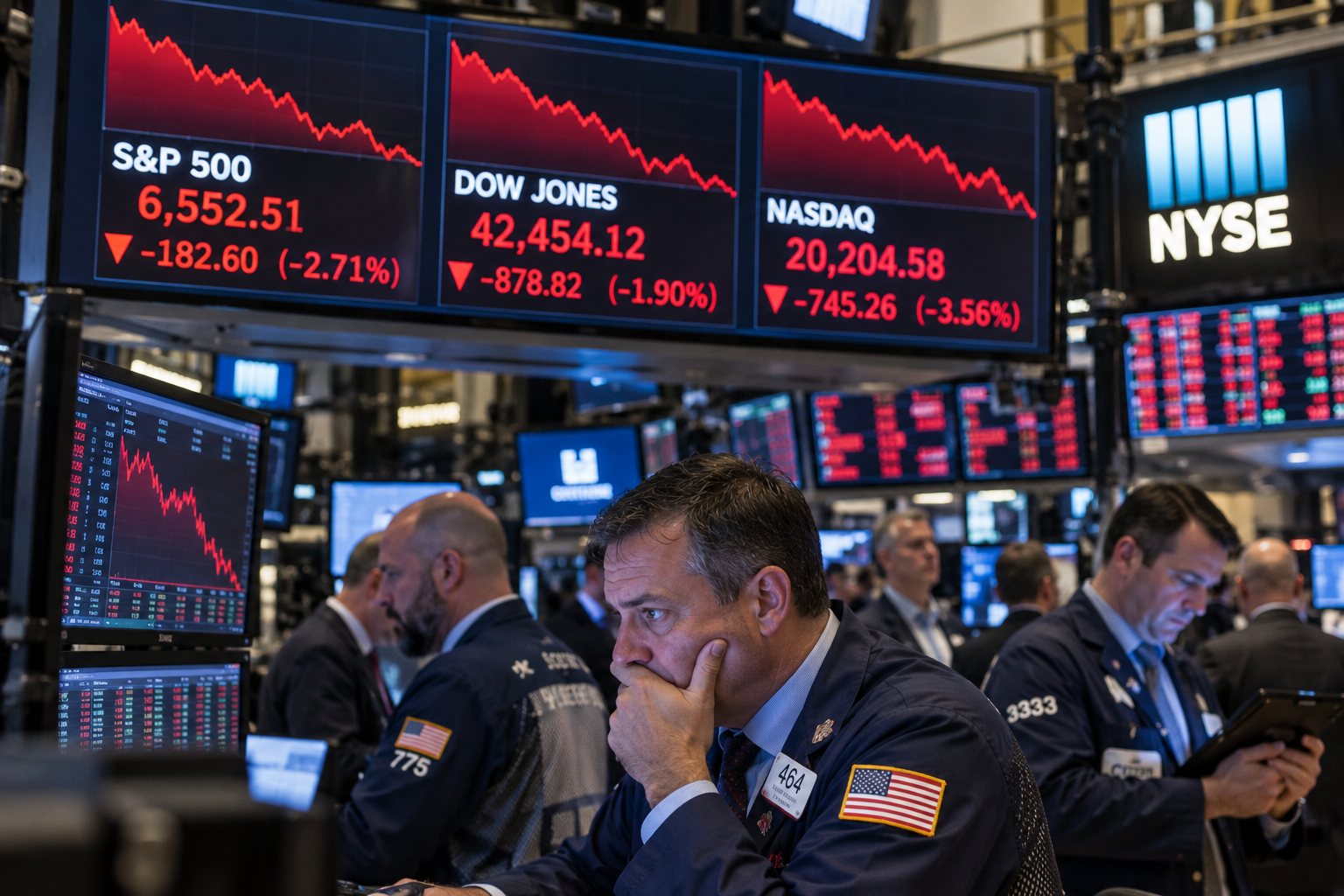
The S&P 500 plunged 2.7%.
The Dow Jones Industrial Average dropped 878 points, or approximately 1.9%.
The technology-heavy Nasdaq Composite fell about 3.6%.
It was the worst day for the S&P 500 and Nasdaq since the tariff-driven market turmoil of April.
And after the closing bell, Trump escalated the confrontation even further.
The president announced that beginning November 1, the United States would impose an additional 100% tariff on imports from China—on top of tariffs China was already paying.
The world's two largest economies were suddenly staring at another major escalation in their trade war.
China Tightens Its Grip on Rare Earths
The confrontation had intensified one day earlier.
On October 9, China announced sweeping new restrictions involving the export of rare-earth materials and technology.
Rare earths are a group of elements essential to a huge range of modern products.
They're used in smartphones.
Electric vehicles.
Computer chips.
Advanced electronics.
Wind turbines.
Robotics.
And crucially, American defense systems.
China dominates significant portions of the global rare-earth mining and processing industry, giving Beijing enormous leverage over industries that depend on those materials.
The new Chinese rules expanded export controls and required government approval for certain products containing Chinese rare-earth materials or produced using Chinese technology.
Beijing said the restrictions were related to national security.
Washington saw something much more threatening.
Trump Responds
On Friday morning, Trump erupted publicly.
In a lengthy social-media post, he accused China of becoming “very hostile” and complained that Beijing was attempting to use its dominance of rare-earth materials against the rest of the world.
Trump then introduced the possibility that the United States would retaliate with a dramatic increase in tariffs.
“One of the Policies that we are calculating at this moment is a massive increase of Tariffs on Chinese products coming into the United States of America,” Trump wrote.
Markets reacted almost immediately.
Stocks that had been relatively stable earlier in the session began falling.
Investors suddenly had to consider the possibility that the fragile trade truce between Washington and Beijing was collapsing.
Wall Street Heads Down
The selling accelerated throughout the afternoon.
Technology companies were particularly vulnerable because many depend heavily on complicated international supply chains involving China.
Nvidia fell nearly 5%.
Amazon and Tesla were among the other major technology companies hit hard.
The Philadelphia Semiconductor Index plunged approximately 6.3%.
Chinese companies trading in the United States fell as well.
By the closing bell, losses had spread across nearly every corner of the market.
Approximately six out of every seven companies in the S&P 500 declined.
The S&P 500 finished down 2.71%.
The Nasdaq Composite dropped 3.56%.
The Dow lost 1.90%.
It was the sharpest Wall Street selloff in months.
Then Trump Announces 100% Tariffs
But Trump wasn't finished.
After markets closed, he announced the specific retaliation.
Beginning November 1—or possibly sooner depending on China's actions—the United States would impose an additional 100% tariff on Chinese goods.
Trump emphasized that the new tariff would be imposed “over and above” existing tariffs.
The administration would also impose new export controls on what Trump described as “any and all critical software.”
It was an extraordinary escalation.
A 100% additional tariff does not simply mean that every Chinese product would automatically double in price at an American store. Tariffs are charged to importers, and the ultimate effects depend on how companies respond—whether they absorb some of the cost, negotiate lower supplier prices, change suppliers, reduce margins or pass costs along to customers.
But a tariff of that magnitude would dramatically increase the cost of importing many Chinese products into the United States.
And American businesses and consumers could ultimately bear significant portions of those higher costs.
Tariffs Aren't Paid by China
Trump has repeatedly described tariffs as money paid by foreign countries to the United States.
That description is misleading.
A tariff is collected by the U.S. government from the American importer bringing the product into the country.
For example, if an American company imports a product from China subject to a tariff, the American importer pays that tariff to U.S. Customs and Border Protection.
The importer then has choices.
It can absorb the cost.
It can pressure the Chinese supplier to lower its price.
It can attempt to move production elsewhere.
Or it can raise prices for American customers.
In practice, the burden can be distributed among companies, suppliers and consumers.
But Beijing does not simply write the United States Treasury a check for the tariff.
That distinction matters whenever tariffs are described as China “paying” America.
A Trade Truce Starts Falling Apart
The sudden escalation was particularly striking because relations between Washington and Beijing had appeared to be stabilizing.
Earlier in 2025, Trump had imposed extremely high tariffs on Chinese imports.
China retaliated.
The two countries subsequently negotiated reductions and pauses as officials attempted to prevent the trade confrontation from spiraling further.
Trump was also expected to meet Chinese President Xi Jinping later in October during a trip to South Korea for the Asia-Pacific Economic Cooperation summit.
After China's rare-earth announcement, Trump suddenly questioned whether that meeting should happen at all.
“There seems to be no reason” to meet Xi, Trump wrote.
Within roughly 24 hours, the relationship had shifted from cautious negotiations toward renewed confrontation.
Why Rare Earths Matter
China possessed an unusually powerful weapon in this trade fight.
Rare-earth elements are difficult to replace quickly because China controls much of the infrastructure required to process them.
Building alternative mines and processing facilities can take years.
That leaves American companies exposed.
The defense industry is particularly sensitive.
Rare-earth materials are used in advanced weapons systems, aircraft, guidance equipment, radar systems and other military technologies.
They are also essential to semiconductor manufacturing and many technologies associated with artificial intelligence.
China therefore wasn't merely retaliating against American tariffs by placing duties on American products.
It was threatening access to materials that some American industries couldn't easily obtain elsewhere.
That was precisely why markets were nervous.
The Market Sends an Immediate Message
Stock markets rise and fall for many reasons, and a single trading day's movement cannot be attributed perfectly to one statement or policy.
But the timing on October 10 was striking.
Stocks had been relatively calm.
Trump announced that he was considering a massive tariff increase against China.
Selling accelerated sharply.
By the end of the session, the S&P 500 had suffered its largest one-day decline since April.
The Nasdaq had fallen even further.
The volatility index—the market's widely watched measure of expected turbulence—jumped to its highest closing level since June.
Investors weren't reacting to an abstract debate about trade policy.
They were attempting to price the possibility of another major economic confrontation between the United States and China.
Tariffs Create Winners and Losers
Trump's argument for tariffs was straightforward.
He maintained that tariffs could pressure companies to manufacture more products in the United States, reduce America's dependence on China, protect American industries and give Washington leverage in trade negotiations.
Supporters of aggressive trade measures also had legitimate concerns about China's economic practices and its dominance of critical supply chains, particularly rare-earth materials.
China's new export restrictions demonstrated exactly why dependence on a geopolitical competitor could be dangerous.
But tariffs also carry costs.
Companies dependent on imported components can face higher expenses.
Manufacturers can see supply chains disrupted.
Farmers can become targets of retaliation.
Consumers can face higher prices.
Businesses can delay investment because they don't know what future trade rules will look like.
Financial markets dislike that uncertainty.
On October 10, Wall Street demonstrated just how quickly that uncertainty could matter.
From Threat to Selloff in Hours
The sequence unfolded remarkably quickly.
China tightened its rare-earth export restrictions.
Trump accused Beijing of economic hostility.
He threatened a massive increase in tariffs.
Stocks plunged.
Then, after the markets closed, Trump announced exactly how massive the increase could be:
An additional 100%.
The president said the tariffs would begin November 1, although he left open the possibility that they could begin sooner depending on China's actions.
He also suggested that despite the potential economic pain, the confrontation would ultimately benefit the United States.
“I never thought it would come to this,” Trump wrote, “but perhaps, as with all things, the time has come.”
One Post, Billions in Market Value
October 10, 2025 demonstrated the extraordinary economic consequences that could follow changes in U.S.-China trade policy.
Trump didn't need Congress to hold a vote that afternoon.
There was no lengthy legislative debate.
There wasn't even a formal tariff announcement when the initial market selloff began.
There was a presidential social-media post threatening a “massive increase” in tariffs.
Wall Street understood the implications.
The S&P 500 fell 2.7%.
The Nasdaq dropped 3.6%.
The Dow lost nearly 900 points.
And then, after the markets had closed, Trump announced that the threatened tariff increase would be 100% on top of existing tariffs.
China had demonstrated the economic leverage created by its control of rare-earth materials.
Trump responded with the economic weapon he had relied upon repeatedly:
Tariffs.
By the end of October 10, the world's two largest economies had moved significantly closer to another full-scale trade confrontation—and American financial markets had already registered the shock.