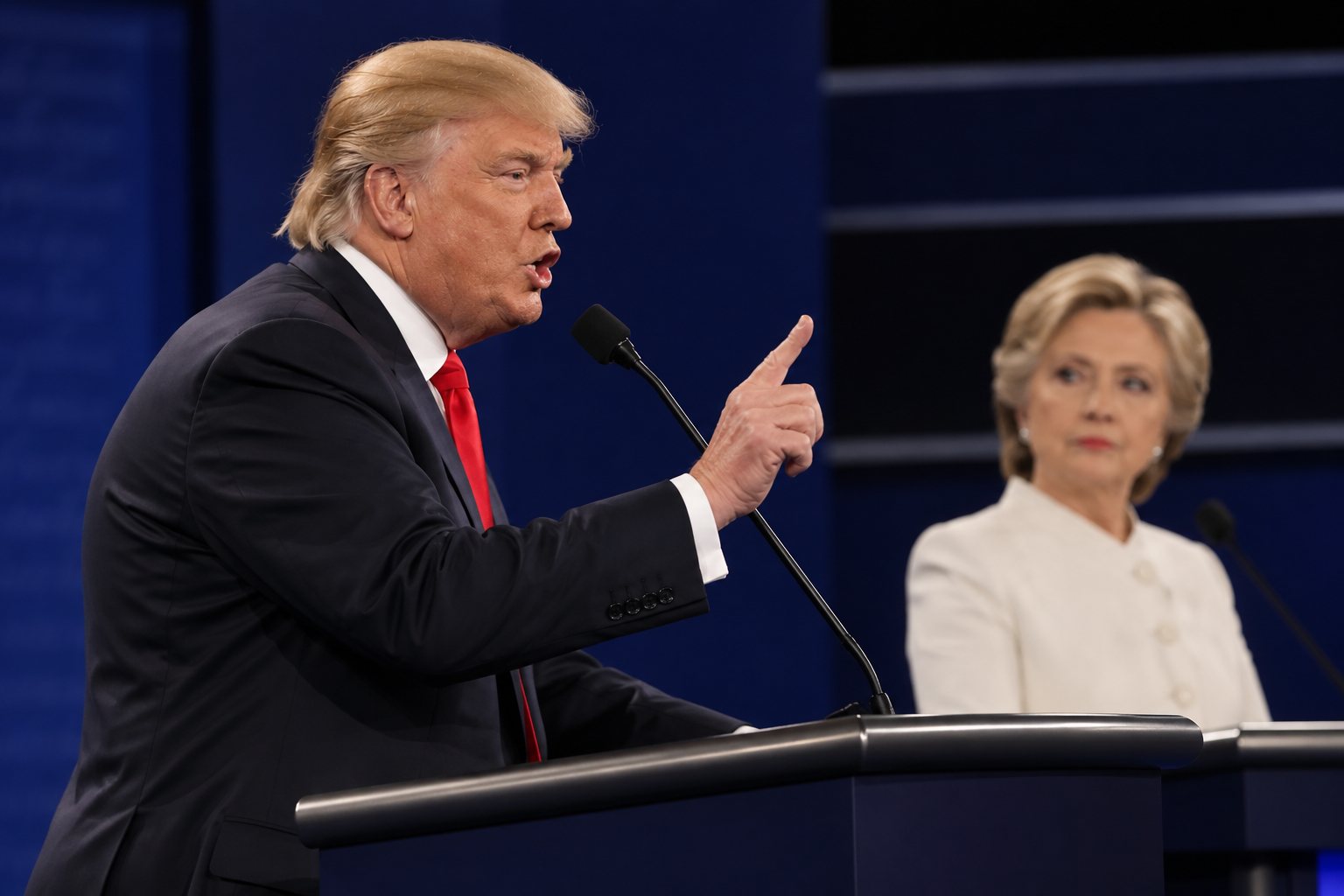
One night after Donald Trump told Hillary Clinton that she would be “in jail” if he became president, the Republican nominee returned to the campaign trail and continued an extraordinary escalation of his attacks against his political opponent.
The moment had come during the second presidential debate in St. Louis on October 9.
Trump accused Clinton of wrongdoing involving her use of a private email server while secretary of state and announced that, if elected, he would instruct his attorney general to appoint a special prosecutor to investigate her.
Clinton responded that it was fortunate someone with Trump's temperament was not in charge of the nation's legal system.
Trump shot back:
“Because you'd be in jail.”
The audience applauded.
It was one of the most remarkable exchanges of the 2016 presidential campaign: a major-party presidential nominee publicly threatening his opponent with prosecution and imprisonment if he won the presidency.
From the Debate Stage to Pennsylvania
Less than 24 hours later, Trump was campaigning across Pennsylvania.
At appearances in Ambridge and Wilkes-Barre on October 10, he continued portraying Clinton as corrupt and seized upon material released by WikiLeaks from emails belonging to Clinton campaign chairman John Podesta.
Trump presented excerpts from Clinton's previously private paid speeches as evidence that she had deceived voters about immigration, terrorism, health care, Social Security, Medicare and her relationship with Wall Street.
But several of Trump's descriptions did not match the fuller context of the leaked material.
FactCheck.org examined the claims and found multiple instances in which Trump distorted or misrepresented what the excerpts actually showed.
Trump claimed, for example, that Clinton's reference to “open borders” demonstrated that she wanted uncontrolled immigration into the United States.
The excerpt showed Clinton discussing a future hemispheric common market involving open trade and borders. FactCheck.org noted that Clinton had supported immigration enforcement and concluded that Trump's claim that she wanted “no controls” over immigration was unsupported.
Trump also claimed Clinton had admitted that ISIS could infiltrate the United States with refugees. The passage he cited concerned Jordan's difficulty screening the enormous number of Syrian refugees entering that country—not refugees entering the United States.
He accused Clinton of wanting to “knock the hell out of” Social Security and Medicare. The excerpts instead showed Clinton discussing the framework of a bipartisan deficit-reduction proposal without endorsing every recommendation it contained.
And Trump told supporters that Clinton had said terrorism was “not a threat to the nation.”
The fuller excerpt was considerably different.
Clinton had said terrorism was not a threat to the United States as a nation—meaning it would not destroy American society or its economy—before immediately describing terrorism as a “real threat” and a danger to American citizens.
“Lock Her Up”
Trump's attacks were taking place against the backdrop of a chant that had become increasingly common at his rallies:
“Lock her up.”
The phrase transformed allegations against Clinton into something more direct. Supporters weren't merely demanding another investigation or criticizing her handling of government records. They were calling for the opposing presidential candidate to be imprisoned.
Trump's debate statement pushed that rhetoric further.
He was no longer simply standing before crowds while they demanded Clinton's imprisonment. He was personally saying that his administration would appoint a prosecutor to investigate her—and telling Clinton to her face that she would end up in jail.
The exchange immediately raised questions about the traditional separation between presidential politics and federal criminal prosecution.
In the United States, presidents appoint attorneys general and set broad law-enforcement priorities, but criminal investigations are supposed to be based on evidence and law rather than used as punishment against political opponents.
Trump's statement suggested something different: winning an election could be followed by using presidential power to pursue the candidate who lost.
A Preview of Politics to Come
October 10, 2016 therefore represents more than another contentious day during an unusually bitter presidential campaign.
It captured an important shift in American political rhetoric.
Accusations of criminality were becoming a central part of Trump's political identity. Investigations, prosecutions and imprisonment were increasingly discussed not simply as matters for law enforcement but as weapons in a political struggle.
The language resonated with his supporters.
“Lock her up” became one of the defining chants of the MAGA movement.
And just hours after telling Hillary Clinton on national television that she would be in jail if he became president, Donald Trump was back before cheering crowds in Pennsylvania—attacking her character, citing leaked emails and presenting disputed interpretations of those documents as further evidence against her.
The campaign had crossed a line that would become increasingly familiar in the years ahead: political opponents were no longer simply people to defeat at the ballot box.
They were people to investigate, prosecute and imprison.