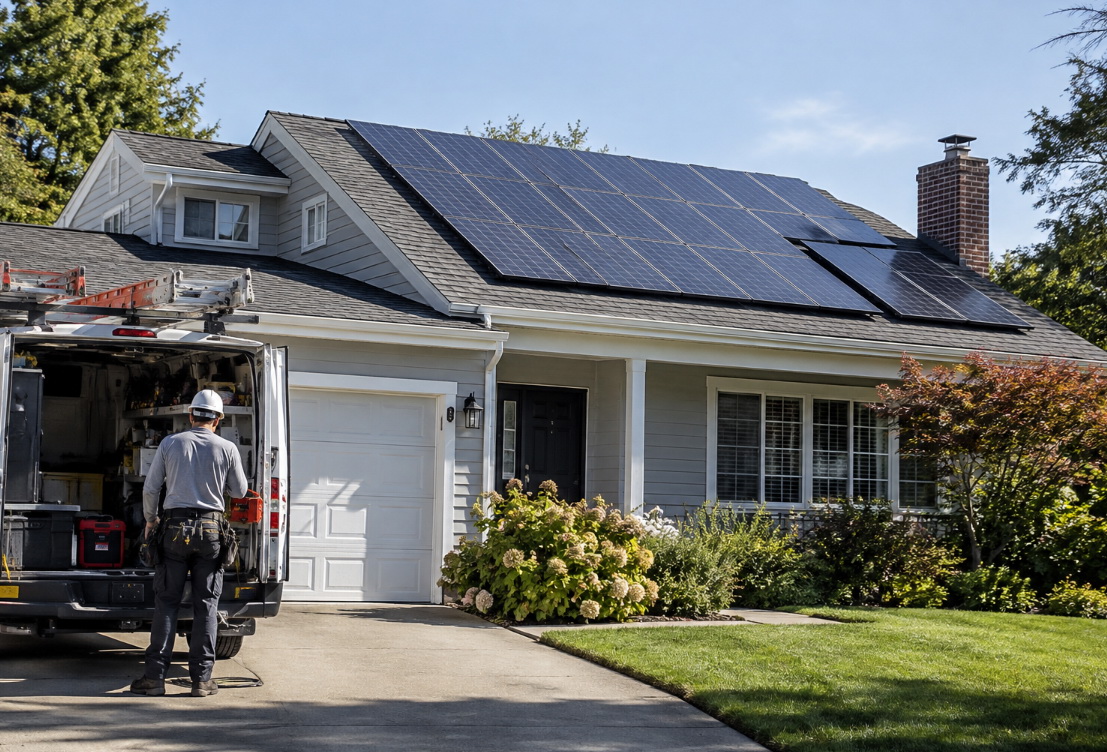
The Trump administration tried to eliminate a $7 billion federal program designed to bring solar power and lower electricity bills to hundreds of thousands of lower-income American households.
A federal judge has now ruled that it didn't have the legal authority to do it.
U.S. District Judge Mary McElroy ruled that the Environmental Protection Agency unlawfully terminated the Solar for All program, dealing another setback to the administration's effort to dismantle clean-energy programs created under President Joe Biden.
The decision doesn't merely criticize how EPA handled the cancellation. McElroy vacated the termination, effectively restoring the grants unless the ruling is overturned on appeal.
THE $7 BILLION PROGRAM
Solar for All was created through the 2022 Inflation Reduction Act and funded with $7 billion appropriated by Congress.
The program awarded money to states, tribal governments, municipalities and nonprofit organizations to expand access to residential solar power in communities where the upfront cost of installing solar panels can otherwise make the technology inaccessible.
EPA originally estimated that the program would benefit more than 900,000 households nationwide and eventually save participating households hundreds of millions of dollars annually on energy costs.
The Trump administration had other plans.
EPA Administrator Lee Zeldin announced in 2025 that the agency was terminating the program, arguing that the grants were no longer consistent with the administration's priorities and that EPA had authority to cancel them.
Grant recipients challenged that decision in court.
THE JUDGE DISAGREED
McElroy concluded that EPA could not simply terminate the program in the manner it had attempted.
Congress had specifically appropriated the money and established the program through federal law.
The court rejected EPA's attempt to treat the grants as though they could simply be withdrawn through an administrative decision.
That distinction is important.
Presidents have broad authority to establish policy priorities inside the executive branch, but federal agencies remain bound by laws passed by Congress. An administration generally cannot erase a congressionally created program simply because it disagrees with the policy behind it.
McElroy's ruling vacated EPA's termination of the Solar for All grants.
A TRUMP-APPOINTED JUDGE
There is another noteworthy detail in the case.
McElroy was appointed to the federal bench by Donald Trump.
Her path to the court was somewhat unusual: President Barack Obama initially nominated her in 2015, but the Senate did not act before Obama's term ended. Trump later nominated her himself, and the Senate confirmed her in 2019.
That doesn't determine how a judge will rule in any particular case, but it does make this decision notable in a political environment where unfavorable court rulings are frequently characterized by Trump and his allies as the work of partisan judges.
This time, the judge blocking the administration's action was one Trump himself placed on the federal bench.
REAL MONEY FOR REAL HOUSEHOLDS
The dispute can easily sound like another Washington fight over billions of dollars and federal programs.
For households expected to participate, however, the consequences are considerably more tangible.
Solar for All was intended to reduce one of the biggest barriers to residential solar energy: the initial cost.
The original program was designed to help communities develop rooftop solar, community solar projects and related energy programs while reducing electricity expenses for lower-income households.
Rhode Island alone had been awarded roughly $49 million through Solar for All.
Similar grants had been awarded throughout the country before EPA attempted to terminate the entire program.
THE ADMINISTRATION CAN STILL APPEAL
The legal battle isn't necessarily finished.
EPA has indicated that it is considering an appeal.
If the administration challenges McElroy's ruling, a federal appeals court could ultimately decide whether the grants remain in place.
For now, however, the administration's attempt to eliminate Solar for All has been stopped.
The ruling also underscores a larger constitutional fight that has repeatedly followed Trump's second administration: how much authority does a president have to refuse to spend money that Congress has already appropriated?
In this case, the answer from a federal court was clear.
Congress created the program.
Congress provided the money.
And the EPA could not simply make it disappear.