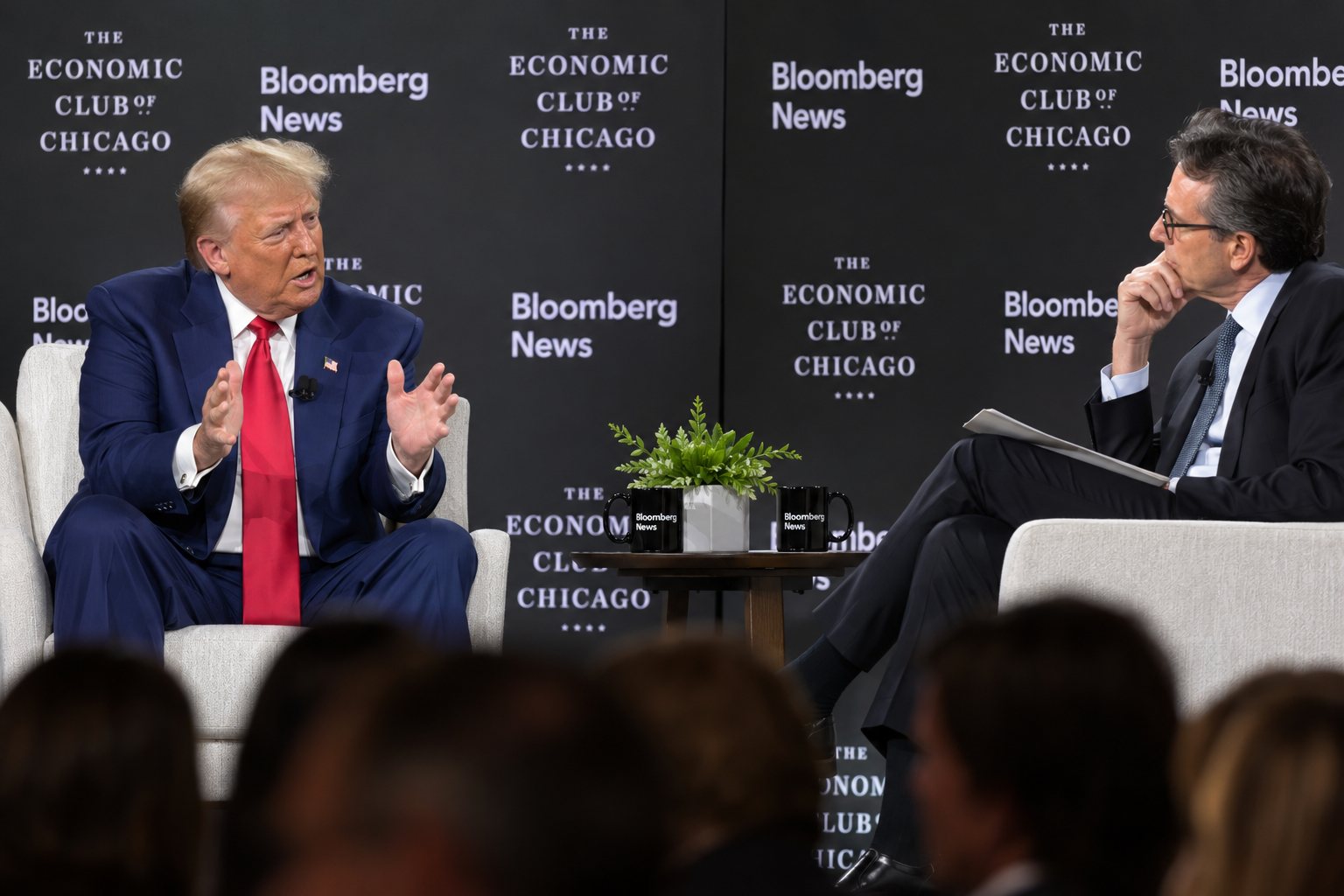
With just three weeks remaining before the presidential election, Donald Trump appeared before the Economic Club of Chicago on October 15, 2024, to explain his economic agenda. What followed was a frequently contentious interview in which the former president enthusiastically defended sweeping tariffs, dismissed economists' warnings, and insisted that taxing imported goods would bring manufacturing jobs back to the United States.
Interviewed by Bloomberg News Editor-in-Chief John Micklethwait, Trump repeatedly promoted tariffs as the solution to America's economic problems, even as his interviewer challenged him on their potential consequences for consumers, businesses, international trade, and the national debt.
At one point, Trump declared:
"To me, the most beautiful word in the dictionary is tariff."
He added that tariffs were his favorite word and joked that they needed a public relations firm to improve their reputation.
But behind the applause and laughter was a serious economic debate about who would ultimately pay for Trump's proposals.
Trump's Plan: Tariffs on Almost Everything
During his 2024 presidential campaign, Trump proposed dramatically expanding tariffs on imported goods.
His proposals included a universal tariff of 10% to 20% on nearly all imported products, tariffs of at least 60% on Chinese goods, and potentially much higher rates on certain automobiles manufactured outside the United States.
During the Chicago interview, Trump reiterated his willingness to impose tariffs as high as 200% on vehicles manufactured in Mexico.
He argued that these measures would discourage American companies from relocating production overseas while encouraging foreign manufacturers to build factories in the United States.
Trump presented tariffs as a powerful economic tool that could simultaneously protect American jobs, generate government revenue, and pressure foreign governments into making concessions.
He also insisted that the policy would not impose significant costs on American consumers.
That assertion was central to the disagreement between Trump and Micklethwait.
Who Actually Pays a Tariff?
A tariff is a tax imposed by a government on imported goods.
When a product enters the United States, the American importer is generally responsible for paying the tariff to U.S. Customs and Border Protection.
For example, if an American company imports a $1,000 product subject to a 20% tariff, the company ordinarily owes $200 in duties.
The importer can absorb that expense, negotiate a lower price with its foreign supplier, or pass some or all of the additional cost to American customers.
The precise burden depends on market conditions, competition, and the ability of businesses to adjust their supply chains.
However, Trump's repeated suggestion that foreign governments directly pay American tariffs misrepresented how the system works.
Research into tariffs imposed during Trump's first administration found that American importers and consumers bore much of their economic burden.
Some domestic manufacturers benefited from reduced foreign competition, but businesses dependent on imported materials also faced higher costs.
Economists warned that imposing much broader tariffs could increase consumer prices across a wide range of products, including automobiles, electronics, clothing, and household goods.
Bloomberg's Editor Challenges Trump's Economic Claims
Micklethwait repeatedly pressed Trump to explain how his proposed tariffs would affect American families and businesses.
He also questioned Trump's broader economic promises, including additional tax cuts and spending commitments.
Citing an analysis from the nonpartisan Committee for a Responsible Federal Budget, Micklethwait noted that Trump's proposals were projected to increase the national debt by approximately $7.5 trillion over a decade.
Trump rejected the concern, arguing that economic growth and tariff revenue would offset the costs.
He maintained that his policies would encourage companies to return manufacturing operations to the United States.
But when Micklethwait challenged the potential effects on prices and trade relationships, Trump often responded with anecdotes about negotiations with foreign leaders and business executives rather than detailed economic calculations.
The conversation grew tense as Trump repeatedly suggested that his interviewer misunderstood tariffs.
At one point, Trump told Micklethwait that he was wrong about their economic consequences, drawing laughter from the audience.
Economists Warn of Higher Prices
Economic researchers had already examined the potential consequences of Trump's proposed trade policies.
The Budget Lab at Yale University estimated that a 10% universal tariff combined with a 60% tariff on Chinese imports could reduce annual household purchasing power by approximately $2,576, including the effects of retaliation.
More aggressive tariff proposals could produce substantially larger losses.
Researchers also warned that tariffs could provoke retaliatory measures from other countries, reducing American exports and potentially hurting farmers, manufacturers, and other businesses dependent on international markets.
Trump's supporters disputed those projections.
They argued that tariffs could encourage domestic investment, reduce dependence on foreign manufacturing, and strengthen America's bargaining position in international negotiations.
A study cited by Trump's campaign suggested that a universal tariff, combined with other tax changes, could generate economic growth and additional employment.
The disagreement reflected a fundamental debate over whether the benefits of protecting domestic industries would outweigh the higher costs and trade disruptions associated with broad import taxes.
Trump Threatens American Allies
Trump's tariff proposals were not limited to China.
During the interview, he criticized America's traditional trading partners and suggested that allies had taken advantage of the United States economically.
When Micklethwait warned that aggressive tariffs could damage relationships with countries whose cooperation was important in competing with China, Trump dismissed the concern.
"Our allies have taken advantage of us more than our enemies," he said.
Trump argued that foreign manufacturers should be encouraged to establish production facilities inside the United States rather than export goods to American consumers.
His proposals raised concerns among businesses operating across international supply chains, particularly automobile manufacturers whose production facilities frequently span several countries.
Even vehicles assembled in the United States often contain parts manufactured abroad, meaning broad tariffs could affect American factories as well as foreign competitors.
The National Debt Question
Beyond tariffs, Micklethwait challenged Trump's promises to reduce corporate taxes and introduce additional tax exemptions.
The Committee for a Responsible Federal Budget estimated that Trump's proposals would substantially increase federal borrowing over the following decade.
Trump rejected the projection, arguing that stronger economic growth would generate sufficient revenue to offset the cost.
However, economists warned that the revenue from tariffs would be unlikely to cover all the proposed tax reductions and spending commitments.
Tariffs also create an economic contradiction when used as both a revenue source and a tool to eliminate imports.
If tariffs successfully persuade companies to manufacture products domestically, fewer imported goods are subject to the tax.
That can benefit certain American industries, but it also reduces the tariff revenue the government collects.
The administration would therefore face difficult tradeoffs between encouraging domestic manufacturing and relying on tariffs to finance other policies.
A Preview of Trump's Economic Agenda
The Chicago interview offered voters an unusually detailed look at Trump's economic philosophy.
He portrayed tariffs as a means of restoring American industrial strength, protecting domestic workers, and forcing foreign governments to negotiate on more favorable terms.
His critics warned that the approach could increase prices, provoke trade disputes, and worsen the federal deficit.
The interview also highlighted Trump's willingness to reject conventional economic analysis when it conflicted with his preferred policies.
Rather than retreating from the most controversial elements of his tariff proposals, Trump repeatedly defended them and suggested that economists and journalists had misunderstood their potential benefits.
With Election Day approaching, the exchange placed one of the campaign's central economic questions directly before voters.
Would sweeping tariffs restore American manufacturing and strengthen the economy, as Trump promised?
Or would American consumers and businesses ultimately pay the price through higher costs and disrupted trade?
On October 15, 2024, Trump made clear that tariffs would be central to his economic agenda. The debate over who would benefit—and who would pay—was far from settled.