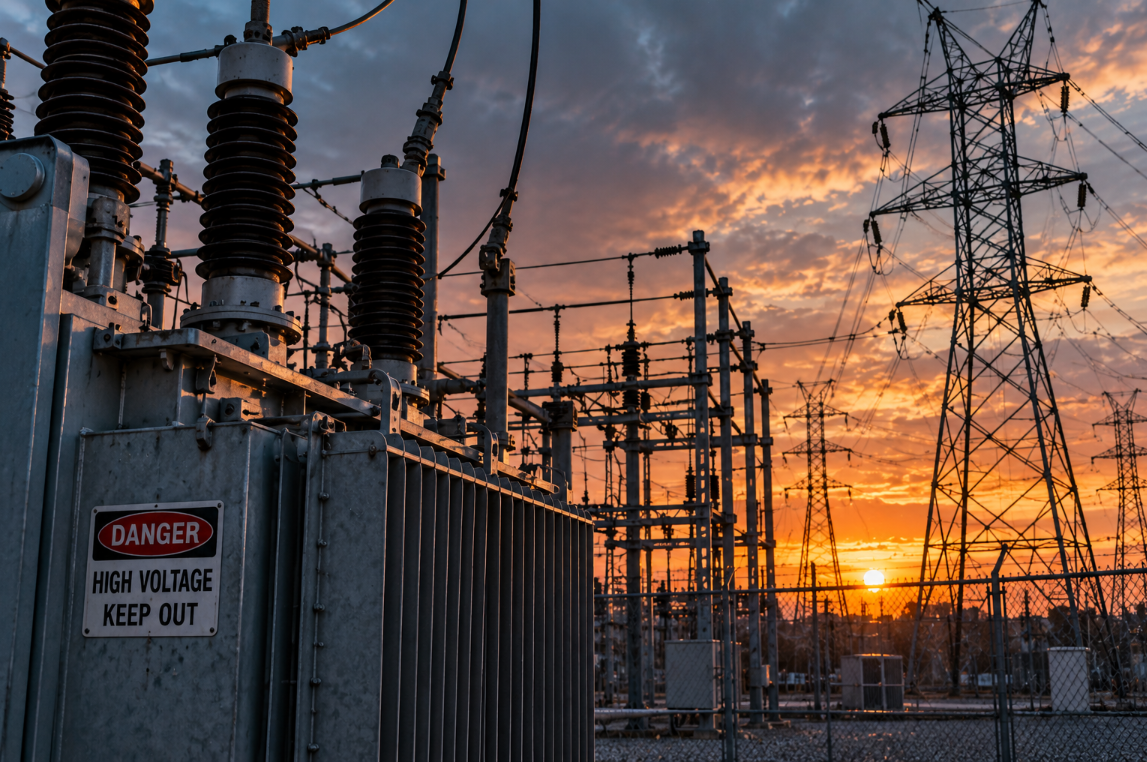
President Donald Trump has declared a national emergency involving the security of America's electrical grid, giving his administration sweeping new authority to restrict foreign-made equipment that officials believe could leave critical U.S. infrastructure vulnerable to sabotage, cyberattacks or remote interference.
Trump signed Executive Order 14421 on August 26, declaring that foreign-supplied equipment used in America's bulk-power system represents an “unusual and extraordinary threat” to the country's national security, foreign policy and economy.
The declaration does not mean that the nation's electrical grid is currently failing or that a nationwide blackout is imminent.
Instead, the administration says the danger comes from America's reliance on electrical equipment manufactured overseas — particularly sophisticated equipment containing software, firmware, communications technology or remote-access capabilities that could potentially be exploited by a foreign adversary.
A Power Grid Increasingly Connected to the Internet
America's electrical grid is no longer simply a network of generators, transformers and power lines.
Modern electrical infrastructure increasingly relies on computerized control systems, digital communications, remotely managed equipment and sophisticated software.
That creates capabilities that did not exist in previous generations of electrical equipment — but also creates new vulnerabilities.
The Trump administration argues that foreign-produced equipment could potentially contain digital backdoors or other hidden vulnerabilities allowing an adversary to remotely access or disrupt portions of America's electrical infrastructure.
A successful attack on the grid could affect far more than household electricity.
Hospitals, military installations, communications networks, water systems, financial institutions, transportation infrastructure, factories and emergency services all depend on a reliable supply of electricity.
Trump Gives the Energy Department New Authority
The executive order gives the Secretary of Energy substantial authority over certain foreign-produced equipment entering the American bulk-power system.
The government can prohibit the acquisition, importation, transfer or installation of covered equipment when officials determine that it is connected to a foreign entity and presents an unacceptable national-security risk.
The list of equipment potentially affected is extensive.
It includes transformers, generators, high-voltage circuit breakers, industrial control systems, utility-scale inverters, battery storage systems and other equipment found inside power plants, substations and control rooms.
Software, firmware, maintenance systems and remote-access capabilities associated with that equipment can also fall under the order.
The restrictions concern the nation's bulk-power system rather than the equipment used for ordinary local distribution of electricity to individual homes and businesses.
Equipment Already Installed Could Be Targeted
Perhaps the most significant part of Trump's order involves equipment that is already operating inside the United States.
The Energy Department can impose conditions on foreign-manufactured or foreign-operated equipment installed before the executive order was issued.
Depending on the risk involved, officials could require equipment to be identified, monitored, isolated or secured.
In more serious circumstances, the government could order equipment disconnected, replaced or removed entirely.
The order requires officials to consider the reliability of the electrical system, public safety, the availability of secure replacement equipment and the continuity of essential services before taking such action.
That provision could eventually lead to utilities examining equipment that has been operating for years without previously receiving this level of federal scrutiny.
China Looms Large Over the Debate
Although Trump's executive order establishes a framework that can apply to multiple foreign countries and entities, concerns about Chinese-manufactured technology have played a major role in Washington's growing scrutiny of the energy supply chain.
The issue extends beyond where a transformer, inverter or other piece of equipment was physically assembled.
Modern electrical equipment can contain components produced by numerous suppliers, along with proprietary software, communications equipment and remotely installed updates.
Determining exactly who controls those systems — and whether they could be manipulated during a confrontation with the United States — has become a national-security concern.
The administration is effectively treating some electrical equipment in much the same way Washington increasingly treats telecommunications and computer infrastructure: not simply as commercial products, but as potential points of access to critical American systems.
America's Electricity Needs Are Growing
The declaration comes as America's demand for electricity is growing.
Artificial intelligence, massive data centers, advanced manufacturing and defense production all require enormous amounts of reliable electrical power.
Trump specifically cited those developments when explaining the national emergency.
That creates a complicated challenge.
The United States needs to expand its electrical infrastructure while simultaneously reducing vulnerabilities created by dependence on foreign suppliers.
Transformers and other major grid components can also take considerable time to manufacture and replace, making it difficult to simply remove foreign equipment overnight.
The administration's order acknowledges that reality by allowing phased compliance and requiring officials to consider whether secure replacement equipment is actually available.
The Government Will Now Decide What Equipment Presents a Threat
The executive order itself does not simply prohibit every piece of foreign-manufactured electrical equipment.
Instead, it creates a process for determining which foreign entities, vendors, equipment and transactions present unacceptable risks.
The Energy Department has been directed to identify potentially dangerous equipment and develop recommendations for identifying, inventorying, isolating, monitoring or replacing it.
The department also has up to 120 days to issue regulations implementing the new authorities as needed.
Federal purchasing rules are expected to change as well.
Within 180 days, the Energy Department must recommend revisions to federal procurement rules intended to give greater consideration to national-security risks and prioritize American-manufactured energy infrastructure.
Another Expansion of Emergency Presidential Power
The declaration also carries significance beyond the electrical grid.
Trump invoked both the National Emergencies Act and the International Emergency Economic Powers Act, giving the executive branch substantial authority to regulate transactions involving equipment that officials determine threatens national security.
It is another example of the administration using emergency authority to address an issue that crosses the traditional boundaries between trade, technology, infrastructure and national defense.
Whether the declaration ultimately results in the removal of large amounts of foreign equipment remains to be seen.
Much will depend on the regulations the Energy Department develops, which countries and companies are ultimately targeted and how much potentially vulnerable equipment federal officials discover already operating inside America's electrical system.
For now, the administration has made one thing clear:
The equipment powering America's electrical grid is no longer being treated simply as infrastructure. It is being treated as a national-security asset — and potentially, as a national-security vulnerability.