The Trump administration faced growing international criticism on October 16, 2025, after President Donald Trump publicly confirmed that he had authorized the Central Intelligence Agency to conduct covert operations inside Venezuela.
The admission, made during an Oval Office appearance the previous day, represented a significant escalation in Washington's confrontation with Venezuelan President Nicolás Maduro.
It came amid an expanding American military buildup in the Caribbean, a series of lethal strikes against vessels accused of transporting drugs, and growing questions in Congress about whether the United States was moving toward another military conflict without explicit congressional authorization.
Trump also acknowledged that his administration was considering attacks on targets located on Venezuelan territory.
The president offered two principal justifications for authorizing CIA operations: allegations that Venezuela had deliberately sent prisoners and psychiatric patients into the United States, and claims that the country was responsible for significant drug trafficking.
The first allegation lacked credible supporting evidence. The second concerned a genuine international criminal problem, but it did not resolve questions about the legality or objectives of the administration's military campaign.
By October 16, the confrontation had expanded beyond maritime drug interdiction into a debate over covert intelligence operations, possible regime change, and the limits of presidential war powers.
Trump Publicly Acknowledges a Secret CIA Authorization
On October 15, reporters questioned Trump about a New York Times report that his administration had authorized covert CIA activities in Venezuela.
Rather than refuse to confirm the classified authorization, Trump acknowledged it.
He told reporters that he had approved the operations for two reasons.
First, he claimed Venezuela had emptied its prisons into the United States.
Second, he cited drugs entering America from Venezuela, particularly through maritime trafficking routes.
Trump declined to disclose the details of the CIA's mission.
When asked whether the agency had authority to take action against Maduro personally, the president avoided a direct answer.
He instead suggested that Venezuela was experiencing increasing American pressure.
The acknowledgment was unusual.
Presidents generally avoid publicly discussing specific covert CIA authorizations, even when the existence of an operation has been reported by news organizations.
Such activities can include intelligence gathering, influence operations, support for foreign groups, and other measures conducted under classified presidential authority.
But Trump's announcement did not establish which activities had actually been authorized or carried out.
That distinction was essential.
The administration had confirmed a covert-action authorization, not publicly disclosed an assassination order, an active coup operation, or a completed CIA attack inside Venezuela.
Trump Says the United States Is Considering Land Strikes
The president's remarks extended beyond intelligence operations.
Trump also said the administration was considering military action against targets on land.
The possibility represented a significant change from the strikes already being conducted against suspected trafficking vessels in Caribbean waters.
Attacking targets inside Venezuela could create a direct confrontation with the country's military and government.
Such operations would also raise questions about sovereignty, international law, civilian casualties, and the authority of the president to initiate hostilities without Congress.
Trump did not identify specific land targets.
He did not announce that a land operation had begun.
And he did not explain whether any potential strikes would target suspected drug facilities, armed groups, or assets associated with Maduro's government.
The uncertainty became part of the international concern.
American officials were discussing possible military action on Venezuelan territory while withholding details about the intelligence, objectives, and legal justification for the campaign.
Five Boat Strikes Had Already Killed 27 People
By October 16, the United States had carried out five publicly announced lethal strikes against vessels it alleged were involved in narcotics trafficking.
The attacks began in September.
According to the administration, 27 people had been killed.
The most recent publicly announced strike occurred on October 14, when Trump said American forces destroyed another vessel, killing six people.
The administration characterized those aboard the boats as members of drug trafficking organizations.
But officials had not publicly released sufficient evidence to independently verify the identities of those killed, the cargo aboard each vessel, or the intelligence supporting the targeting decisions.
That lack of disclosure was central to the controversy.
Traditional maritime counter-narcotics operations generally involve identifying suspected trafficking vessels, intercepting them, seizing contraband, and arresting suspects for prosecution.
The Coast Guard has conducted such operations for decades.
The Trump administration's approach involved destroying suspected trafficking vessels through military strikes.
The distinction was not merely tactical.
It raised the question of whether suspected criminal activity could lawfully be treated as grounds for lethal military targeting outside a recognized armed conflict.
The Administration's Unusual Legal Argument
Trump's administration asserted that the United States was engaged in an armed conflict with certain drug trafficking organizations.
Under that position, alleged members of designated criminal groups could be treated as military targets.
The argument attracted scrutiny from international law specialists and members of Congress.
Drug trafficking is a serious criminal offense, and organized trafficking groups can engage in extensive violence.
But criminal activity does not automatically create an armed conflict under international law.
Nor does an allegation that a person is transporting drugs, by itself, establish that the person may lawfully be killed in a military attack.
The legal standards governing the use of force depend on circumstances including the existence of an armed conflict, the status of the target, military necessity, and applicable international and domestic law.
The administration defended its actions as necessary to protect Americans from dangerous narcotics organizations.
Critics argued that the White House had not demonstrated the legal basis for treating the targeted individuals as enemy combatants.
By October 16, the administration had also provided lawmakers with limited evidence about the boats it had destroyed.
The controversy therefore involved two separate questions: whether the intelligence supporting the strikes was accurate, and whether the strikes were lawful even if the intelligence was accurate.
Trump Repeats an Unsupported Claim About Venezuelan Prisoners
One of Trump's stated reasons for authorizing CIA activity was his allegation that Venezuela had deliberately emptied its prisons and mental institutions into the United States.
He had repeated variations of this claim throughout his 2024 presidential campaign.
But he had not produced credible evidence establishing that the Venezuelan government was systematically releasing prisoners or psychiatric patients for the purpose of sending them across the American border.
Individual migrants may have criminal histories, and governments have legitimate responsibilities to identify and investigate such cases.
That is different from proving a coordinated foreign-government program to send prison populations into another country.
Trump presented the allegation as a principal justification for authorizing covert intelligence activity.
The absence of substantiating evidence made the claim particularly consequential.
The administration was invoking an extraordinary national security measure while relying, at least in its public explanation, on an accusation that had not been established.
Venezuela and the Drug Trade
The second justification involved drug trafficking.
Venezuela has long been a concern in international counter-narcotics investigations because of trafficking routes, corruption allegations, and the activities of organized criminal networks.
American prosecutors have accused Maduro and other Venezuelan officials of involvement in drug trafficking.
Maduro has denied wrongdoing.
The United States also offered a reward of up to $50 million for information leading to Maduro's arrest and conviction.
Those allegations were serious.
But the existence of drug trafficking networks in Venezuela did not establish that every vessel targeted by American forces was transporting drugs.
It also did not demonstrate that covert action against the Venezuelan government was the only available response.
Furthermore, Venezuela is not generally identified as the principal source of illicit fentanyl entering the United States.
Much of the fentanyl supply reaching American consumers has been linked to trafficking networks operating through Mexico.
Trump's broad references to the American drug crisis therefore did not fully explain the decision to concentrate such substantial military and intelligence resources on Venezuela.
Maduro Condemns the CIA Announcement
Venezuela's government reacted sharply.
Maduro accused Washington of reviving a history of American-backed interventions and attempts to remove foreign governments.
In public remarks on October 15, he rejected the prospect of regime change and warned against a wider conflict in the Caribbean.
Venezuela's Foreign Ministry described the authorization as a serious violation of international law and the United Nations Charter.
Those statements reflected the Maduro government's position.
They did not establish that the United States had already carried out an unlawful operation inside Venezuela.
But they illustrated how Trump's announcement was being interpreted in Caracas.
For Maduro, the CIA authorization was not simply another American law enforcement initiative.
It was presented as a potential threat to the survival of his government.
That interpretation was reinforced by Washington's military buildup and the administration's refusal to rule out additional forms of military action.
The CIA's History in Latin America Adds to the Alarm
The announcement also carried historical significance.
During the Cold War, the CIA participated in covert activities across Latin America, including operations intended to influence or remove governments.
In 1954, a CIA-backed operation helped overthrow Guatemala's elected president, Jacobo Árbenz.
In Chile, the Nixon administration authorized covert efforts to undermine President Salvador Allende's government before the 1973 military coup.
Historical investigations have documented American involvement in political destabilization and support for anti-communist forces across the region.
Those events remain important to political debates in Latin America.
They also explain why the public acknowledgment of new CIA activity inside Venezuela immediately raised concerns about possible regime change.
However, historical precedents do not establish the details of the 2025 authorization.
Trump had not publicly confirmed a plan to overthrow Maduro.
The New York Times reported that administration strategy was aimed at removing him from power, citing officials familiar with the matter.
The president himself declined to clarify whether that was the objective of the CIA authorization.
The uncertainty left a central question unanswered: Was the United States conducting a counter-narcotics operation, applying pressure to force political change, or preparing for a broader confrontation?
Congress Questions the Administration's Authority
The escalation prompted criticism from lawmakers concerned about the absence of congressional authorization and oversight.
Senator Jeanne Shaheen, the senior Democrat on the Senate Foreign Relations Committee, warned that the combination of covert CIA operations, deadly boat strikes, and discussion of land attacks was bringing the United States closer to open conflict.
Shaheen supported efforts to combat narcotics trafficking but questioned the administration's methods and lack of transparency.
Her concerns reflected a longstanding constitutional debate.
Under the Constitution, Congress possesses the power to declare war, while the president serves as commander in chief of the armed forces.
Presidents have historically ordered limited military operations without formal declarations of war.
But the legal boundaries of that authority remain contested, particularly when operations risk expanding into sustained hostilities.
Covert CIA activities also operate under statutory authorization and congressional notification requirements.
The fact that an activity is classified does not exempt it from legal oversight.
By October 16, lawmakers were asking whether the administration's actions could lead to an undeclared conflict whose scope and objectives had not been adequately explained to Congress or the public.
A Major American Military Presence in the Caribbean
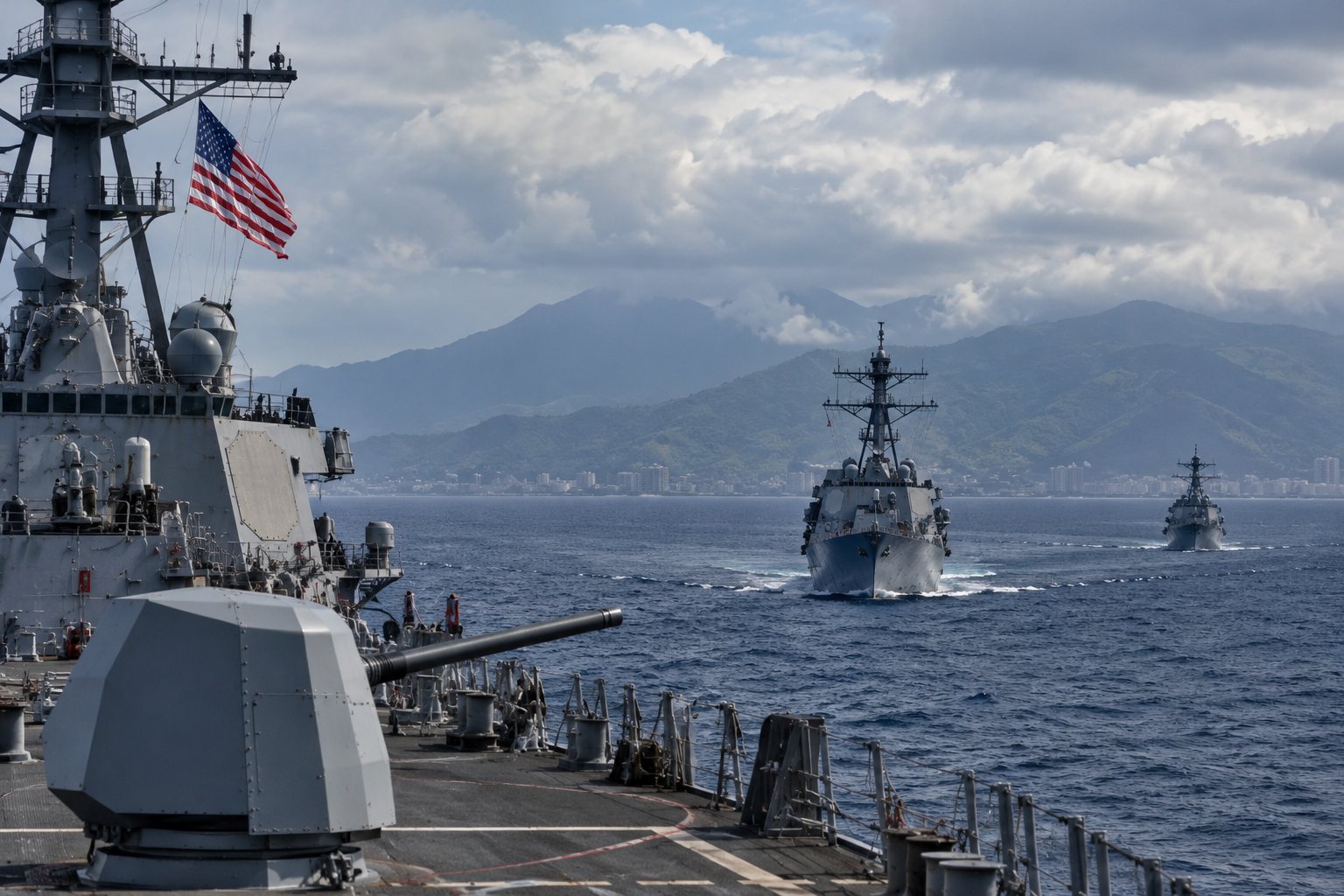
The CIA announcement came during a substantial American military deployment in the region.
U.S. naval forces, aircraft, and military personnel had been positioned near Venezuela as part of the administration's counter-narcotics campaign.
The deployment included major naval combatants and aviation assets capable of supporting operations far beyond routine maritime interdiction.
The administration maintained that the buildup was necessary to confront trafficking organizations.
But its size and capabilities also raised questions about whether the United States was preparing for additional military action.
A force assembled to intercept suspected drug smugglers can also provide options for surveillance, deterrence, strikes, and other military missions.
The distinction depends on the orders issued and the objectives established by civilian leadership.
Trump's acknowledgment that land operations were under consideration made those questions more urgent.
Was the Real Objective Removing Maduro?
The administration's publicly stated rationale emphasized drugs and migration.
But reporting about its broader Venezuela strategy suggested that pressure on Maduro's government was a major objective.
The New York Times reported that officials viewed the CIA authorization within a strategy intended to remove Maduro from power.
Trump did not publicly confirm that goal when questioned.
The distinction matters because counter-narcotics enforcement and regime change are different policy objectives.
The first focuses on disrupting criminal activity and prosecuting offenders.
The second seeks a change in political leadership.
Both can involve intelligence operations, diplomatic pressure, and sanctions, but they raise different legal and strategic questions.
A government may face legitimate criticism for authoritarian practices, corruption, or criminal conduct without every proposed foreign intervention automatically being lawful or effective.
Maduro's government had been widely criticized over disputed elections, political repression, and human rights abuses.
Those concerns were not erased by questions about American military policy.
But criticism of Maduro did not, by itself, establish that Washington possessed unlimited authority to use military force against Venezuela.
The Risks of Escalation
By October 16, several potentially dangerous developments were occurring simultaneously.
The United States had already killed 27 people in maritime strikes.
The president had acknowledged covert CIA authorization inside Venezuela.
American military forces were concentrated in the Caribbean.
And Trump had publicly discussed the possibility of extending attacks onto land.
Each development increased the importance of understanding the administration's intentions.
A strike on Venezuelan territory could provoke retaliation.
An intelligence operation discovered by Venezuelan security forces could trigger a diplomatic or military crisis.
A campaign intended to pressure Maduro could escalate if either government miscalculated the other's intentions.
Those were risks, not predictions that a particular conflict would occur.
But they were serious enough to warrant congressional scrutiny and public explanation.
What Was Known on October 16
By the end of October 16, the publicly established facts were significant.
Trump had authorized covert CIA activity involving Venezuela.
He had acknowledged that authorization on October 15.
He had said his administration was considering land-based strikes.
American forces had conducted five publicly announced attacks against alleged trafficking vessels, killing 27 people.
Venezuela's government had condemned the CIA announcement.
And lawmakers were questioning the legal basis, evidence, and objectives of the administration's actions.
Other matters remained unconfirmed.
The specific activities authorized for the CIA were classified.
There was no public confirmation that Trump had authorized the assassination of Maduro.
There was no public confirmation that a land strike had occurred.
And the administration had not established its claims about Venezuela systematically sending prisoners and psychiatric patients into the United States.
Those distinctions were essential to understanding the developing confrontation.
From Drug Enforcement to the Possibility of War
The events of October 15 and 16 marked a significant expansion of the Trump administration's confrontation with Venezuela.
What had been presented primarily as a campaign against drug trafficking now involved covert intelligence authorization, discussion of attacks on foreign territory, and increasingly direct pressure on another country's government.
The administration insisted that its actions were necessary to protect the United States.
Its critics questioned the evidence, legal authority, and possibility of a much wider conflict.
The central unanswered question was how far the president intended to go.
On October 16, 2025, the United States was confronting Venezuela with deadly military force, covert intelligence authority, and the possibility of strikes on land — while Congress and the American public still lacked clear answers about the administration's ultimate objectives.
The authorization of CIA operations did not establish that a regime-change operation was already underway.
But combined with the boat strikes, military buildup, and Trump's own remarks, it made the possibility of a broader confrontation an immediate and legitimate concern.
The consequences of that confrontation would depend not only on what Washington intended, but on how Venezuela responded and whether American political institutions exercised meaningful oversight of the use of force.