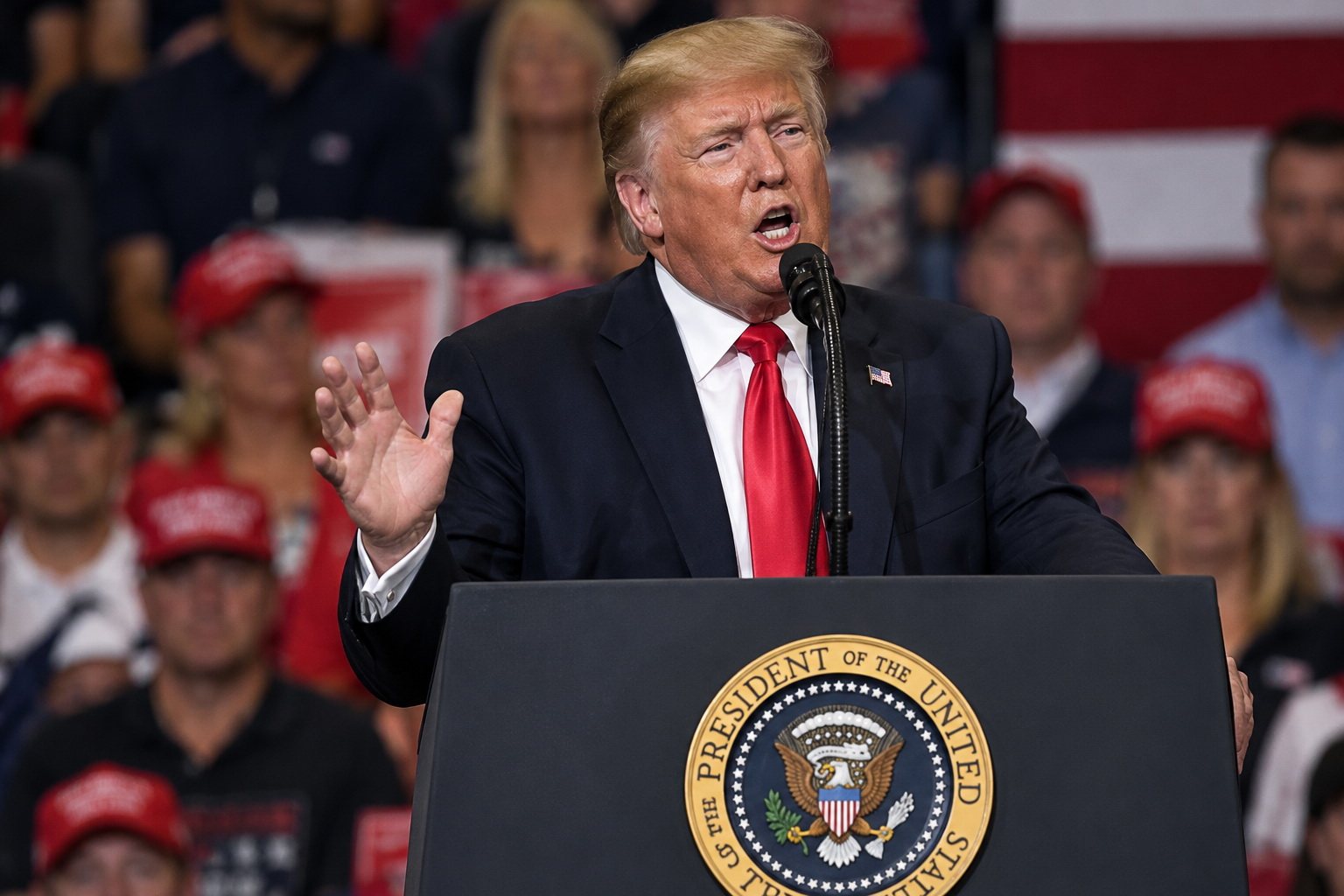
President Donald Trump sparked widespread outrage Tuesday after comparing the congressional impeachment investigation against him to a lynching, invoking one of the darkest chapters in American history to describe a constitutional process examining his conduct in office.
The president's remarks drew immediate criticism from Democrats, civil rights advocates, and several prominent Republicans, who condemned his comparison of a congressional investigation to the racially motivated murders of thousands of African Americans.
Trump Claims He Is the Victim of a Lynching
In a morning Twitter post, Trump complained that House Democrats were conducting an unfair impeachment investigation.
He warned that Republicans could eventually use impeachment against a future Democratic president before declaring:
"All Republicans must remember what they are witnessing here — a lynching. But we will WIN!"
The statement immediately ignited controversy.
Lynching was a form of extrajudicial violence used for generations to terrorize African Americans, particularly throughout the South during the Jim Crow era.
According to historical figures cited by the NAACP, 4,743 lynchings were recorded in the United States between 1882 and 1968. Of those victims, 3,446 were Black.
Trump's comparison placed his experience as president of the United States alongside the experiences of people who were murdered without legal protections, often by racist mobs.
Even Republicans Reject Trump's Language
Senate Majority Leader Mitch McConnell, one of Trump's most important Republican allies, criticized the president's choice of words.
"That was an unfortunate choice of words," McConnell told reporters, adding that he would not compare impeachment to a lynching given the country's history.
Republican Senator Susan Collins of Maine also rejected the comparison, saying the president should never have used it.
Representative Adam Kinzinger, an Illinois Republican, called on Trump to retract his statement, arguing that the country's history of lynching cannot reasonably be compared with political disagreements.
Not every Republican objected.
Senator Lindsey Graham of South Carolina defended the president, declaring that the impeachment investigation amounted to a lynching in every sense.
His defense drew additional criticism from civil rights organizations.
Black Lawmakers Condemn the Comparison
Representative James Clyburn of South Carolina, the highest-ranking African American member of Congress, strongly criticized Trump's remarks.
"That is one word no president ought to apply to himself," Clyburn said.
Congressional Black Caucus Chairwoman Karen Bass accused Trump of comparing a constitutionally established process to the systematic torture and murder of Black Americans.
Democratic presidential candidate Cory Booker described lynching as an instrument of white supremacist terrorism and rejected the president's analogy.
Former Maryland Lieutenant Governor Michael Steele, a Republican and former chairman of the Republican National Committee, also condemned the comparison.
Steele posted a historical photograph of an actual lynching to emphasize the difference between racial violence and a congressional investigation.
Impeachment Is a Constitutional Process
The controversy comes as House Democrats investigate whether Trump abused presidential power by pressuring Ukraine to investigate former Vice President Joe Biden and his son Hunter Biden.
The investigation centers on a July telephone conversation between Trump and Ukrainian President Volodymyr Zelensky, along with the administration's decision to withhold nearly $400 million in congressionally approved military assistance.
Trump has denied wrongdoing and repeatedly described the investigation as politically motivated.
But impeachment is an authority explicitly granted to Congress by the United States Constitution.
It involves an investigation by the House of Representatives, possible articles of impeachment, and, if approved, a trial in the Senate.
A lynching, by contrast, involves violence outside the legal system, without due process or judicial protections.
Critics argue that equating the two trivializes the suffering of lynching victims and their families.
The Controversy Overshadows Damaging Testimony
Trump's remarks arrived on the same day that William Taylor, the top American diplomat in Ukraine, delivered detailed testimony to congressional investigators.
Taylor described concerns that military assistance to Ukraine was being conditioned on the country's willingness to publicly announce investigations that could benefit Trump politically.
His testimony challenges the president's repeated insistence that there was no quid pro quo.
The impeachment inquiry continues to examine whether Trump used American foreign policy and military assistance to advance his personal political interests.
A President's Words Carry Weight
Presidents have long criticized investigations, political opponents, and congressional proceedings. But Trump's decision to invoke lynching has prompted objections extending beyond ordinary partisan disagreement.
The American Civil Liberties Union condemned the comparison, arguing that it diminished the historical reality of racial terror.
For families whose relatives were murdered by lynch mobs, the term represents a history of violence, intimidation, and denial of justice.
For Trump, it was a description of a congressional investigation into his conduct.
The controversy illustrates how the president's rhetoric can become a national issue even as lawmakers examine the underlying allegations against him.
As the impeachment inquiry proceeds, Congress must determine whether Trump abused the powers of his office. That investigation is taking place through procedures established by the Constitution—not through the lawless violence that defined America's history of lynching.