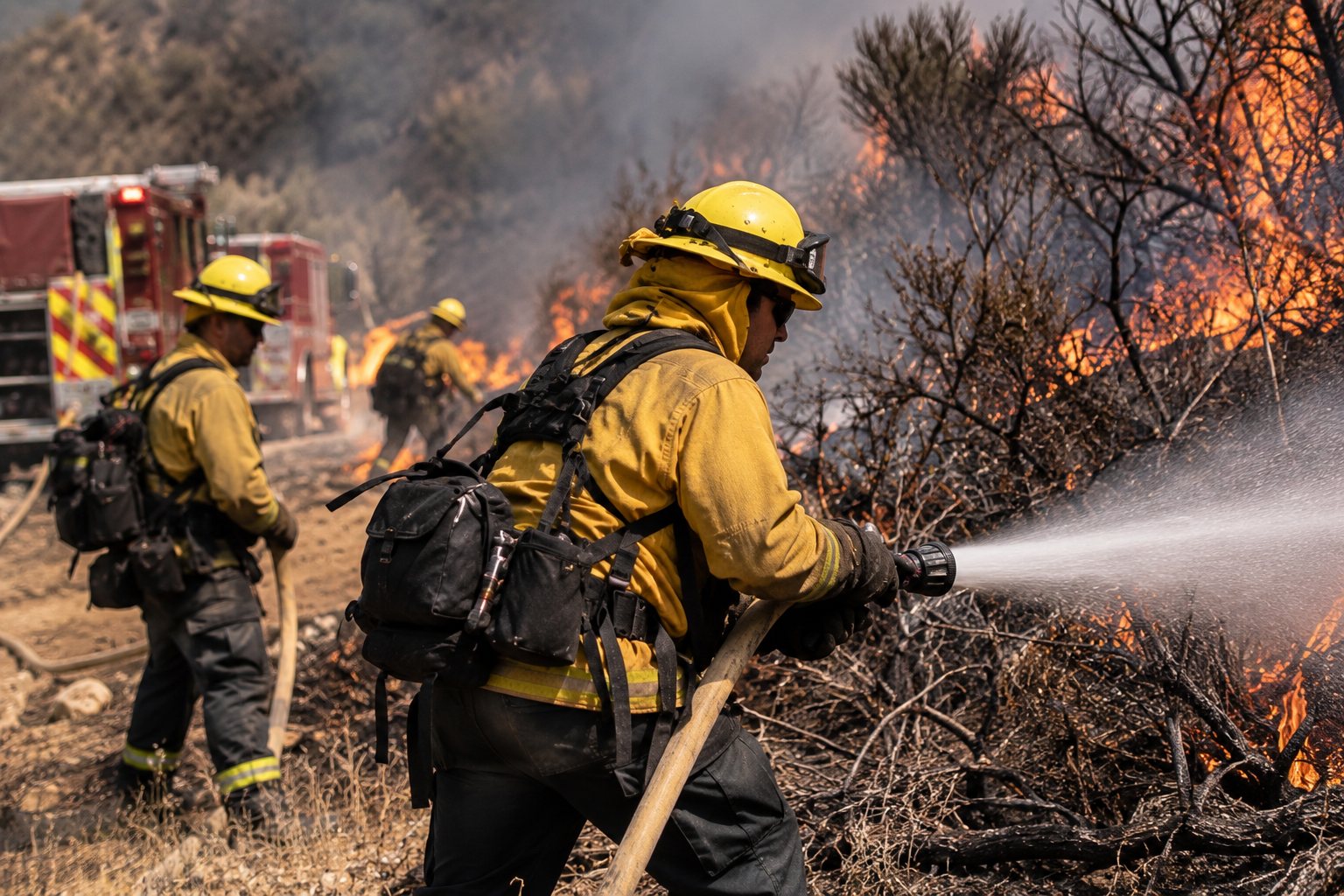
Donald Trump traveled to California's Coachella Valley and delivered a sweeping indictment of the state, blaming Democratic leaders and presidential opponent Kamala Harris for everything from crime and homelessness to immigration, energy costs and water policy. Along the way, he mixed genuine California problems with exaggerations and false claims—and threatened to withhold federal wildfire assistance unless state leaders complied with his demands on water.**
Donald Trump came to California with a warning.
What happened here, he told thousands of supporters gathered at Calhoun Ranch near Coachella, could happen to the entire country.
With Election Day just 23 days away, Trump used Kamala Harris' home state as a backdrop for his argument against her presidency.
California, he said, had once been a paradise.
Now, according to Trump, Democrats had destroyed it.
“California's really, it's a paradise lost,” Trump told the crowd.
Then he delivered a rapid-fire list of everything he said had gone wrong.
California, Trump claimed, had the highest inflation, highest taxes, highest gasoline prices, highest cost of living, most regulations, most expensive utilities, most homelessness, most crime, most decay and most undocumented immigrants.
“Other than that,” Trump joked, “I think you're doing quite well actually.”
It made for a devastating political sound bite.
The reality was considerably more complicated.
California Had Real Problems
There was no need to invent problems in California in 2024.
Housing was extraordinarily expensive.
Homelessness remained a serious crisis.
Gasoline prices were routinely among the highest in the nation.
Electricity rates were painful for many households.
And California's cost of living placed enormous pressure on working- and middle-class families.
Those were legitimate issues for a presidential candidate to criticize.
But Trump went much further.
The Los Angeles Times reported that his portrayal of California was peppered with distortions and falsehoods.
Trump claimed, for example, that California experienced brownouts and blackouts “every day.”
It did not.
He repeatedly portrayed the state as consumed by violent crime and tied immigration to that supposed lawlessness.
Research has repeatedly failed to support the broader claim that immigrants commit crimes at higher rates than people born in the United States.
Yet Trump described immigrants arriving from “dungeons of the Third World” and told supporters that California and the country were being invaded by dangerous criminals.
Blaming Kamala Harris for California
Trump's larger objective wasn't simply attacking Gov. Gavin Newsom or California Democrats.
He was attacking Kamala Harris.
Harris had served as San Francisco district attorney and California attorney general before becoming a U.S. senator and eventually vice president.
Trump attempted to make California's problems her personal record.
“We're not going to let Kamala Harris do to America what she did to California,” he told the crowd.
But a state of nearly 40 million people isn't governed by its attorney general.
California's housing shortage, homelessness, energy costs, taxes, water disputes and other problems developed over decades under numerous governors, legislatures, local governments and economic conditions.
That distinction largely disappeared from Trump's presentation.
California became Harris.
And Harris became California.
Then Trump Threatened California's Wildfire Money
One portion of Trump's speech went considerably beyond ordinary campaign criticism.
Trump returned to his long-running dispute with California officials over water.
He claimed that enormous amounts of water could simply be redirected toward California communities and agriculture if state leaders stopped environmental protections that limited pumping from parts of the state's water system.
Then he connected that dispute to something entirely different:
Federal disaster assistance for wildfires.
Trump said that if Gov. Gavin Newsom didn't comply with his demands, he would withhold federal fire assistance.
“We're going to take care of your water situation,” Trump said, before describing what he would tell Newsom:
> “If you don't do it, we're not giving any of that fire money that we send you all the time.”
It was an extraordinary threat.
Federal disaster assistance exists to help Americans recover from catastrophes.
Wildfires don't distinguish between Democrats and Republicans.
They don't check voter registration.
Homes, businesses and entire communities can disappear regardless of how their residents voted—or whether their governor agreed with the president.
Trump was openly describing federal disaster money as leverage in a political and policy dispute with a governor.
The Water Story Wasn't That Simple
Trump had spent years describing California's water system as though state officials were deliberately allowing enormous quantities of usable water to flow uselessly into the ocean.
California's water system is considerably more complicated.
Water flowing through the Sacramento-San Joaquin Delta serves cities and farms while also supporting wetlands, fisheries, water quality and endangered species.
Federal and state agencies jointly operate massive infrastructure that moves water throughout California.
How much water can be pumped—and when—is the subject of decades of environmental regulation, litigation and political conflict.
There are legitimate arguments about how California should allocate that water.
But there isn't simply a giant valve that the governor refuses to open.
Trump nevertheless presented the problem as something that could be solved through presidential force.
“Too Big to Rig”
Trump also returned to another familiar theme.
The 2020 election.
Although Joe Biden had legitimately won the election four years earlier, Trump continued promoting the idea that elections could be stolen.
He urged Californians to vote in numbers that would make the 2024 election “too big to rig.”
Then Trump asked the crowd what Democrats were good at.
“Cheating!” supporters shouted back.
Nearly four years after Trump's attempts to overturn his 2020 defeat culminated in the January 6 attack on the Capitol, election fraud remained part of his campaign rhetoric.
California as a Warning
Trump's decision to hold a rally in overwhelmingly Democratic California was unusual this close to Election Day, when presidential campaigns normally concentrate their candidates' time in competitive states.
But California served another purpose.
It gave Trump a political prop.
The state's genuine struggles with housing affordability, homelessness, taxes, energy costs and other issues provided the foundation.
Trump then added claims about rampant crime, daily blackouts, immigration and water that often lacked important context or were contradicted by available evidence.
And finally came the threat.
If California's governor wouldn't implement the water policies Trump wanted, Trump said he would withhold federal wildfire money.
The message of the October 12 rally was supposed to be that California demonstrated what Kamala Harris would do to America.
But one of the day's most consequential statements revealed something else about Trump's own approach to governing:
He was willing to publicly contemplate conditioning federal disaster assistance to Americans on whether their state's governor gave him what he wanted.