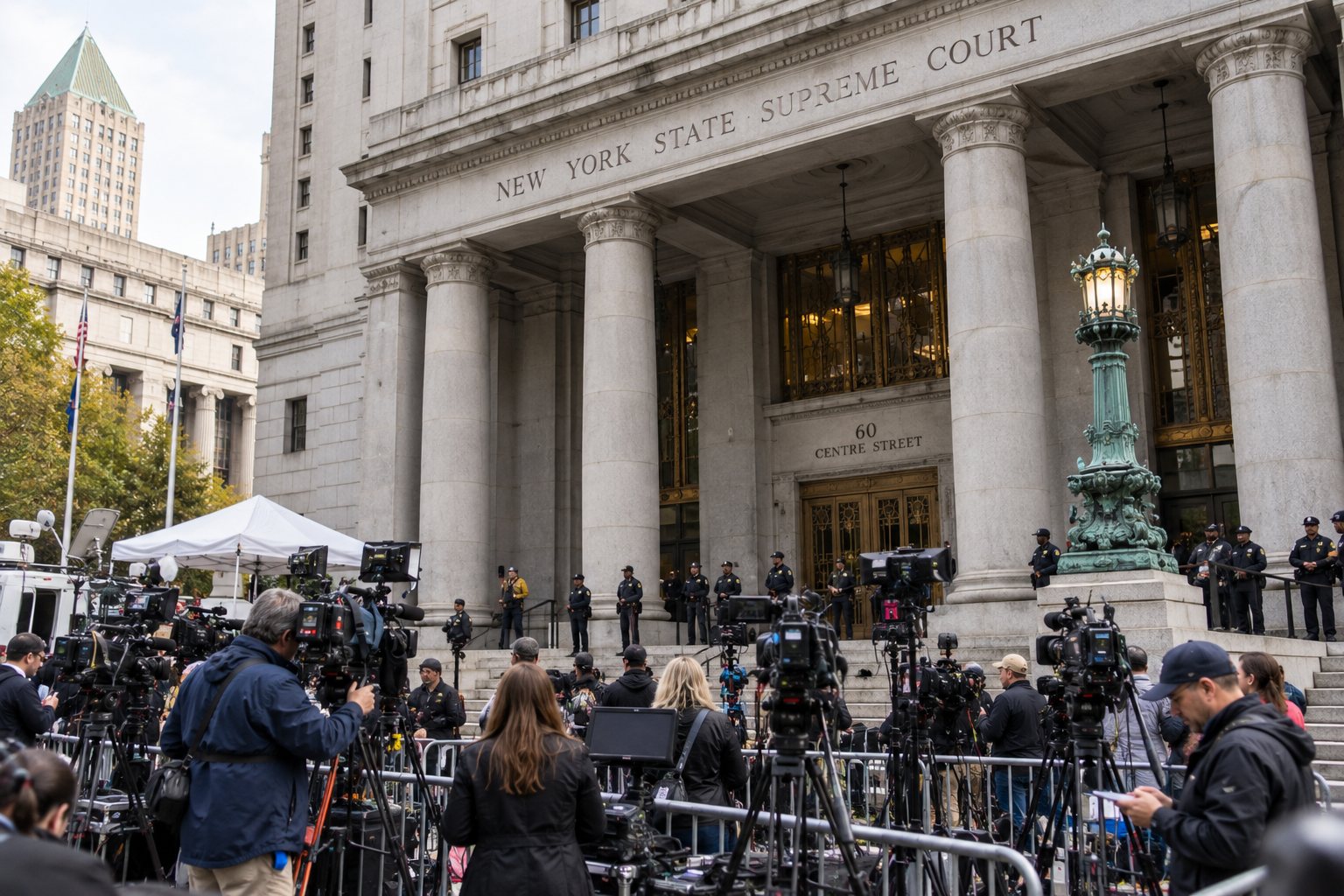
Donald Trump's civil fraud trial entered its fourth day Thursday, moving from the spectacle surrounding the former president's courthouse appearances to the financial records at the heart of a case that could have serious consequences for his business empire.
Trump attended the first three days of the trial in Manhattan, repeatedly speaking to reporters outside the courtroom and attacking New York Attorney General Letitia James and Judge Arthur Engoron.
On Thursday, Trump was absent.
Inside the courtroom, however, the case continued.
Accountant Donald Bender, whose former firm Mazars USA prepared Trump's annual statements of financial condition, returned to the witness stand as state attorneys continued examining how Trump's claimed wealth was calculated and presented to banks and other financial institutions.
The proceedings are part of James' lawsuit accusing Trump, his company and several executives of repeatedly providing false or misleading valuations of properties and other assets.
But one of the most important questions has already been decided.
Before the trial even began, Engoron ruled that Trump and other defendants had committed persistent fraud by submitting financial statements containing false valuations.
The trial will now help determine what additional violations occurred and what penalties should follow.
A Case About Trump's Claimed Wealth
For decades, Trump's public identity has been closely connected to his wealth.
His buildings, golf courses, hotels and other properties became central to the image he cultivated first as a businessman, then as a television personality and ultimately as president.
The New York attorney general's case attacks something at the center of that image: the financial statements Trump used to represent the value of his holdings.
James alleges that Trump and his company repeatedly inflated asset values, allowing him to portray himself as wealthier and obtain financial benefits.
The disputed valuations involve some of Trump's most recognizable properties.
Among them are Trump Tower in Manhattan, his Mar-a-Lago club in Florida and other real estate holdings.
The attorney general alleges that the misstatements were not occasional mistakes but part of a pattern stretching across years.
Trump denies wrongdoing.
His attorneys argue that real-estate valuations are subjective, that sophisticated banks performed their own evaluations and that lenders were repaid.
The Trump Tower Apartment
One of the most striking examples involves Trump's own triplex apartment at Trump Tower.
For years, Trump's financial statements treated the apartment as if it contained approximately 30,000 square feet.
Its actual size is approximately 11,000 square feet.
That enormous difference allowed the apartment to be assigned a substantially higher value on financial statements.
Engoron specifically highlighted the discrepancy in his pretrial fraud ruling.
For a real-estate developer evaluating his own longtime residence, the judge rejected arguments that such a large discrepancy could simply be dismissed as an innocent difference of opinion.
The apartment illustrates an important distinction in the case.
Real-estate values can legitimately be debated.
The physical size of an apartment is not similarly subjective.
Mar-a-Lago Valuation Also Challenged
Another major dispute concerns Trump's Mar-a-Lago property in Palm Beach, Florida.
Trump has publicly argued that the property is worth vastly more than the figures cited by the attorney general and the judge.
But the case involves more than simply estimating what an oceanfront Palm Beach property might sell for.
Mar-a-Lago is subject to legal restrictions affecting how the property can be used.
Trump converted the estate into a private club, and restrictions associated with the property complicate attempts to value it as though it were an unrestricted private residence.
The attorney general alleges Trump's financial statements failed to properly account for those restrictions when representing the property's value.
Trump argues that the estate's location, prestige and development potential make it extraordinarily valuable.
That dispute reflects a recurring theme throughout the case: whether Trump's financial statements represented reasonable estimates or manipulated figures designed to produce a desired result.
The Accountant Takes the Stand
Bender's testimony provides investigators with a view inside the process used to prepare Trump's statements of financial condition.
Mazars compiled those statements using information provided by the Trump Organization.
The accounting firm's role did not mean it independently appraised every Trump property.
That distinction is critical.
The financial statements were based substantially on information and valuations supplied by Trump's company.
Bender has testified about the responsibilities involved in preparing the documents and the information Mazars received from Trump Organization employees.
The state is attempting to establish how questionable valuations moved from internal company calculations into financial statements ultimately provided to lenders and others.
Trump Turns the Trial Into a Political Fight
Although this is a civil business case, Trump has repeatedly portrayed it as part of a broader political campaign against him.
He has accused James, a Democrat, of pursuing him for political reasons and has repeatedly attacked Engoron.
James has rejected those accusations and says the case is about enforcing New York's laws regardless of Trump's political status.
Trump's courthouse appearances during the first three days transformed the trial into a major media event.
Before entering court and during breaks, he frequently stopped before television cameras to denounce the proceedings.
His rhetoric became contentious enough that Engoron imposed a limited gag order after Trump posted an attack involving one of the judge's law clerks.
The judge ordered Trump to remove the post and prohibited parties in the case from publicly attacking members of his staff.
This Is Not a Criminal Trial
The proceeding is a civil trial.
Trump is not facing imprisonment as a result of this case.
But the potential financial and business consequences are substantial.
James is seeking hundreds of millions of dollars in penalties and restrictions on Trump's ability to conduct business in New York.
Engoron's pretrial ruling also ordered the cancellation of business certificates associated with several Trump entities, although the precise consequences and implementation of that order remain subjects of legal dispute.
For a businessman whose identity has been tied to New York real estate for decades, the case could have consequences reaching far beyond a monetary penalty.
The Fraud Finding Has Already Been Made
Perhaps the most important fact about the trial is also one that can become obscured by the daily courtroom drama.
Engoron has already ruled on the central fraud claim.
In granting partial summary judgment to the attorney general before trial, he concluded that Trump and other defendants repeatedly submitted financial statements containing fraudulent valuations.
Trump's attorneys strongly dispute that ruling and are appealing.
But inside Engoron's courtroom, the question is no longer simply whether every valuation was accurate.
The trial is examining additional allegations including falsification of business records, insurance fraud and conspiracy, as well as what financial consequences should result.
The attorney general argues that false statements enabled Trump to obtain financial advantages, including more favorable lending terms.
Trump's attorneys counter that lenders were sophisticated institutions capable of evaluating his finances for themselves and that the transactions were successful.
A Business Empire Under Examination
For years, Trump has presented his business success as evidence of his abilities.
Now the documents underlying portions of that business empire are being examined line by line in a Manhattan courtroom.
The spectacle of Trump's courthouse appearances may have temporarily subsided Thursday.
The substance of the case has not.
Accountants are testifying.
Financial statements are being examined.
Property valuations are being compared against underlying facts.
And the court is considering what consequences should follow a finding that Donald Trump and his company repeatedly submitted false financial information.
Trump says the case is politically motivated and insists his properties are worth far more than prosecutors acknowledge.
The attorney general says the case demonstrates that even one of America's most famous businessmen must follow the same financial rules as everyone else.
With the first week of testimony nearing its conclusion, those competing narratives are now being tested against years of Trump Organization records.
Source: New York court records, New York Attorney General filings and contemporary reporting on the civil fraud trial.