Donald Trump stood in the Oval Office this week and presented a proposed $15 billion Iowa steel plant as evidence that his tariff policies are reviving American manufacturing.
“Everyone is building their plants here because they don't want to pay tariffs,” Trump said while announcing the project. He described the American steel industry as “roaring back to life.”
But developments surrounding the announcement paint a considerably more complicated picture.
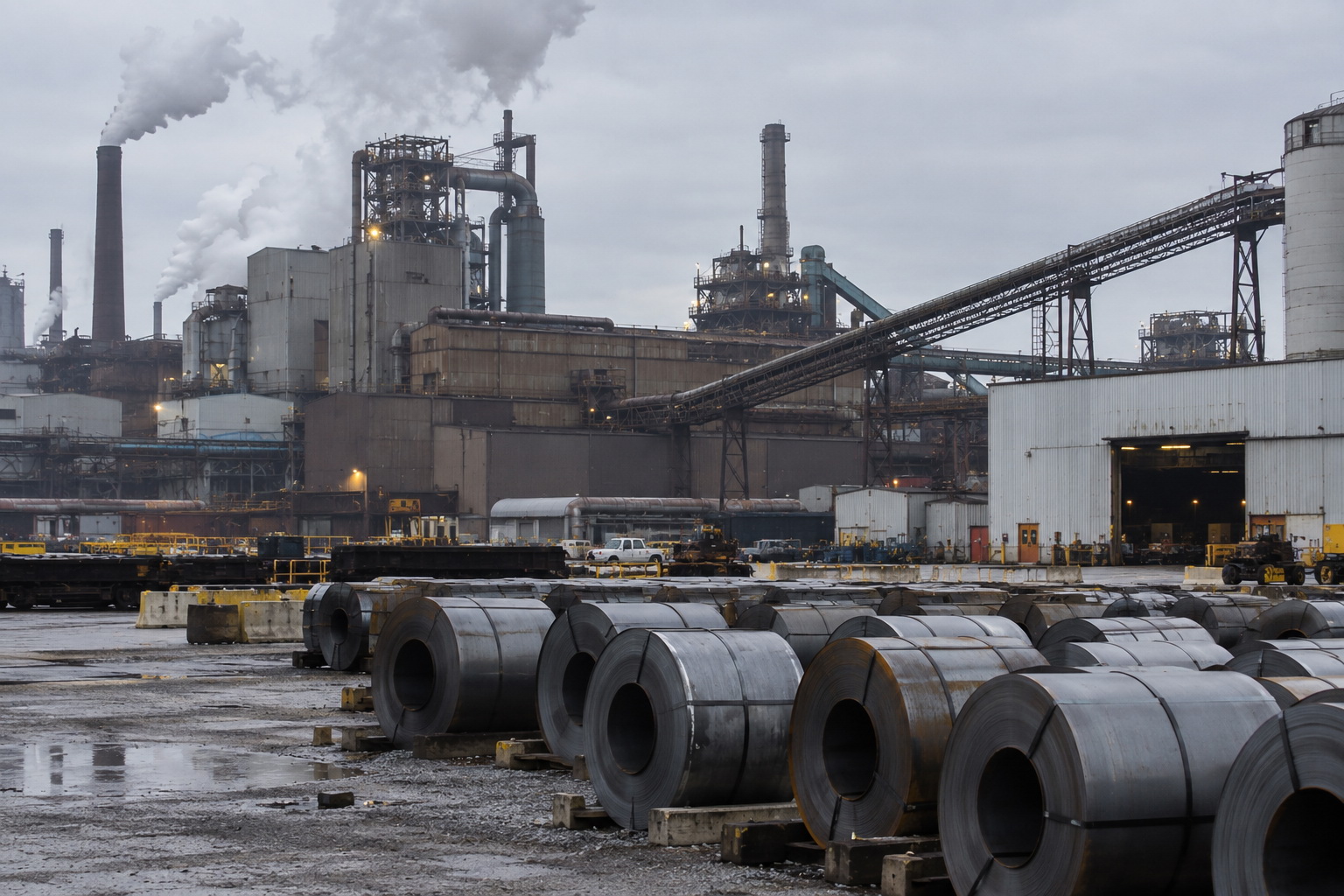
While Trump was celebrating a proposed steel plant in Iowa, Stelco announced that it would indefinitely idle its cold-rolled and coated-steel operations at its historic Hamilton Works facility in Ontario beginning October 9. The decision could affect as many as 500 workers.
Stelco specifically cited the trade disruptions affecting the Canadian steel industry. The company has reported a roughly 25 percent decline in demand for the affected products, including a decline within Canada itself. Trump's tariffs on certain Canadian steel and aluminum imports reached 50 percent in 2025.
There is an unusual irony in the Hamilton situation.
Stelco is owned by American steelmaker Cleveland-Cliffs, whose CEO Lourenco Goncalves has supported Trump's steel tariffs. Now the company's Canadian subsidiary is cutting operations while citing the trade environment those tariffs helped create.
Canadian Prime Minister Mark Carney has accused Cleveland-Cliffs of violating the spirit of commitments made when it acquired Stelco in 2024 and has threatened enforcement action over employment commitments associated with the takeover.
At almost the same time, Trump unveiled what he described as a historic American steel investment.
Mesabi Metallics, owned by India's Essar Group, says it intends to construct a $15 billion steelmaking complex in Lee County, Iowa. The proposed facility would eventually produce as much as 10 million tons of steel annually and employ roughly 1,700 people once fully operational. Production is projected to begin around 2030.
At the White House announcement, Commerce Secretary Howard Lutnick was emphatic.
“This deal is done,” Lutnick said.
Trump went even further.
“They've already started building,” he said.
Local records tell a different story.
An investigation of Lee County records found no major property purchase associated with the project. County officials said they had not received detailed plans from the company, no permits for the project had come before county supervisors, and the precise location of the proposed plant had not even been publicly disclosed.
Construction in Lee County therefore has not started.
Iowa lawmakers are also being called into a special legislative session to consider incentives necessary to advance the project. Iowa Gov. Kim Reynolds has described the arrangement as a memorandum of understanding while acknowledging that additional incentives are still needed.
That is a substantial distance from a completed steel mill — or even a construction project already underway.
There is also history behind Mesabi Metallics.
The company's Minnesota operation traces back to Essar Steel Minnesota, which began construction on an ambitious Iron Range project years ago. The project remained unfinished and Essar Steel Minnesota entered Chapter 11 bankruptcy in 2016.
Mesabi Metallics subsequently emerged from the bankruptcy reorganization in 2017.
So it would be incorrect to say that Mesabi Metallics has been bankrupt for the last decade. But it is accurate to say that its predecessor went bankrupt after failing to finish the Minnesota project, and that today's Mesabi operation is the successor to that project. Federal regulatory records confirm that history.
To its credit, the Minnesota project is now much further along.
Mesabi has begun mining ore and says its roughly $2.5 billion Minnesota operation is approaching production. The project represents the first new taconite mine developed on Minnesota's Iron Range in decades.
But taxpayers are also involved.
Just days before Trump's Iowa announcement, the U.S. Export-Import Bank approved a $770 million direct federal loan to Mesabi Metallics for its Minnesota iron-ore mine and processing operation.
The federal government is therefore directly financing part of the supply chain that is intended to feed the proposed Iowa steel mill.
The distinction matters: the $770 million is not a federal loan for the $15 billion Iowa mill itself. Administration officials say private capital will finance the Iowa steelmaking project.
But the federally financed Minnesota operation and the proposed Iowa plant are explicitly connected. EXIM itself says the Minnesota iron ore will directly supply the new Iowa steel plant.
That leaves two very different steel stories unfolding simultaneously.
In Hamilton, hundreds of workers face layoffs as a major steel operation responds to a trade environment disrupted in part by Trump's tariffs.
In Iowa, Trump is pointing to a proposed $15 billion plant as evidence those same tariffs are working.
The Iowa project could ultimately become everything its developers promise. Mesabi's Minnesota mine has advanced significantly after years of delays, and a 10-million-ton steel complex would represent an enormous American industrial investment if completed.
But as of now, the Iowa plant remains a proposal facing some of the most basic steps required of any project of its size: acquiring land, finalizing a site, obtaining permits, securing state incentives and actually beginning construction.
That makes Trump's declaration that construction has “already started” particularly notable.
The more accurate picture is less dramatic than the Oval Office announcement.
A huge steel plant has been proposed.
A related mining project has received $770 million in federal financing.
Iowa is considering incentives.
Local permits haven't been issued.
The site hasn't publicly been finalized.
And hundreds of steelworkers north of the border are simultaneously preparing for layoffs amid the trade disruption Trump says is bringing steel production roaring back.