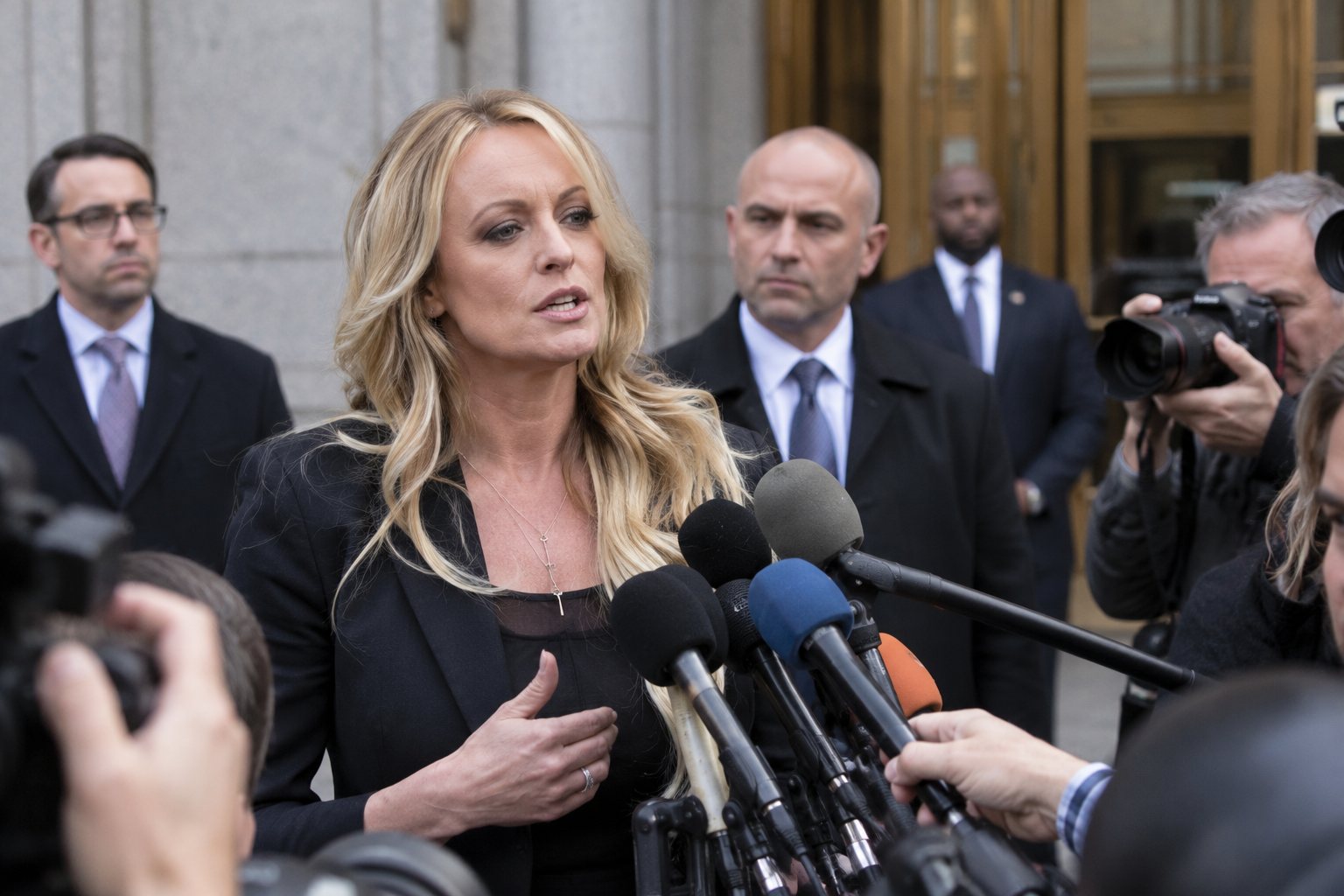
President Donald Trump celebrated a legal victory on October 16, 2018, by publicly insulting adult film actress Stormy Daniels, calling her "Horseface" and threatening further legal action against her and her attorney.
The attack came one day after a federal judge dismissed a defamation lawsuit Daniels had filed against the president.
Rather than simply acknowledge the court's decision, Trump used his personal Twitter account to ridicule the woman's appearance and announce that he intended to pursue her and attorney Michael Avenatti.
The exchange reignited controversy over Trump's treatment of women who publicly challenged him and drew renewed attention to the allegations surrounding his relationship with Daniels.
It also highlighted a distinction largely lost in the president's celebration: the judge had dismissed one specific defamation claim, not determined whether Daniels' account of a sexual encounter with Trump was true or false.
Trump Celebrates by Calling Daniels 'Horseface'
On the morning of October 16, Trump posted a message on Twitter referencing Fox News coverage of the court ruling.
After quoting a report that a federal judge had dismissed Daniels' lawsuit and that he was entitled to legal fees, Trump wrote:
"Great, now I can go after Horseface and her 3rd rate lawyer in the Great State of Texas."
He also claimed Daniels knew nothing about him and described her as a con artist.
The message came from the sitting president of the United States.
Daniels, whose legal name is Stephanie Clifford, had spent much of 2018 publicly challenging Trump over a nondisclosure agreement connected to an alleged sexual encounter in 2006.
Trump denied the alleged encounter.
His October 16 message, however, focused not on evidence concerning the underlying dispute but on Daniels' appearance and the prospect of additional legal confrontation.
The nickname attracted immediate national attention.
What the Judge Actually Ruled
The legal decision prompting Trump's celebration had been issued on October 15 by U.S. District Judge S. James Otero in Los Angeles.
Daniels had sued Trump for defamation over an April 2018 tweet in which he accused her of promoting a fabricated story about being threatened.
Daniels said that in 2011, a man approached her in a Las Vegas parking lot and warned her to remain silent about her alleged relationship with Trump.
In April 2018, she released a composite sketch of the man she claimed had threatened her.
Trump responded on Twitter by describing the account as a con job.
Daniels argued that the president's statement falsely portrayed her as dishonest and damaged her reputation.
Judge Otero dismissed the claim.
He determined that Trump's statement was protected by the First Amendment because it constituted rhetorical exaggeration in the context of a public political dispute.
The judge also ruled that Trump was entitled to recover reasonable attorneys' fees associated with defending that lawsuit, with the amount to be determined separately.
Trump's attorney, Charles Harder, described the ruling as a complete legal victory.
But the decision had a narrow scope.
It did not establish that Daniels had fabricated her alleged sexual encounter with Trump.
It did not determine whether the reported parking-lot threat had occurred.
And it did not resolve the separate legal dispute involving the $130,000 payment Daniels received shortly before the 2016 presidential election.
The $130,000 Payment at the Center of the Scandal
The broader controversy began attracting national attention in January 2018, when The Wall Street Journal reported that Trump's longtime personal attorney, Michael Cohen, had arranged a $130,000 payment to Daniels shortly before the November 2016 election.
The payment was connected to a nondisclosure agreement intended to prevent Daniels from publicly discussing her alleged 2006 encounter with Trump.
Daniels maintained that the encounter had occurred.
Trump denied it.
The payment itself, however, was not merely an allegation.
Cohen acknowledged arranging the transaction.
In August 2018, Cohen pleaded guilty to several federal offenses, including campaign finance violations connected to payments intended to influence the presidential election.
In federal court, Cohen stated that he had acted at the direction of a candidate for federal office.
Trump disputed allegations that he had committed campaign finance violations.
By October 2018, the matter had already become a significant legal and political controversy involving the president, his former attorney, and the circumstances surrounding payments made during the election campaign.
The dismissal of Daniels' defamation lawsuit did not end those broader questions.
Daniels Fires Back at Trump
Daniels responded to the president's insult with a sharply worded message of her own.
She accused Trump of displaying hostility toward women and lacking self-control on social media.
She also mocked the president with the nickname "Tiny."
Her attorney, Michael Avenatti, condemned Trump's remarks and described the president as a misogynist.
Avenatti announced plans to appeal the dismissal of the defamation lawsuit.
The exchange quickly escalated into a public confrontation involving personal insults from both sides.
But there was an important difference in the participants' positions.
Daniels was a private citizen engaged in litigation involving the president.
Trump was the nation's chief executive, using a public platform followed by millions of Americans to insult someone who had brought a legal claim against him.
The episode raised questions about the standards of public conduct expected from the presidency and the use of presidential visibility in disputes with private individuals.
A Familiar Pattern of Personal Attacks
Trump's remarks about Daniels were not an isolated example of his use of appearance-based insults against women.
During the 2016 presidential campaign, he repeatedly clashed with former Republican presidential candidate Carly Fiorina.
In a 2015 Rolling Stone interview, Trump made a disparaging comment about Fiorina's face, prompting criticism from Republicans and Democrats.
He also publicly attacked television journalist Megyn Kelly following her questioning of his past comments about women during a Republican presidential debate.
Trump had a longstanding feud with comedian Rosie O'Donnell, whom he repeatedly insulted in public.
His remarks about women frequently became political controversies because they shifted disputes over policy, journalism, or personal allegations toward comments about appearance.
Trump and his supporters argued that he regularly used insulting nicknames against male opponents as well, including Republican rivals and Democratic leaders.
Indeed, his political style relied heavily on personal attacks against adversaries of both sexes.
Critics nevertheless argued that appearance-based insults directed at women carried particular significance because they reinforced the idea that women's physical characteristics were legitimate targets in political disputes.
The October 16 attack on Daniels became another example in that debate.
A President and a Private Citizen in Court
The legal dispute also raised broader questions about the relationship between presidential power and the courts.
Daniels had the right to bring a civil lawsuit against Trump.
Trump had the right to defend himself.
The federal court had the responsibility to evaluate the claim under applicable law.
Judge Otero's ruling reflected the substantial protections American law provides for political speech, including harsh and exaggerated statements.
Those protections can apply even when the speech is insulting.
The court did not conclude that Trump's original tweet was polite, appropriate, or accurate in every respect.
It concluded that the statement did not meet the legal requirements for actionable defamation.
That distinction mattered because Trump publicly treated the ruling as vindication in the larger dispute with Daniels.
In reality, several separate legal questions remained unresolved.
A successful defense against one defamation claim did not settle the underlying allegations or the legal consequences of the nondisclosure payment.
Trump's Threat of Further Legal Action
Trump's declaration that he could now pursue Daniels and her attorney attracted attention because it suggested that the court ruling might be followed by additional litigation.
The president did not clearly explain in his tweet what new lawsuit he intended to file.
His reference to Texas did not establish that any particular legal action had been initiated there.
At the time, the most immediate consequence of the ruling was the possibility that Daniels would have to pay Trump's legal fees associated with the dismissed defamation case.
Daniels and Avenatti maintained that the decision would be appealed.
The remaining litigation over the nondisclosure agreement was a separate matter.
The public exchange therefore involved both an actual court victory for Trump and a threatened legal escalation whose details remained unclear.
The Political Significance
By October 2018, Trump was approaching the midpoint of his first presidential term.
The midterm elections were only three weeks away.
Republicans were defending their congressional majorities while Democrats sought to regain control of the House of Representatives.
Trump's handling of controversies involving women had become a recurring subject of political debate.
The Daniels dispute also continued to raise questions about the president's conduct before the 2016 election and the financial arrangements made to prevent damaging allegations from becoming public.
Against that backdrop, the October 16 tweet generated headlines not because it resolved any major legal question, but because the president chose to respond to a courtroom victory with a personal insult.
The decision was characteristic of his confrontational communication style.
Supporters viewed his willingness to attack critics as evidence that he refused to be intimidated.
Critics regarded the insult as conduct inconsistent with the dignity of the presidency.
A Court Victory Becomes Another Controversy
The events of October 16, 2018, began with a legitimate legal victory for Donald Trump.
A federal judge had dismissed Stormy Daniels' defamation lawsuit, concluding that the president's earlier statement was constitutionally protected political speech.
Trump was also entitled to seek reimbursement for his attorneys' fees.
But the ruling did not decide whether Daniels' account of their alleged relationship was true.
It did not erase the documented $130,000 payment.
And it did not resolve the separate legal issues surrounding that payment.
Rather than limit his response to the court's findings, Trump publicly attacked Daniels' appearance and threatened further action against her and her attorney.
The exchange became another chapter in the continuing controversy over the president's conduct toward women who challenged him.
On October 16, 2018, the president of the United States responded to a federal court victory by calling a woman who had sued him "Horseface."
The legal ruling was about the limits of defamation law and the protections of the First Amendment.
The controversy that followed was about something different: how a sitting president chose to exercise his own right to speak when confronting a private citizen who had challenged him in court.