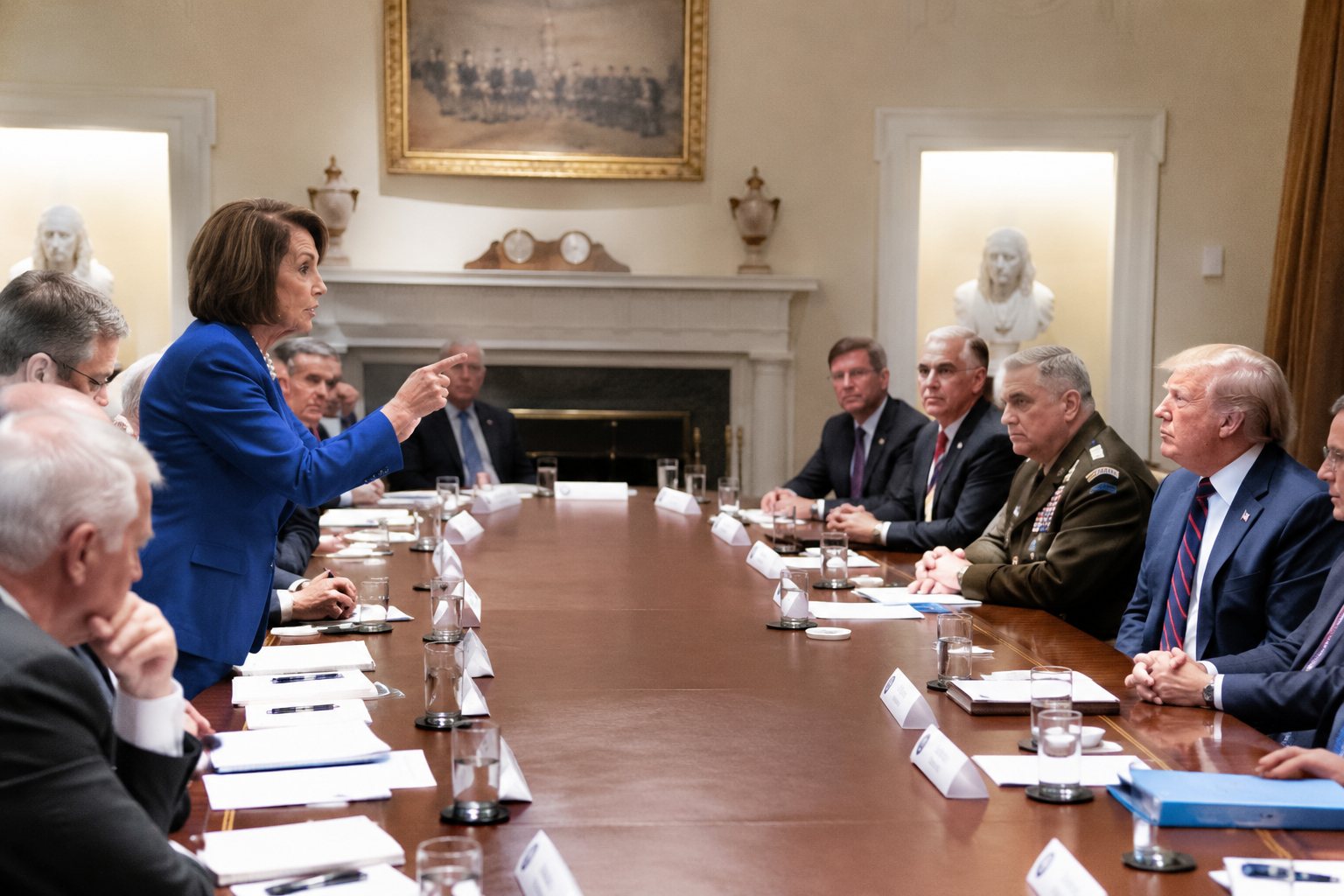
A White House meeting intended to address a growing military crisis in Syria collapsed into personal insults and political confrontation on October 16, 2019, after President Donald Trump clashed with House Speaker Nancy Pelosi and other congressional leaders over his decision to withdraw American troops from northern Syria.
The meeting ended with Democratic leaders walking out, accusing Trump of insulting lawmakers and failing to explain how his administration intended to contain ISIS or protect Kurdish forces who had fought alongside American troops.
Trump responded by publishing an official White House photograph showing Pelosi standing across a conference table and pointing toward him.
He captioned the photograph:
"Nervous Nancy's unhinged meltdown!"
But the photograph did not have the effect Trump apparently intended.
Pelosi embraced the image, making it the cover photograph on her Twitter account. Her supporters interpreted the scene as a demonstration of the House speaker confronting the president over a major foreign policy decision.
The exchange quickly became one of the most recognizable political images of Trump's first presidency.
Behind the confrontation, however, was a serious international crisis involving American military commitments, the future of Kurdish allies, and the expanding influence of Russia in Syria.
Congress Had Just Rebuked Trump in a Bipartisan Vote
The confrontation came only hours after the House of Representatives delivered an unusually strong bipartisan rejection of Trump's Syria policy.
By a vote of 354 to 60, the House approved a resolution opposing the administration's decision to withdraw American forces from northern Syria.
The resolution criticized the withdrawal and called on Turkey to end its military offensive against Kurdish-led forces.
Significantly, 129 Republicans joined Democrats in supporting the measure.
The vote demonstrated that opposition to Trump's decision extended well beyond the Democratic Party.
Many Republican lawmakers believed the withdrawal endangered Kurdish partners who had played a central role in defeating the Islamic State's territorial caliphate.
They also warned that the decision could create opportunities for ISIS to regroup and allow Russia, Iran, and the Syrian government to expand their influence.
The bipartisan vote set the stage for the White House meeting.
Congressional leaders arrived expecting to discuss the military situation and the administration's strategy for addressing the consequences of the withdrawal.
Instead, according to Democratic participants, the meeting deteriorated into an argument.
The Crisis Began With Trump's Decision to Withdraw American Troops
On October 6, Trump spoke with Turkish President Recep Tayyip Erdoğan.
Following that conversation, the White House announced that American troops would no longer remain in the immediate area of a planned Turkish military operation in northern Syria.
Turkey launched its offensive on October 9.
The operation targeted Kurdish-led forces that Ankara considered a security threat because of their connections to Kurdish militants involved in a longstanding conflict with the Turkish government.
Those same Kurdish-led forces had been essential American partners in the campaign against ISIS.
The Syrian Democratic Forces had fought alongside U.S. personnel for years, suffering thousands of casualties while helping liberate territory previously controlled by the terrorist organization.
Trump defended the withdrawal as part of his effort to reduce American involvement in prolonged Middle Eastern conflicts.
Critics argued that the abrupt troop movement removed an important deterrent to Turkey's offensive and left American partners vulnerable.
By October 16, Kurdish forces were fighting Turkish troops and Turkish-backed Syrian fighters.
Large numbers of civilians had fled their homes.
Syrian government forces, supported by Russia, were moving into areas previously secured by Kurdish and American forces.
The military situation was changing rapidly.
It was against this backdrop that congressional leaders gathered at the White House.
Pelosi Challenges Trump Over Russia's Growing Influence
During the meeting, Pelosi challenged Trump's decision and its consequences for American national security.
According to accounts from Democratic participants, she argued that the withdrawal had strengthened Russian President Vladimir Putin's position in the Middle East.
Russia had supported Syrian President Bashar al-Assad throughout the Syrian civil war.
As American troops withdrew, Russian-backed Syrian government forces began moving into territory where U.S. forces had previously operated.
Pelosi reportedly told Trump:
"All roads with you lead to Putin."
The remark reflected her criticism that Trump's decision had created a strategic opportunity for Moscow.
The administration rejected the suggestion that its Syria policy was designed to benefit Russia.
Trump maintained that the United States should not remain indefinitely responsible for policing the region.
But the withdrawal had already altered the balance of power in northern Syria.
For congressional critics, that made the need for a coherent American strategy particularly urgent.
Trump Reportedly Insults Pelosi and General Mattis
The discussion grew increasingly contentious.
Senate Minority Leader Chuck Schumer questioned the administration's plans for preventing an ISIS resurgence following the withdrawal.
According to Democratic accounts, Schumer cited concerns raised by former Defense Secretary James Mattis.
Trump reportedly responded by criticizing Mattis, whom he had previously appointed to lead the Pentagon.
He called Mattis the world's most overrated general.
The remark was notable because Mattis, a retired Marine Corps general, had served as Trump's first defense secretary before resigning in December 2018 amid disagreements over foreign policy.
Democratic leaders also reported that Trump repeatedly insulted Pelosi.
Schumer and House Majority Leader Steny Hoyer said Trump called her a "third-rate politician."
Pelosi later said she heard the phrase as "third-grade politician."
Although accounts differed on the precise wording, the participants agreed that the president had made a disparaging personal remark about the speaker.
Schumer described the encounter as an insulting exchange rather than a productive discussion of the military crisis.
Hoyer said the meeting had become so disrespectful that further discussion appeared pointless.
Democrats Walk Out of the White House
The meeting lasted less than 45 minutes before Pelosi, Schumer, and Hoyer left.
Speaking to reporters outside the White House, Pelosi accused Trump of having a meltdown.
She suggested that the overwhelming House vote condemning his Syria decision had contributed to the confrontation.
Schumer said the meeting had failed to produce a meaningful discussion of the administration's strategy.
Hoyer expressed frustration with the president's treatment of congressional leaders.
Republicans offered a sharply different interpretation.
House Minority Leader Kevin McCarthy accused Pelosi and other Democrats of abandoning a meeting that could have continued productively.
White House Press Secretary Stephanie Grisham defended Trump, describing him as measured and decisive while criticizing Pelosi's decision to leave.
The competing accounts made clear that participants disagreed about who was responsible for the breakdown.
What was undisputed was that the meeting ended without a public agreement on how to address the escalating crisis in Syria.
Trump Publishes a Photograph Intended to Embarrass Pelosi
After the meeting, Trump turned to Twitter.
He posted several photographs taken inside the White House Cabinet Room.
One image showed Pelosi standing at the conference table, extending her arm and pointing toward the president.
Trump remained seated across from her.
Around the table were senior administration officials, congressional leaders, and military officials.
The photograph captured a tense moment in the meeting.
Trump presented it as evidence that Pelosi had lost her composure.
His caption characterized the speaker's behavior as an unhinged meltdown.
But a photograph cannot establish the tone or complete context of an exchange.
The image showed Pelosi standing and gesturing while others remained seated. It did not reveal what had been said immediately before or after the photograph was taken.
Observers consequently interpreted it in very different ways.
Trump's supporters saw a confrontation in which Pelosi had become angry.
Pelosi's supporters saw a congressional leader standing up to the president while challenging his handling of a military crisis.
The photograph quickly circulated across social media and news outlets.
Pelosi Turns Trump's Attack Into Her Cover Photo
The political dispute took an unexpected turn when Pelosi's team adopted the very photograph Trump had posted to criticize her.
The image became the cover photograph on her Twitter account.
Her chief of staff, Drew Hammill, publicly thanked Trump for providing it.
The response transformed the image into a symbol of the confrontation from Pelosi's perspective.
Instead of treating the photograph as embarrassing, her team presented it as an image of the speaker asserting congressional authority.
The moment attracted particular attention because Pelosi was the only woman prominently visible standing among the officials gathered around the conference table.
For her supporters, that visual reinforced the message that she was willing to confront the president directly.
Trump continued criticizing Pelosi after the meeting.
The episode became a prominent example of how political leaders could use the same image to advance competing narratives.
The Impeachment Investigation Added to the Tension
The October 16 confrontation was also significant because it marked the first face-to-face meeting between Trump and Pelosi since she announced a formal impeachment inquiry on September 24.
The inquiry centered on Trump's efforts to pressure Ukraine to announce investigations involving former Vice President Joe Biden and his son Hunter Biden.
A whistleblower complaint and the administration's release of a memorandum describing Trump's July 25 telephone conversation with Ukrainian President Volodymyr Zelensky had intensified congressional scrutiny.
Trump rejected the allegations of wrongdoing and characterized the inquiry as a partisan effort to remove him from office.
Pelosi maintained that Congress had a constitutional responsibility to investigate the president's conduct.
The impeachment dispute created an additional layer of tension during the Syria meeting.
Although the meeting's stated purpose was foreign policy, it brought together two political leaders already engaged in a major constitutional confrontation.
The Real Crisis Continued Thousands of Miles Away
While the photograph dominated American political coverage, the situation in Syria remained dangerous.
Turkish forces continued their offensive.
Kurdish-led fighters faced pressure to withdraw from areas near the Turkish border.
Civilians were displaced by the fighting.
The Syrian government and Russia were expanding their presence in northeastern Syria.
And concerns persisted about the security of detention facilities holding suspected ISIS members.
The administration had announced sanctions against Turkey on October 14, but the measures had not immediately ended the military operation.
American officials were still seeking a diplomatic arrangement that could halt the fighting.
The following day, October 17, Vice President Mike Pence announced an agreement with Turkey to pause military operations temporarily while Kurdish forces withdrew from a designated border area.
But on October 16, no such agreement had yet been reached.
The White House confrontation occurred while the military and humanitarian consequences of the withdrawal were still unfolding.
A Photograph That Outlived the Meeting
The October 16 meeting became memorable partly because of the photograph, but its significance extended beyond an exchange of insults.
The House had just delivered a bipartisan rebuke of Trump's Syria withdrawal.
Congressional leaders sought an explanation of how the administration intended to manage the consequences.
The president defended his decision, while Democratic leaders said he responded to their questions with personal attacks.
Republicans disputed that account and blamed the Democrats for ending the discussion.
The meeting broke down without resolving those disagreements.
Trump then attempted to define the confrontation publicly by releasing an official photograph and describing Pelosi's behavior as an unhinged meltdown.
Pelosi responded by displaying the same photograph prominently on her own social media account.
The image became a lasting reminder of the political confrontation, but the underlying issue was far more consequential than the exchange on Twitter.
American troops were withdrawing from northern Syria, Kurdish partners were under attack, and rival powers were moving into the resulting security vacuum.
On October 16, 2019, a meeting intended to address those developments ended in a political walkout and a public argument over who had lost control.
The photograph preserved the confrontation.
The unresolved questions about America's Syria policy remained.