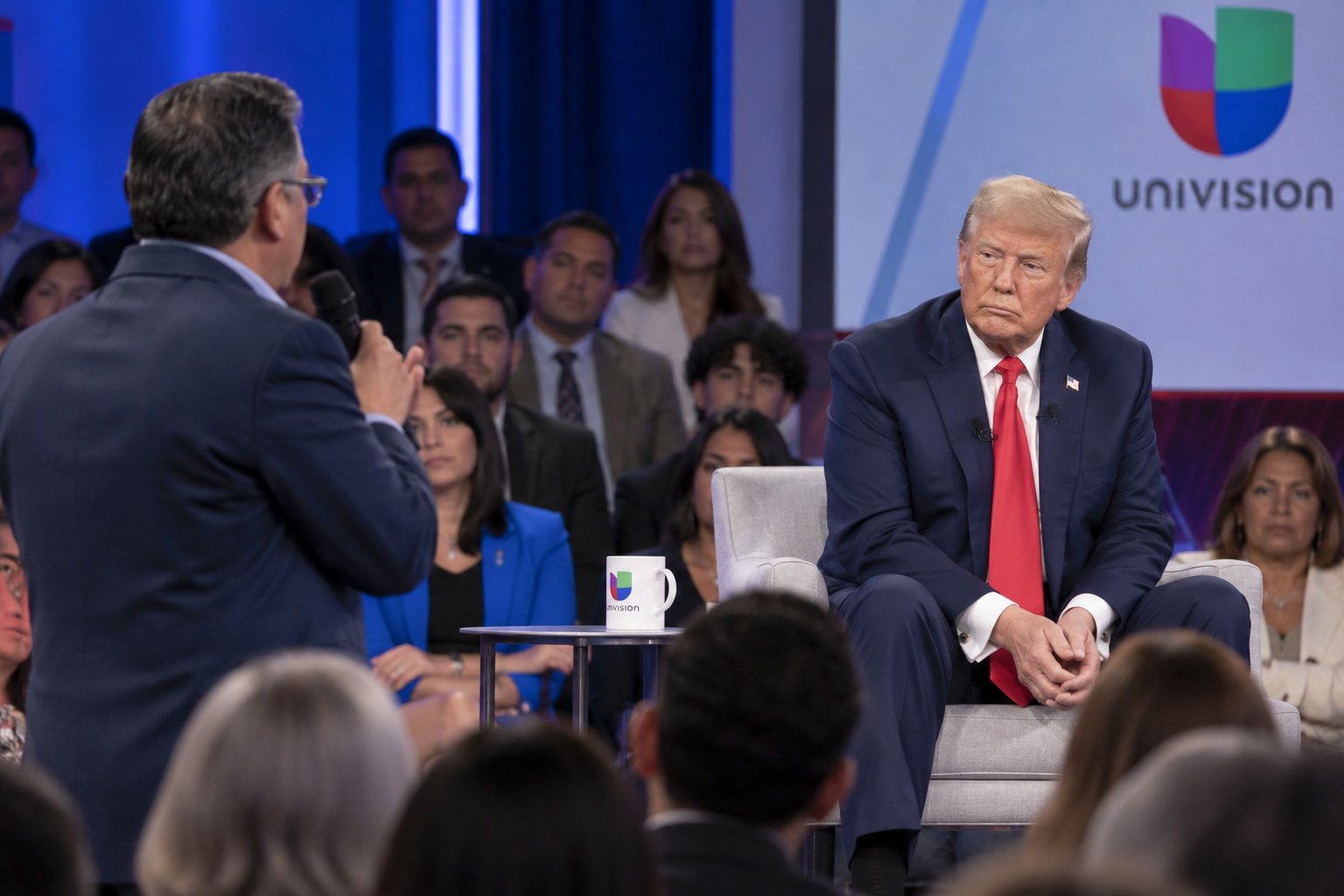
With less than three weeks remaining before the presidential election, Donald Trump appeared at a Univision town hall in Doral, Florida, on October 16, 2024, to answer questions from undecided Latino voters.
The event offered the former president an opportunity to explain his policies directly to an audience whose concerns included immigration, rising living costs, agricultural labor, and the January 6, 2021, attack on the United States Capitol.
Instead, several exchanges drew attention to Trump's repeated use of disputed or demonstrably false claims.
He described January 6 as a "day of love," defended his allegations that Haitian immigrants in Ohio were eating household pets, and repeated claims about immigrants arriving from foreign prisons and mental institutions.
When a California farmer asked how mass deportations would affect agricultural labor and food prices, Trump did not directly explain how his proposal would address those consequences.
The event revealed the distance between some of the questions voters wanted answered and the subjects Trump chose to emphasize.
A Republican Voter Confronts Trump About January 6
One of the most consequential exchanges came from Ramiro González, a 56-year-old construction worker from Tampa who identified himself as a former Republican voter.
González explained that he had become concerned about Trump's conduct during his presidency, particularly his response to the attack on the Capitol.
He also raised concerns about Trump's handling of the COVID-19 pandemic and the criticism directed at him by former administration officials.
González made clear that he was willing to listen to an explanation.
He wanted Trump to address why he had waited so long to act while his supporters attacked the Capitol.
Trump responded by defending his January 6 speech and portraying the gathering as peaceful.
He described January 6 as a "day of love."
He also asserted that nothing had been done wrong by the people he was discussing and claimed that his supporters had not brought guns.
Those statements conflicted with the documented events of January 6.
The Violence Trump Minimized
On January 6, 2021, a crowd of Trump supporters breached the Capitol as Congress met to certify Joe Biden's presidential election victory.
Rioters assaulted police officers, broke windows, forced their way through security barriers, and entered congressional chambers and offices.
Lawmakers and Vice President Mike Pence were evacuated or sheltered as the violence unfolded.
Approximately 140 police officers were assaulted during the attack.
Court records established that some participants carried firearms, while others used chemical sprays, flagpoles, and other weapons.
Four people died during the events of January 6, including Ashli Babbitt, who was fatally shot by a police officer while attempting to climb through a broken doorway near the House chamber. Three others died from medical emergencies.
Capitol Police Officer Brian Sicknick died the following day after responding to the attack. The medical examiner attributed his death to natural causes while noting that the events of January 6 played a role in his condition.
By October 2024, more than 1,000 defendants had been convicted of offenses connected to the attack.
Trump's description of January 6 as a day characterized by love did not account for the violence, injuries, property damage, and disruption of the constitutional certification process.
Nor did his answer directly address González's central question about the delay before Trump publicly urged the rioters to leave.
Trump had delivered remarks encouraging supporters to march to the Capitol earlier that day.
As the attack developed, he posted messages calling for peace and support for law enforcement, but he did not explicitly tell the crowd to go home until a video released at approximately 4:17 p.m.
In that video, he also repeated the false claim that the 2020 election had been stolen.
For González, the issue was presidential responsibility during a national emergency.
Trump's answer focused instead on defending his supporters and disputing the characterization of the day.
A Latino Republican Challenges the Haitian Pet-Eating Story
Another revealing exchange involved José Saralegui, a registered Republican who described himself as undecided.
Saralegui asked Trump about the allegations he had repeatedly promoted concerning Haitian immigrants living in Springfield, Ohio.
During his September presidential debate with Kamala Harris, Trump had claimed that immigrants in Springfield were eating residents' pets.
The allegations had circulated online despite local authorities reporting that they had found no credible evidence supporting them.
Saralegui reminded Trump that Springfield officials had repeatedly rejected the claims.
He also questioned Trump's proposal to revoke legal protections allowing certain Haitian migrants to remain in the United States.
The question was straightforward: Did Trump actually believe the allegations?
Trump responded that he had been repeating information reported elsewhere.
He added that migrants were supposedly eating other things they should not be eating.
He offered no substantiated evidence.
Trump also said he intended to visit Springfield and examine the situation.
His response was notable because he had already amplified the allegations during a nationally televised presidential debate.
By October 16, the claims had been repeatedly investigated and rejected by local officials.
Yet Trump continued discussing them as though they might be true.
Springfield Officials Had Already Rejected the Rumors
Springfield, Ohio, had experienced a substantial increase in its immigrant population, including thousands of Haitian residents.
The influx created genuine challenges involving housing availability, public services, schools, and health care.
Those concerns were legitimate subjects for public policy debate.
But the allegations about immigrants stealing and eating pets were a separate matter.
Springfield officials had reported no credible evidence of the conduct Trump described.
Ohio Republican Governor Mike DeWine also publicly rejected the pet-eating claims.
The distinction mattered.
A community experiencing population growth and pressure on public services is not evidence that its immigrant residents are engaging in bizarre criminal behavior.
Trump nevertheless continued linking the community's difficulties to allegations that local authorities had not substantiated.
During the town hall, he also exaggerated the number of immigrants who had arrived in Springfield.
He suggested that the city had gained nearly 30,000 migrants.
Local estimates were substantially lower, generally placing the number of recent arrivals between 12,000 and 20,000.
The exchange illustrated how Trump's immigration messaging combined genuine local challenges with claims unsupported by the available evidence.
A California Farmer Asks Who Will Harvest America's Food
Another voter raised a question about the economic consequences of Trump's proposed immigration policies.
Jorge Velázquez, a 64-year-old farmer from California, asked what would happen to agricultural production if undocumented workers were deported.
Farm labor is physically demanding, seasonal, and heavily dependent on immigrant workers.
Velázquez wanted to know who would perform that work if the labor force were reduced.
He also asked what consumers would pay for food.
The question addressed a practical consequence of Trump's proposal to carry out mass deportations.
Removing large numbers of workers from agriculture could create labor shortages, increase production costs, and place upward pressure on food prices.
Trump did not provide a detailed answer explaining how farms would replace those workers or how his administration would prevent disruption to food production.
Instead, he returned to familiar assertions about people entering the United States from foreign prisons and mental institutions.
He argued that his immigration policies would improve public safety and protect American workers.
But those statements did not resolve the economic question Velázquez had raised.
The exchange demonstrated an important policy challenge: proposals to remove large numbers of workers have consequences not only for immigration enforcement but also for industries that depend on their labor.
The Claim About Foreign Prisons and Mental Institutions
Throughout the 2024 campaign, Trump repeatedly asserted that foreign governments were emptying prisons and mental institutions and sending their occupants into the United States.
He returned to that allegation during the Univision town hall.
Trump specifically referred to countries such as Venezuela and claimed that dangerous individuals were being directed toward the American border.
The United States has documented cases involving migrants with criminal histories, and concerns about screening and border security are legitimate.
But those cases do not establish Trump's much broader allegation that foreign governments were systematically emptying their prisons and psychiatric facilities into the United States.
Trump did not present credible evidence supporting that sweeping claim.
Independent fact-checkers had repeatedly found the allegation unsupported.
His answer also failed to distinguish between undocumented immigrants generally and the much smaller population involved in serious criminal activity.
That distinction is essential when evaluating immigration policy.
An individual criminal case does not establish the characteristics of millions of immigrants.
Trump Misrepresents Immigration Crime Statistics
During the event, Trump also cited a figure of 13,099 noncitizens convicted of homicide who were not being held in immigration detention.
He presented the figure in a way that suggested the Biden-Harris administration had allowed those individuals into the United States.
The underlying government data did not support that interpretation.
The figure came from Immigration and Customs Enforcement records covering people who had entered the country over several decades, including during administrations of both political parties.
It did not represent 13,099 convicted murderers newly admitted under Biden and Harris.
Furthermore, not being in immigration detention did not necessarily mean a person was free in the community.
Some individuals were in state or federal criminal custody.
Others had legal or procedural circumstances affecting their immigration status.
The number was real, but the political interpretation Trump attached to it was misleading.
It was another example of an exchange in which an alarming statistic was presented without the context necessary to understand it.
Trump Attempts a More Measured Tone
The town hall was not simply a repetition of Trump's usual campaign rallies.
In several answers, he adopted a more measured tone when discussing legal immigration.
He said the United States should welcome people who enter lawfully and contribute to the country.
That position reflected a distinction he frequently made between legal and unauthorized immigration.
But it also contrasted with some of his broader campaign proposals.
Trump had promised the largest deportation operation in American history.
He had also proposed ending birthright citizenship through executive action and revoking certain temporary legal protections for immigrants.
Those proposals raised significant legal, economic, and administrative questions.
During the town hall, Trump did not provide detailed explanations of how his administration would carry them out or address their potential consequences.
His comments in favor of legal immigration therefore did not resolve concerns about the scope of his enforcement agenda.
Latino Voters Are Not a Single Political Group
The event also challenged a common oversimplification about Latino voters.
The audience included registered Republicans, undecided voters, immigrants, workers, and people with differing views on immigration and economic policy.
Their questions reflected different priorities.
Some wanted stronger border enforcement.
Others worried about the consequences of mass deportations.
Some were concerned about public safety.
Others wanted answers about presidential accountability and the events of January 6.
Those concerns were not mutually exclusive.
A voter could support stricter immigration enforcement while rejecting unsupported claims about immigrants.
A voter could favor conservative economic policies while questioning Trump's conduct after the 2020 election.
The town hall illustrated that Latino voters, like other Americans, cannot be reduced to a single position on immigration or any other issue.
What the Questions Revealed
The most revealing moments of the evening came from the audience rather than the campaign's prepared messaging.
A former Republican asked Trump to account for his actions during an attack on Congress.
Trump described the day in affectionate terms and minimized the violence.
A Republican voter asked whether Trump believed a debunked allegation about Haitian immigrants.
Trump defended repeating the story without providing evidence.
A farmer asked who would harvest crops and what would happen to food prices under mass deportations.
Trump redirected the discussion toward claims about criminals and mental institutions.
These were questions about evidence, consequences, and responsibility.
Trump had opportunities to explain his positions in detail.
Instead, several answers relied on claims that were contradicted by public records or failed to address the practical concerns being raised.
A Campaign Appearance That Invited Closer Scrutiny
The October 16 town hall was designed to connect Trump with undecided Latino voters before the election.
It also placed him in a setting where audience members could ask questions grounded in their own experiences.
That produced exchanges different from those at a typical campaign rally.
The questions were not limited to broad political slogans.
They concerned specific events, documented statements, and potential consequences of proposed policies.
The answers provided a record against which Trump's claims could be evaluated.
His description of January 6 conflicted with court records and the documented violence at the Capitol.
His defense of the Springfield allegations conflicted with statements from local and state officials.
His claims about immigrants from prisons and mental institutions lacked credible supporting evidence.
And his response to the California farmer left important questions about agricultural labor and food prices unanswered.
On October 16, 2024, Donald Trump faced direct questions from Latino voters about his political record and policy proposals. Several of his answers exposed substantial gaps between his campaign rhetoric and the documented facts.
The town hall demonstrated why direct questioning matters: it allowed voters to hear the candidate's explanations and compare them with the evidence, rather than relying solely on campaign advertisements or prepared speeches.