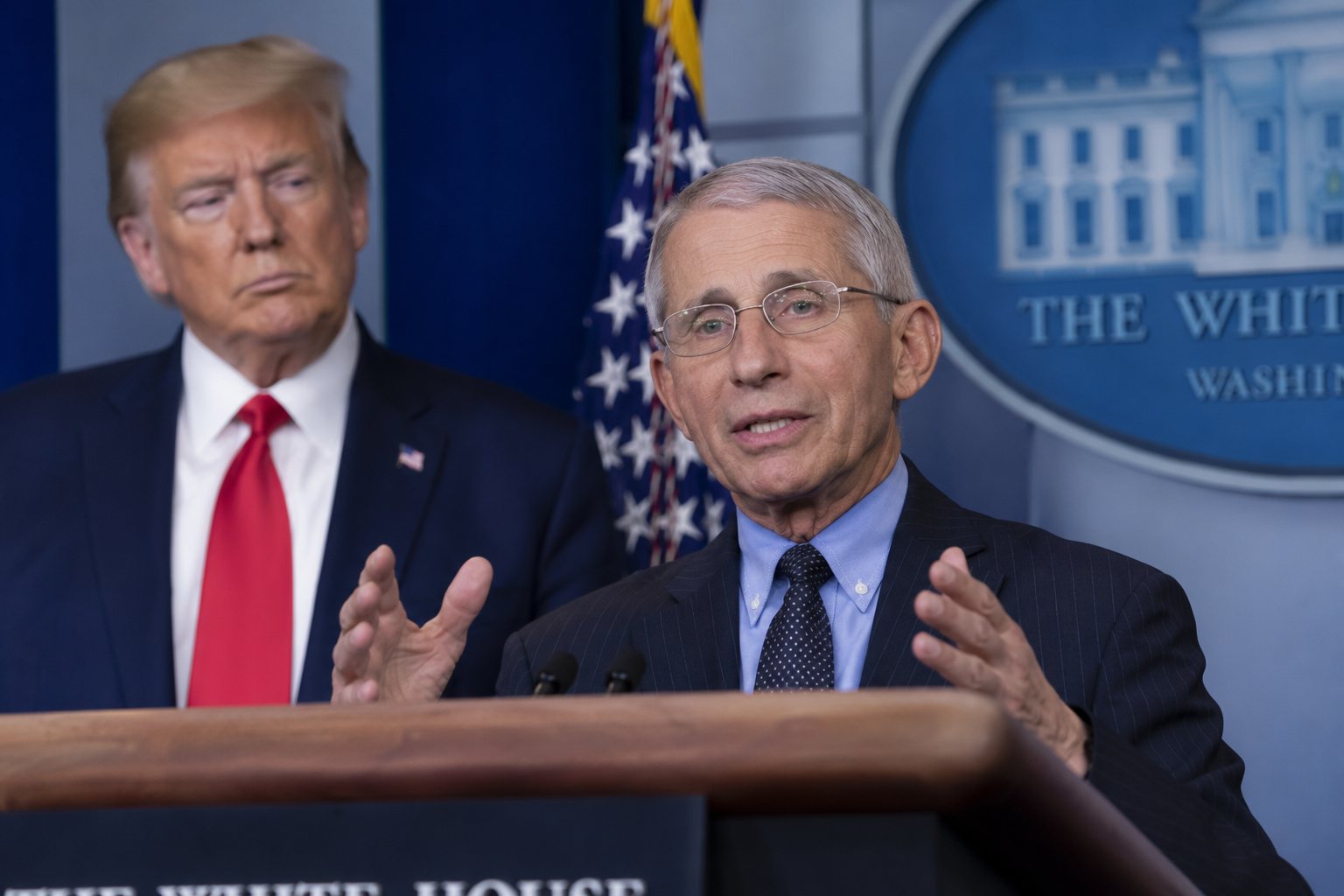
With more than 220,000 Americans dead from COVID-19 and coronavirus infections rising across the country, President Donald Trump launched an extraordinary attack Monday against Dr. Anthony Fauci, the nation's leading infectious-disease expert and a physician whose career has been devoted to combating some of the deadliest diseases in modern history.
During a conference call with campaign staff, Trump dismissed Fauci as a "disaster" and disparaged scientists who have urged Americans to take the pandemic seriously.
The remarks came just 15 days before the presidential election, as Trump faced growing criticism over his administration's handling of a public health emergency that has killed hundreds of Americans every day.
Rather than focus on the accelerating outbreak, the president directed his frustration toward the medical experts advising his own administration.
"People are tired of hearing Fauci and all these idiots," Trump told campaign staff.
The attack targeted a physician who has served under six presidents, advised both Republican and Democratic administrations, helped transform HIV/AIDS from a frequently fatal diagnosis into a manageable condition, and received the Presidential Medal of Freedom from Republican President George W. Bush.
Fauci's professional history stretches back more than half a century.
His work has helped shape America's response to HIV/AIDS, Ebola, SARS, pandemic influenza, and other infectious diseases.
Now, at 79 years old, he finds himself publicly criticized by the president he is attempting to advise during the worst American public health crisis in generations.
Trump Attacks Scientists as the Pandemic Accelerates
Trump's comments came during a campaign conference call intended to reassure staff about his reelection prospects.
Instead, the president spent part of the conversation attacking his own administration's public health experts.
Trump complained that Americans were tired of hearing about the coronavirus and suggested that scientists had repeatedly been wrong about the disease.
He singled out Fauci, accusing him of making poor predictions and receiving too much favorable attention.
The president also suggested that dismissing Fauci would create an even larger political controversy.
The remarks reflect an increasingly public disagreement between Trump and the medical professionals responsible for advising the federal government's pandemic response.
Fauci has repeatedly emphasized the need for masks, physical distancing, testing, and other measures intended to reduce transmission.
Trump, meanwhile, has pushed for a rapid return to normal economic and social activity, arguing that the country cannot remain restricted indefinitely.
The economic damage caused by the pandemic is substantial, and public health restrictions carry real consequences for workers and businesses.
But those costs do not change the underlying epidemiological reality: the coronavirus continues to spread, and Americans continue to die.
As of Monday, the United States has recorded more than 220,000 COVID-19 deaths, according to widely reported national tracking figures.
New infections are increasing in numerous states, and hospitalizations are climbing.
Public health experts are warning that colder weather and more indoor activity could intensify transmission.
Against that backdrop, Trump's criticism of Fauci raises questions about whether the administration's public messaging is being guided primarily by scientific assessments or political considerations.
Who Is Dr. Anthony Fauci?
Anthony Stephen Fauci was born on December 24, 1940, in Brooklyn, New York.
The son of Italian American parents, Fauci grew up working in his family's neighborhood pharmacy, where his father was a pharmacist.
His early exposure to medicine helped shape a career that would eventually place him at the center of some of the world's most difficult public health challenges.
Fauci attended Regis High School, a Jesuit institution in Manhattan, before earning his undergraduate degree from the College of the Holy Cross in Worcester, Massachusetts.
He received his medical degree from Cornell University Medical College in 1966.
After completing his internship and residency at New York Hospital–Cornell Medical Center, he joined the National Institutes of Health in 1968.
He has spent the overwhelming majority of his professional life there.
At NIH, Fauci began investigating how the immune system functions and how disorders of the immune system contribute to disease.
His early research helped advance treatment for serious inflammatory and autoimmune conditions, including forms of vasculitis that had previously carried high mortality rates.
He became chief of the Laboratory of Immunoregulation in 1980.
Four years later, he was appointed director of the National Institute of Allergy and Infectious Diseases, commonly known as NIAID.
He has held that position continuously since 1984.
By the time Trump entered the White House in January 2017, Fauci had already spent nearly five decades in federal medical research and more than three decades leading one of the country's most important infectious-disease research institutions.
The AIDS Crisis: A Career Defined by Fighting a Deadly Epidemic
Fauci's national prominence began during the HIV/AIDS crisis of the 1980s.
When physicians first encountered patients suffering from the mysterious disease, the medical community knew little about its cause, transmission, or treatment.
The illness devastated communities, particularly gay men, and was accompanied by widespread fear, discrimination, and political controversy.
Fauci redirected much of his research toward understanding the disease.
He studied the immune-system damage associated with HIV and helped guide federal research into treatments that could slow its progression.
The early years were devastating.
Patients frequently died because effective treatments did not yet exist.
Fauci also faced fierce criticism from AIDS activists who believed federal research institutions were moving too slowly and excluding patients from decisions about experimental therapies.
Activists associated with organizations such as ACT UP confronted him publicly.
Those conflicts became an important chapter in the history of American medical research.
Rather than permanently dismissing the activists, Fauci eventually developed working relationships with them and supported changes that gave patients a greater role in clinical research and access to experimental treatments.
The collaboration helped reshape the relationship between federal researchers and communities affected by HIV/AIDS.
Over time, advances in antiretroviral treatment transformed the prognosis for millions of people living with HIV.
Combination drug therapies introduced in the 1990s dramatically reduced AIDS-related deaths in countries where treatment became available.
Fauci was not solely responsible for those breakthroughs. They were the product of extensive international research involving thousands of scientists, physicians, patients, and advocates.
But he played an important leadership role in directing and supporting the research that made them possible.
That work remains among the defining achievements of his career.
Helping Build a Global Program That Has Saved Millions
Fauci's influence extended beyond laboratory research.
During the administration of President George W. Bush, he helped develop the President's Emergency Plan for AIDS Relief, known as PEPFAR.
Launched in 2003, the initiative represented a major expansion of American efforts to fight HIV/AIDS, particularly in countries facing severe epidemics.
The program supports HIV testing, treatment, prevention, and care across numerous nations.
By 2020, PEPFAR had been credited with saving millions of lives and helping provide treatment to millions of people living with HIV.
The program has become one of the most consequential American global health initiatives of the modern era.
Fauci's involvement demonstrated the value of combining scientific expertise with sustained government investment.
It also illustrated that infectious-disease policy has historically attracted substantial bipartisan support.
A Republican president championed the program.
Scientists and public health professionals helped design and implement it.
Congress provided funding across successive administrations.
The effort became an example of American medical leadership reaching far beyond the country's borders.
Honored by a Republican President
In 2008, President George W. Bush awarded Fauci the Presidential Medal of Freedom, one of the nation's highest civilian honors.
The award recognized his contributions to understanding and treating HIV/AIDS.
It was an acknowledgment of decades of medical research and public service.
The distinction is especially relevant to Trump's remarks Monday.
The physician the president now describes as a disaster was honored by an earlier Republican president for work that contributed to saving lives.
Fauci has also been elected to the National Academy of Sciences and the National Academy of Medicine.
His scientific publications have contributed to research involving immune-system disorders, HIV infection, and other infectious diseases.
His reputation was established long before the current pandemic and long before his disagreements with Trump became a recurring subject of political news coverage.
Serving Presidents of Both Parties
Fauci's tenure as NIAID director has spanned the administrations of Ronald Reagan, George H. W. Bush, Bill Clinton, George W. Bush, Barack Obama, and Donald Trump.
Across those administrations, he has advised federal officials on emerging diseases and public health emergencies.
His work has included responses to HIV/AIDS, West Nile virus, SARS, H1N1 influenza, Ebola, and Zika.
Those outbreaks differed substantially in their severity, transmission, and impact on the United States.
But each required scientific investigation, surveillance, medical research, and communication with the public.
Fauci's long tenure reflects the continuity that scientific institutions can provide across changes in political leadership.
Presidents come and go.
Infectious diseases do not observe election calendars.
Federal medical institutions therefore depend on experienced researchers whose responsibilities extend beyond the priorities of any single administration.
That institutional continuity is one reason Fauci's role in the coronavirus response carries particular weight.
He is not a political newcomer seeking influence through television appearances.
He is a career physician-scientist whose expertise was developed through decades of work on infectious diseases.
Fauci's Warnings About COVID-19
Since the coronavirus emerged as a global threat, Fauci has repeatedly urged Americans to take the disease seriously.
He has explained that public health recommendations may change as researchers learn more about a previously unknown virus.
Early guidance on face coverings, for example, evolved as evidence accumulated about transmission and the potential role of people without symptoms in spreading infection.
Scientists have also revised estimates and recommendations as testing, clinical experience, and research have improved.
Such changes can create public confusion, particularly when officials fail to explain why their guidance has evolved.
But revising recommendations in response to new evidence is an essential part of scientific practice.
Trump has frequently portrayed changing guidance as proof that experts do not know what they are doing.
Fauci has argued that uncertainty should be communicated openly and that public health decisions should follow the best available evidence.
Their disagreement has become increasingly visible as the presidential campaign enters its final weeks.
The '60 Minutes' Interview That Preceded Trump's Attack
Trump's criticism followed a nationally televised interview with Fauci on CBS's 60 Minutes Sunday evening.
During the interview, Fauci discussed the administration's response to the pandemic and his concerns about the public health risks associated with large gatherings.
He said he was not surprised when Trump contracted COVID-19 earlier this month.
Fauci explained that he had become concerned after observing a crowded White House event where many attendees were not wearing masks or maintaining physical distance.
The September 26 Rose Garden gathering announcing Judge Amy Coney Barrett's Supreme Court nomination has received scrutiny after multiple attendees subsequently tested positive for the coronavirus.
Fauci's remarks reflected his assessment of the risks associated with crowded gatherings.
Trump interpreted the physician's public comments as another criticism of his administration.
The president's frustration was evident during Monday's campaign call.
The timing underscores how closely the administration's public health disagreements have become intertwined with the presidential election.
Trump Recently Contracted the Virus Himself
The president's attacks on Fauci are occurring less than three weeks after Trump announced that he had tested positive for COVID-19.
Trump was hospitalized at Walter Reed National Military Medical Center in early October and received treatment before returning to the White House.
His illness brought the pandemic directly into the presidency.
It also raised questions about the administration's approach to masking, testing, and gatherings at the White House.
Following his discharge, Trump resumed campaign appearances and emphasized his recovery.
He has continued urging Americans not to allow the coronavirus to dominate their lives.
Public health experts, however, warn that one patient's recovery does not diminish the danger the virus poses to others.
Older Americans and people with certain medical conditions face particularly serious risks.
Hospitals in affected communities must also contend with the demands of treating large numbers of infected patients.
Fauci's recommendations are intended to reduce those risks across the population.
Republicans Defend Fauci's Public Service
Trump's criticism drew a response Monday from Republican Senator Lamar Alexander of Tennessee, chairman of the Senate Health, Education, Labor and Pensions Committee.
Alexander defended Fauci's professional record, describing him as one of the country's most distinguished public servants.
The statement was notable because it came from a senior Republican lawmaker rather than a political opponent of the president.
Alexander's defense reflected a broader recognition that Fauci's scientific career cannot be reduced to his disagreements with the current administration.
The senator emphasized Fauci's decades of service and the importance of respecting scientific expertise.
It was a reminder that support for medical research and infectious-disease preparedness has long crossed party lines.
Scientific Expertise Is Not the Same as Political Authority
Fauci does not set national economic policy.
He does not possess unilateral authority to close businesses, order Americans to remain home, or determine how states manage their reopening plans.
Those decisions involve elected officials and government authorities weighing public health, economic, legal, and social considerations.
His responsibility is to provide scientific assessments of infectious-disease risks and the likely consequences of different responses.
Elected leaders may consider those assessments alongside other legitimate concerns.
But attacking a scientist's professional credibility is not the same as addressing the evidence behind his recommendations.
If the administration disagrees with a particular forecast or public health measure, it can explain the scientific basis for that disagreement.
Calling researchers idiots does not provide such an explanation.
Nor does public frustration with pandemic restrictions establish that the danger has passed.
More Than 220,000 Americans Have Died
The scale of the crisis provides the essential context for Monday's confrontation.
The United States has recorded more than 220,000 deaths associated with COVID-19.
Families across the country have lost parents, grandparents, spouses, children, friends, and colleagues.
Health care workers have spent months treating patients with a disease that can deteriorate rapidly and unpredictably.
Businesses have closed, workers have lost jobs, and schools have struggled to determine how to operate safely.
The country faces both a public health emergency and an economic crisis.
Fauci has not claimed that scientific recommendations can eliminate those hardships.
He has argued that controlling transmission is necessary to reduce illness and death while helping communities resume normal activity more safely.
Trump's suggestion that Americans are tired of hearing about COVID-19 may reflect genuine public exhaustion.
But fatigue does not prevent infection.
And frustration with public health restrictions does not reduce the number of people requiring hospital care.
A Physician's Career Versus a Presidential Campaign
Monday's confrontation places two very different responsibilities in sharp focus.
Trump is seeking reelection and defending his administration's handling of a pandemic that has become a central issue in the campaign.
Fauci is serving as the nation's leading infectious-disease adviser while continuing the work of a career devoted to understanding and treating dangerous illnesses.
That distinction does not make Fauci immune from scrutiny.
Scientists can make mistakes, and their recommendations should be evaluated against evidence.
Public health officials also have a responsibility to communicate clearly, acknowledge uncertainty, and explain changes in guidance.
But Fauci's career provides substantial context for assessing the president's accusations.
He entered federal medical research in 1968.
He helped advance treatment for serious immune-system diseases.
He became a leading researcher during the AIDS epidemic.
He helped develop a major international HIV/AIDS relief initiative.
He advised six presidential administrations.
He received the Presidential Medal of Freedom from a Republican president.
And at an age when many Americans have long since retired, he remains engaged in the federal response to a deadly pandemic.
Those are documented professional accomplishments, independent of any disagreement with Trump.
A Question of Leadership During a National Emergency
The dispute between Trump and Fauci is larger than a disagreement between two public figures.
It raises questions about how a president should communicate with the public during a health emergency, particularly when scientific findings are politically inconvenient.
The administration faces difficult decisions involving employment, education, medical capacity, and individual freedom.
Those decisions deserve serious debate.
But the underlying scientific evidence cannot be settled through campaign rhetoric.
As infections rise and hospitals prepare for additional patients, Americans need accurate information about the risks they face.
They also need to understand which statements reflect medical evidence and which reflect political arguments.
On Monday, Trump chose to describe the country's leading infectious-disease expert as a disaster.
Fauci's professional record tells a much longer story: more than five decades of medical research, public service, and work to combat diseases that have killed millions of people around the world.
The president's criticisms deserve examination against that record.
As the United States confronts more than 220,000 COVID-19 deaths, the immediate public health question is not whether Americans are tired of hearing from scientists. It is whether the country is doing enough to prevent additional illness and loss of life.
That is the question Fauci continues to address.
And it remains unanswered as the pandemic enters another dangerous phase.