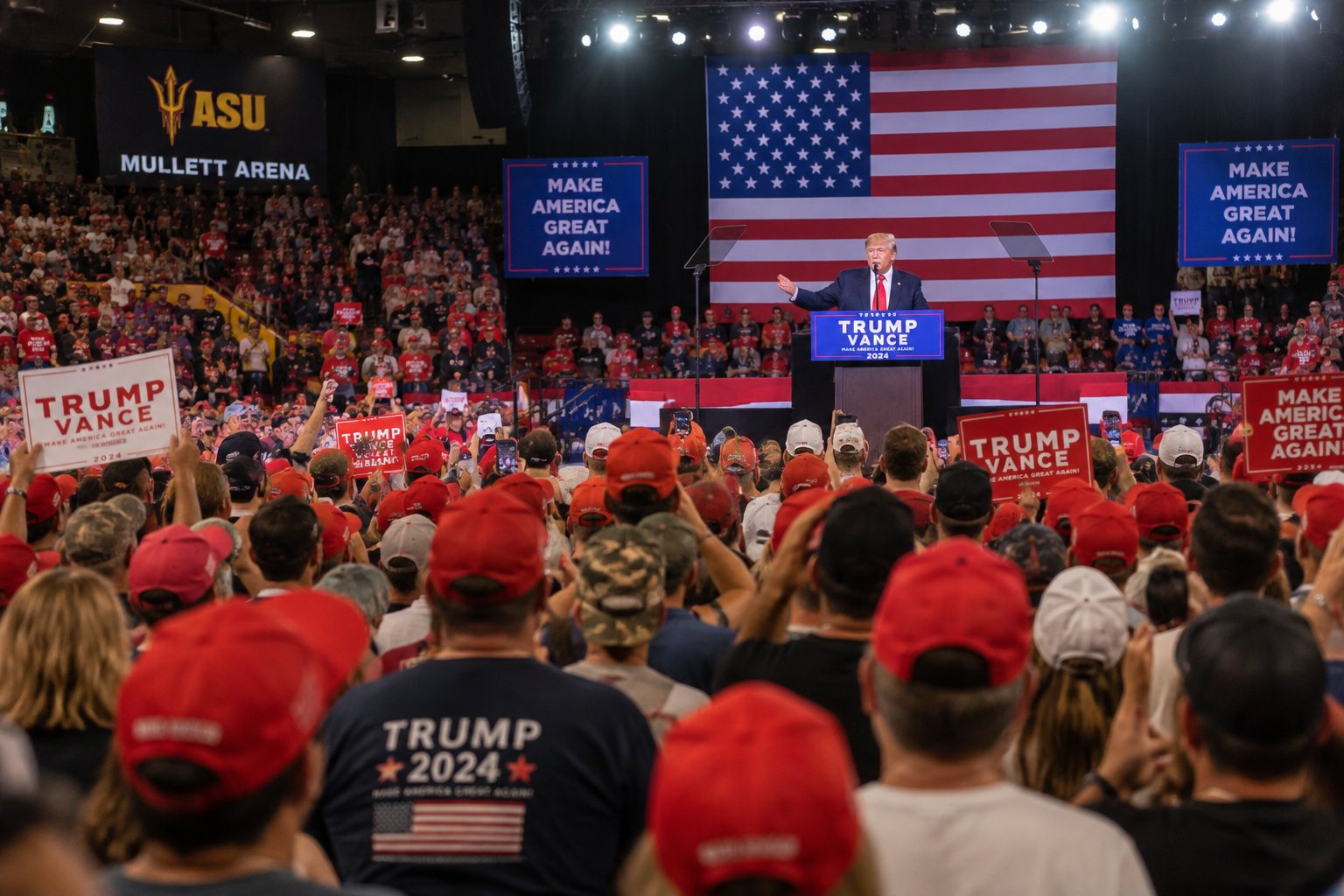
Former President Donald Trump described the United States as a "garbage can for the world" during a campaign rally in Arizona Thursday, delivering another inflammatory attack on immigrants while blaming Vice President Kamala Harris for what he claims is the destruction of the country.
Speaking to supporters at Mullett Arena on the campus of Arizona State University, the Republican presidential nominee painted a bleak picture of America, claiming that foreign governments are deliberately sending criminals and other unwanted individuals across the southern border.
The remarks came just 12 days before the presidential election, as Trump intensified his attacks on immigrants and portrayed the United States as a nation under siege.
Rather than emphasizing America's strength, prosperity, or opportunities, Trump repeatedly described the country as a dumping ground.
'We're Like a Garbage Can for the World'
Trump made the remark while accusing the Biden administration of allowing migrants from countries around the world to enter the United States.
"We're like a garbage can for the world," Trump declared.
He repeated the comparison and appeared pleased with his new description.
Trump told supporters it was the first time he had used the phrase, adding that he considered it an accurate characterization of the country.
The remark was not an isolated insult. It formed part of a broader speech in which Trump repeatedly characterized immigration as an invasion and portrayed migrants as dangerous outsiders.
His central argument was that other nations are deliberately exporting their criminals and unwanted populations to the United States.
He offered no substantiated evidence that foreign governments are systematically emptying their prisons and mental institutions into America.
Trump Blames Harris for the Border
Trump directed much of his anger toward Vice President Kamala Harris, his Democratic opponent in the November 5 election.
He accused Harris of deliberately dismantling border security and allowing criminals to enter the country.
Trump also repeated his familiar characterization of Harris as the administration's "border czar," despite the fact that her assigned diplomatic responsibilities focused on addressing the underlying causes of migration from Central America rather than directly managing border enforcement.
The former president claimed that migrants were arriving from 181 countries and accused the administration of facilitating their entry.
He described immigration as an existential threat to American communities.
The speech was designed to make border security a defining issue in the election's closing days, particularly in Arizona, where immigration remains a major political concern.
A Familiar Pattern of Dehumanizing Language
Trump's description of America as a garbage can adds another entry to a growing collection of inflammatory statements about immigrants.
During his presidential campaigns, Trump has repeatedly associated immigration with criminality, violence, and national decline.
He has previously accused immigrants of "poisoning the blood of our country," language that drew widespread condemnation because of its historical associations with racial and ethnic exclusion.
During the current campaign, Trump has also promoted false claims about Haitian immigrants in Springfield, Ohio, including allegations that they were stealing and eating residents' pets.
Local authorities have reported no credible evidence supporting those accusations.
Thursday's comparison continued the same political theme.
By describing America as a receptacle for people supposedly discarded by other countries, Trump suggested that migrants arriving at the border are inherently undesirable.
His language leaves little room to distinguish between violent criminals, asylum seekers, families escaping persecution, and people seeking employment or a better life.
Claims About Immigrant Crime
Trump claimed that migrant gangs are spreading violence throughout American communities.
His remarks included warnings that the country faces a growing threat from foreign criminals.
Immigration enforcement and border security are legitimate subjects of public debate, and crimes committed by individuals who enter the country illegally warrant investigation and prosecution.
But Trump's sweeping claims go far beyond documented evidence.
Research examining immigration and crime has generally found that immigrants are not more likely to commit crimes than people born in the United States.
There is also no credible evidence supporting Trump's recurring allegation that countries are systematically sending prison populations and psychiatric patients to America.
Nevertheless, the former president continues to present these claims as established facts at campaign rallies.
Promising Mass Deportations
Trump has made mass deportation a centerpiece of his proposed second administration.
He has pledged to carry out the largest deportation operation in American history, targeting millions of undocumented immigrants.
The proposal raises substantial questions about cost, logistics, due process, and the impact on American communities and businesses.
Carrying out deportations on the scale Trump describes would require an enormous expansion of immigration enforcement.
It could also affect families in which some members are American citizens and others lack legal immigration status.
Trump has offered few detailed explanations of how such an operation would be implemented while respecting existing legal protections.
Instead, his campaign has increasingly emphasized the language of invasion, emergency, and national survival.
The Reality Behind the Rhetoric
The United States faces genuine challenges involving immigration policy, asylum processing, border security, and the capacity of local communities to accommodate new arrivals.
Those issues deserve serious discussion and workable solutions.
But describing the country as a garbage can does little to explain how immigration policy should be improved.
Nor does portraying migrants collectively as dangerous criminals provide an accurate picture of the people entering the country.
Many migrants are families, workers, and individuals seeking protection from violence or persecution.
Some arrive legally, while others cross without authorization or seek asylum under procedures established by American law.
The distinction matters because immigration policy affects millions of people with different legal circumstances and personal histories.
Trump's rhetoric largely erases those differences.
A Different Message From Harris
Harris has sought to present a contrasting vision of the country, emphasizing political stability, constitutional principles, and cooperation across party lines.
She has also advocated stronger border enforcement while supporting changes to the immigration system.
Her campaign has criticized Trump's rhetoric as divisive and dangerous.
The Democratic nominee has repeatedly argued that Americans should reject political leaders who rely on fear and resentment.
Trump, meanwhile, has made immigration one of his most prominent closing arguments, calculating that public frustration with border policy will help him win undecided voters.
The competing messages reflect two sharply different approaches to the presidency.
Arizona Remains a Critical Battleground
Arizona is one of the states expected to play a decisive role in the presidential election.
Trump narrowly lost the state to Joe Biden in 2020, and both campaigns are investing significant resources in winning its electoral votes.
The state's proximity to the Mexican border makes immigration a particularly prominent campaign issue.
Trump's appearance at Arizona State University was intended to energize supporters and encourage early voting.
He also discussed tax proposals and other campaign priorities, but immigration dominated the opening of his remarks.
With fewer than two weeks remaining before Election Day, both candidates are working to persuade voters in Arizona and other closely contested states.
The Politics of National Humiliation
Presidential candidates traditionally campaign on promises to make America stronger, safer, and more prosperous.
Trump has adopted a different approach.
His campaign frequently depicts the United States as a nation in catastrophic decline, overwhelmed by criminals, betrayed by its leaders, and humiliated by foreign countries.
Thursday's garbage-can comparison is perhaps one of the clearest examples of that message.
Trump is not merely arguing that immigration policy needs reform.
He is telling voters that the United States has become a dumping ground for the world's unwanted people.
The description is intended to generate anger toward the Biden administration and Harris, while presenting Trump as the only candidate capable of reversing the country's supposed collapse.
It is a message built around fear and humiliation rather than confidence in America's institutions and people.
Twelve Days Until Election Day
The presidential election is now entering its final stretch.
Voters face consequential choices about immigration, economic policy, democratic institutions, and the direction of the country.
Trump's latest remarks demonstrate that he intends to continue making immigration a central focus of his campaign.
His supporters may view the language as an unusually forceful condemnation of failed border policies.
His critics see another example of a former president using dehumanizing rhetoric to turn public frustration into hostility toward immigrants.
But the words themselves are not in dispute.
At a campaign rally in Arizona, a former president seeking to return to the White House described the United States of America as a "garbage can for the world."
And he told the cheering crowd that he believed the description was accurate.