Donald Trump has spent years attacking journalists who challenge him, dismissing unfavorable reporting as “fake news” and portraying independent news organizations as enemies.
Now his White House has taken the next logical step: create its own television channel.
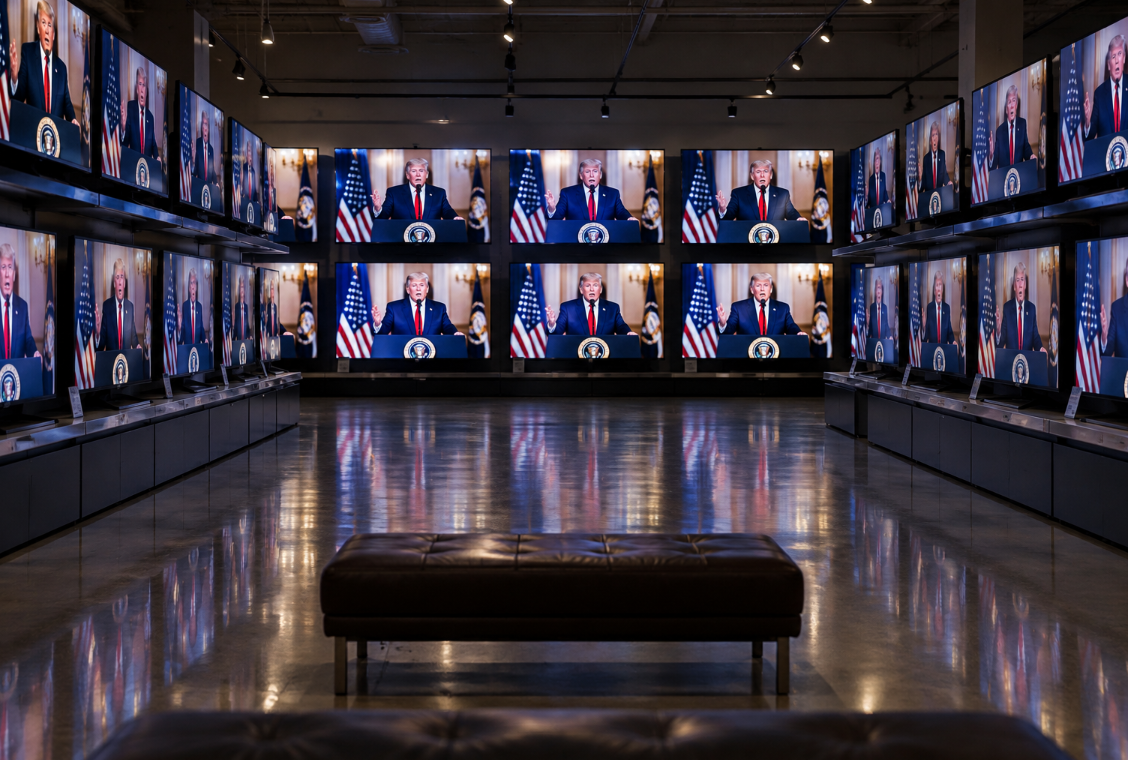
The White House this week launched “Trump TV,” a 24-hour government-run video stream devoted largely to Donald Trump. Instead of independent journalists deciding what is newsworthy, questioning administration officials or providing context, viewers get a carefully selected collection of presidential speeches, appearances, executive actions and White House-produced material.
There are no skeptical reporters interrupting the narrative. No opposing voices asking uncomfortable questions. No independent newsroom deciding what deserves scrutiny.
Just Trump, presented by Trump’s own government.
And apparently, almost nobody wants to watch it.
The Mirror conducted an online reader poll asking whether people planned to watch Trump TV. An extraordinary 98 percent of respondents said no. The poll is not a scientific survey of the American electorate, but the channel’s actual early viewership has hardly suggested a television revolution either.
Trump TV reportedly debuted with roughly 8,500 simultaneous viewers before falling dramatically. At points, the audience reportedly hovered around only 1,000 people.
For a president who has spent decades boasting about television ratings, those are remarkably small numbers.
But the more important story isn't whether Trump TV becomes a ratings success.
It's why a presidential administration believes America needs a government-controlled television channel devoted to the president in the first place.
A Familiar Authoritarian Playbook
History provides plenty of warnings about governments attempting to replace independent journalism with information they control.
Authoritarian governments have repeatedly followed a recognizable pattern: undermine public confidence in independent journalists, portray critical reporting as dishonest or dangerous, restrict the access of troublesome reporters and elevate government-controlled media as the supposedly trustworthy alternative.
Nazi Germany represents the most infamous and extreme historical example of state-controlled propaganda. Joseph Goebbels' Ministry of Propaganda worked to ensure Germans increasingly encountered information shaped around the government's preferred version of reality.
Trump TV is obviously not the propaganda apparatus of Nazi Germany, and pretending the two are identical would trivialize history.
But the underlying lesson remains relevant.
A democracy depends upon independent journalists precisely because the government should not get to decide which information citizens receive about the government.
Government communication is normal. Presidents have always issued statements, recorded speeches, maintained websites and communicated directly with Americans.
Government communication becomes much more troubling when it develops alongside attempts to punish or exclude independent journalists.
And that is the context surrounding Trump TV.
Trump recently barred CNN, MS NOW and Politico journalists from White House access following coverage he disliked. The organizations sued, and a federal judge ordered the administration to restore their access, finding they were likely to succeed on their due-process claim.
Meanwhile, several major television networks suspended participation in presidential pool coverage in protest.
Against that backdrop, the White House launched a television stream where the administration itself controls the cameras, programming and message.
That combination deserves attention.
News Without Journalism
Trump TV isn't really a news network.
It is closer to a presidential highlight reel.
The programming has consisted largely of Trump speeches, administration events and previously recorded appearances selected by the White House.
That distinction matters.
Journalism isn't simply pointing a camera at the president.
Journalists investigate claims. They provide context. They compare statements with evidence. They interview critics. They uncover information governments would rather keep hidden. And, perhaps most importantly, they ask questions government officials would prefer not to answer.
Trump TV eliminates that entire process.
The administration becomes both the subject of the coverage and the organization producing it.
The government gets to tell you what the government is doing — and then tell you how well the government thinks it is doing it.
That isn't independent journalism.
It's public relations with a television schedule.
Americans Still Have a Choice
The irony may be that Trump TV demonstrates why independent journalism remains so important.
The White House can create its own channel. It can replay Trump's speeches around the clock. It can select flattering moments, promote administration accomplishments and communicate directly with supporters.
What it cannot force Americans to do is watch.
So far, relatively few appear interested.
And perhaps that's the most reassuring part of this strange experiment in government television.
Trump may be able to build himself a 24-hour channel.
He still can't make America tune in.