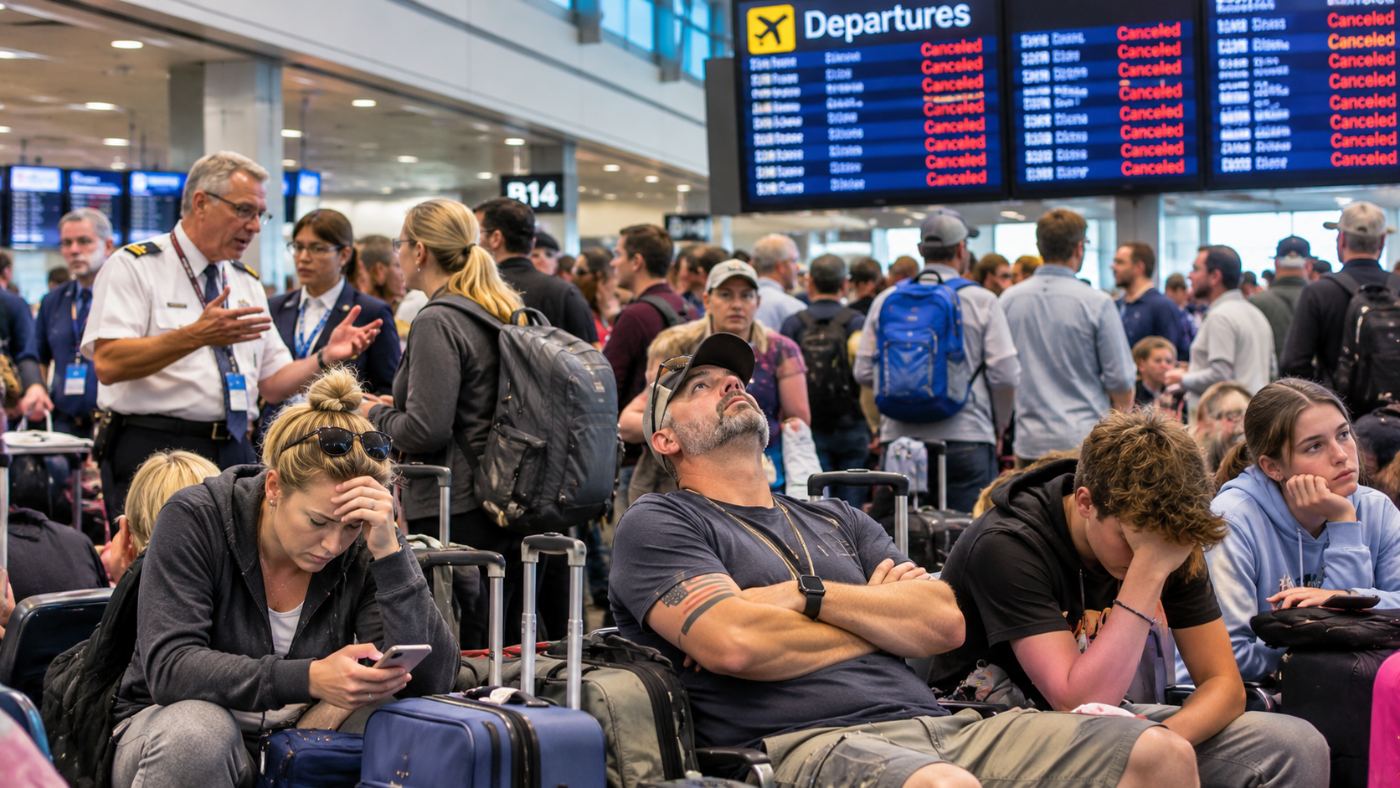
President Donald Trump has responded to the nationwide aviation shutdown that stranded travelers and disrupted thousands of flights by blaming former President Joe Biden and declaring that he takes no responsibility for the crisis.
The remarks came Monday, three days after a massive Federal Aviation Administration systems failure forced aircraft across the country to remain grounded for hours.
With Trump approaching the second anniversary of his return to the White House, his response has renewed questions about presidential accountability and the administration's management of America's aging air traffic control infrastructure.
A Nationwide Aviation Breakdown
On Friday, November 13, the FAA ordered a nationwide ground stop after serious communications and radar disruptions affected the air traffic control system.
The shutdown lasted more than four hours, forcing thousands of aircraft to remain on the ground and disrupting travel across the country.
Airlines canceled thousands of flights, while delays continued throughout the weekend.
Transportation Secretary Sean Duffy explained that the failure occurred during work to replace aging copper telecommunications infrastructure with fiber-optic technology.
Federal officials have also identified problems involving equipment and network routers.
The precise sequence of technical failures remains under investigation.
Trump Points the Finger at Biden
When reporters questioned Trump on November 16, he blamed his predecessor for the aviation crisis.
Trump complained that the system relied on equipment decades old and criticized the Biden administration's handling of modernization efforts.
He also offered an unusual technical explanation, suggesting that Biden officials had improperly connected copper infrastructure to glass.
Fiber-optic systems do use glass fibers, but connecting older copper-based networks to fiber networks through appropriate equipment is an established telecommunications practice.
The administration has not presented evidence establishing that Biden-era decisions directly caused Friday's failure.
"I Don't Take Any Responsibility"
The president's most striking response came when a reporter asked what responsibility he accepted for the shutdown.
Trump answered:
"I don't take any responsibility."
He argued that previous administrations should have modernized the system decades earlier.
America's aging aviation infrastructure is indeed a longstanding problem that predates both Trump and Biden.
However, Trump previously served four years as president and has now governed for nearly two additional years.
His administration currently oversees the Department of Transportation and the FAA.
Billions Already Approved
The funding debate further complicates Trump's criticism.
The bipartisan infrastructure legislation enacted under Biden allocated approximately $25 billion to the FAA.
Congress subsequently approved another $12.5 billion for air traffic control modernization in 2025.
Duffy argues that existing funding remains insufficient and has called for approximately $50 billion to complete a broader overhaul.
Democratic lawmakers have questioned how previously approved funding has been spent and whether additional appropriations are justified.
The funding figures do not establish which administration caused the equipment failure. They do demonstrate that aviation modernization has received substantial federal investment across administrations.
Travelers Pay the Price
While political leaders argue over responsibility, passengers have endured canceled flights, missed connections, unexpected hotel expenses, and disrupted schedules.
The administration has also rolled back certain Biden-era airline passenger compensation measures, although those rules would not necessarily have applied to an FAA-caused shutdown.
The distinction between airline responsibility and federal infrastructure failures is important.
Friday's disruption originated within the federal aviation system, not from an ordinary airline scheduling problem.
Accountability Cannot End With Blame
Trump is correct that America's air traffic control infrastructure has suffered from decades of underinvestment and technological problems.
But assigning responsibility for a specific failure requires evidence, not simply identifying a political predecessor.
The administration must now explain what went wrong, how modernization funds are being used, and what safeguards will prevent another nationwide shutdown.
The question is not whether Trump inherited an aging aviation system. It is what his administration is doing to fix it—and why the president refuses to accept any responsibility for managing it.