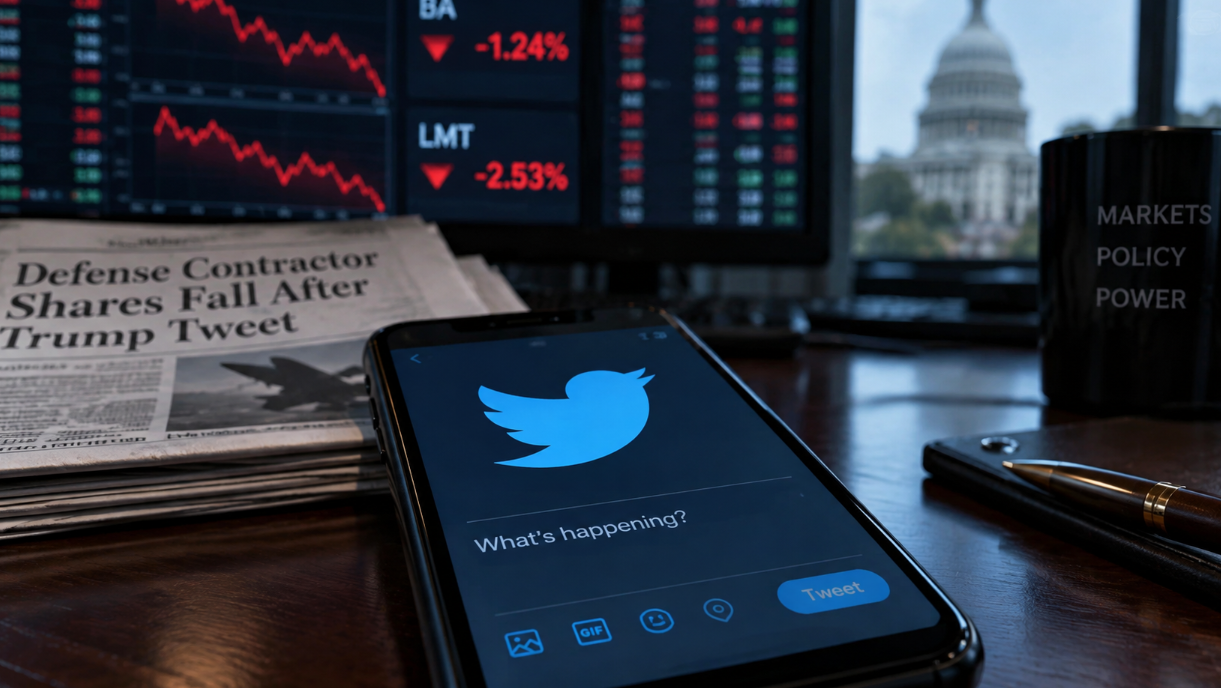
Donald Trump wasn't president yet.
But corporate America was already discovering that a few sentences from his Twitter account could suddenly become a multibillion-dollar problem.
On December 6, 2016, President-elect Trump turned his attention to Boeing and the program to replace the aging aircraft used as Air Force One.
His message was characteristically short.
He claimed costs were "out of control," put the price at more than $4 billion and finished with two words:
"Cancel order!"
There was no formal presidential directive.
There was no Pentagon announcement.
There was no lengthy policy proposal explaining exactly what Trump intended to change.
There was a tweet.
And the market reacted.
Boeing Suddenly Finds Itself in the Crosshairs
Boeing shares fell immediately following Trump's comments, briefly dropping more than 1 percent before recovering much of the loss.
Trump later expanded on his criticism while speaking with reporters at Trump Tower, arguing that the aircraft program was too expensive and accusing Boeing of essentially charging the government too much.
There were legitimate questions about the cost of replacing Air Force One.
But Trump's claim that Boeing was already building a new aircraft costing more than $4 billion overstated where the program actually stood.
At the time, Boeing had received a contract worth about $170 million for preliminary development work. The broader replacement program was still being planned, and the final cost had not yet been established.
That distinction disappeared inside Trump's 140-character version of events.
More important than the details of this particular contract, however, was the method Trump had chosen to challenge it.
A president-elect had publicly singled out one of America's largest corporations and suggested the government should cancel its business with the company.
And he had done it through Twitter.
Six Days Later, It Happened Again
Any possibility that Boeing's experience was an isolated incident disappeared less than a week later.
On December 12, Trump turned his attention to Lockheed Martin and the F-35 Joint Strike Fighter.
Again, the announcement arrived through Twitter.
Trump declared that the F-35's costs were "out of control" and promised that billions of dollars would be saved on military purchases after he took office.
Investors reacted almost immediately.
Lockheed Martin shares plunged during trading, at one point falling roughly 5 percent. The company's market capitalization temporarily lost billions of dollars before its shares recovered some of those losses.
Lockheed ultimately finished the day down about 2.5 percent.
One message from the incoming president had demonstrated just how quickly political communication could become a market-moving event.
Governing by Tweet
Presidents had obviously communicated directly with the American public before Trump.
Franklin Roosevelt had radio.
John F. Kennedy mastered television.
Ronald Reagan understood the power of the televised address.
Barack Obama embraced emerging social media.
Trump was doing something different.
Twitter wasn't merely going to be another communications platform for his administration.
It was beginning to look like a governing tool.
Trump could wake up, identify a company, government program, political opponent or foreign government and instantly place it at the center of a national controversy.
There was no press secretary standing between the president and the message.
There was no requirement for a formal policy announcement.
There wasn't even necessarily enough information for investors to understand exactly what the government planned to do.
Yet markets could move anyway.
A New Kind of Presidential Pressure
Supporters of Trump's approach saw an advantage.
Government procurement programs were notoriously expensive, and the F-35 in particular had faced years of criticism over delays and rising costs.
Why shouldn't an incoming president publicly pressure defense contractors to give taxpayers a better deal?
That argument had considerable appeal.
But the method raised a different question.
What happens when the president's personal social-media account can suddenly affect the value of an American corporation?
Investors now had something entirely new to consider.
A company's financial outlook could be affected not merely by earnings reports, government regulations, contracts or economic conditions.
It could be affected by whatever Donald Trump decided to type that morning.
The Presidency Was Changing Before It Even Began
Trump's use of Twitter during the campaign had often been treated as part of his unconventional political style.
After the election, that explanation became harder to maintain.
He wasn't a candidate anymore.
He was weeks away from becoming president of the United States.
And companies receiving billions of dollars in federal contracts understood that his words could soon be backed by the enormous purchasing power of the federal government.
Boeing learned that lesson on December 6.
Lockheed Martin learned it six days later.
America was getting an early preview of something that would become one of the defining characteristics of the Trump presidency.
Government policy, presidential messaging and personal commentary were beginning to blur together — 140 characters at a time.